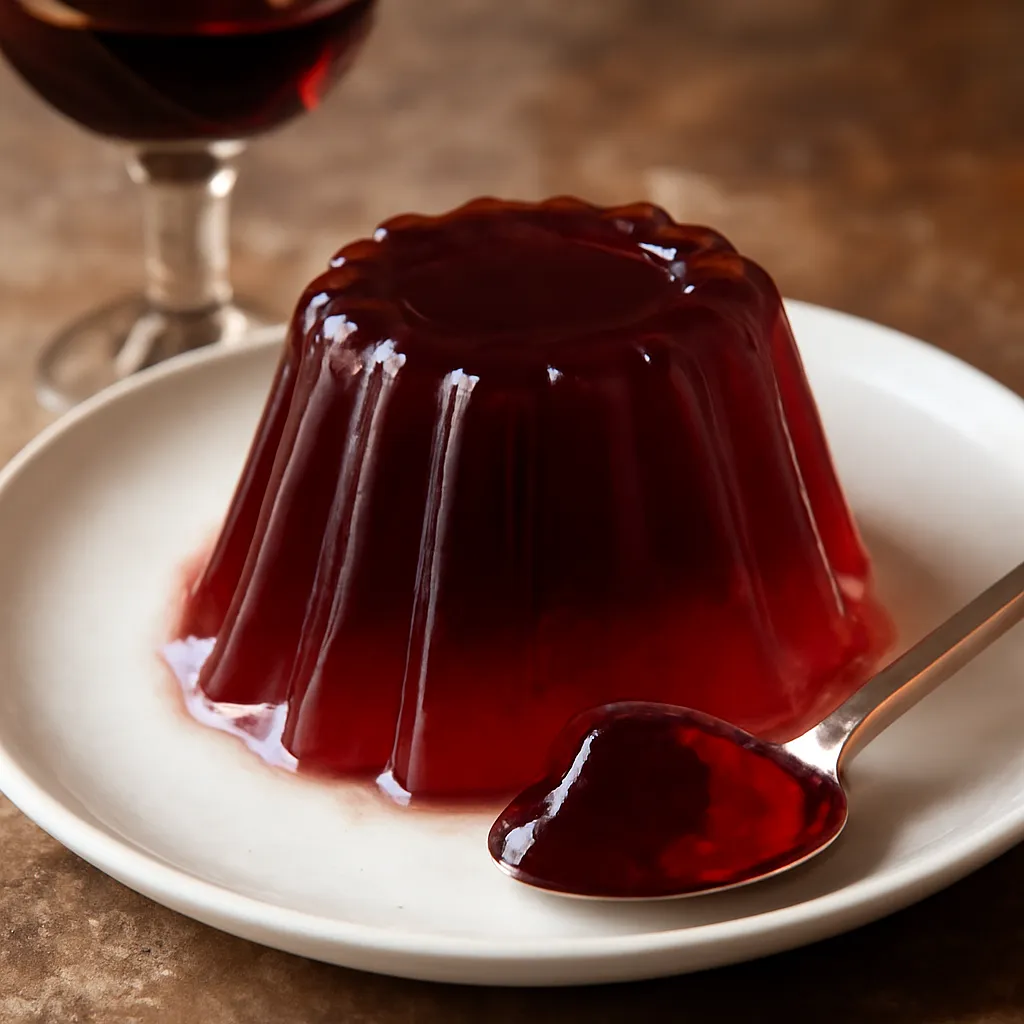
Red wine jelly is an elegant French dessert with a deep, fruity-spicy aroma and a transparent, ruby hue. The origin of this type of dessert comes from classic French compositions, where alcohol is combined with spices and a gel-like structure to achieve a delicate consistency. It is perfect as a light ending to a dinner — served in small glasses or molds, it looks very decorative. The taste of the jelly is sweet and sour with hints of cinnamon and vanilla; it can be served with whipped cream, natural yogurt, madeleine cookies, or fresh fruits such as raspberries. Visually, it attracts with its deep color and shiny surface, and the addition of orange zest and a mint leaf gives it freshness and contrast.
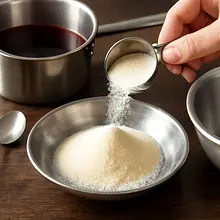
Prepare the gelatin to bloom: sprinkle the gelatin powder (10 g) into a small, wide bowl. Pour cold water (80 ml) evenly over the surface of the powder, do not stir immediately. Leave aside for 5–10 minutes until the gelatin swells and looks like a thick jelly-like mass.
Ingredients:
Gelatin (powder), Water (cold, for soaking gelatin)
Use a small glass or plastic bowl. Do not use hot water – the gelatin must swell in cold water. A common mistake: adding hot water right away will ruin the structure of the gelatin.
Wine base
2
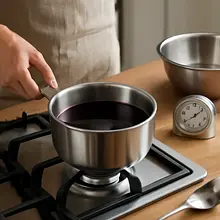
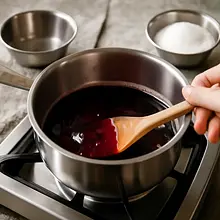
Pour red wine (600 ml) into a medium saucepan. Add sugar (100 g), two cinnamon sticks (6 g), and a split vanilla pod (5 g) — scrape the seeds from it and add both the seeds and the pod to the saucepan. If you are using orange peel, add it now (optional). Place the saucepan over medium heat.
Ingredients:
Red wine, White sugar, Cinnamon stick, Vanilla bean, Orange zest (optional)
Use a saucepan with a diameter of 18–20 cm. If you have a tea strainer or a spice bag, you can put the cinnamon and vanilla in it for easier removal. A common mistake: cooking over too high heat causes the alcohol to evaporate quickly and changes the flavor.
3
Heat over low to medium heat, stirring occasionally with a wooden spoon, until the sugar is completely dissolved (3–5 minutes). Once the sugar has dissolved, reduce the heat to low and maintain very gentle heating for another 3–5 minutes to allow the spices to release their aroma. Do not let it boil — gentle steaming is fine, but boiling will remove excessive alcohol and the refreshing notes of the wine.
Ingredients:
Red wine, White sugar, Cinnamon stick, Vanilla bean, Orange zest (optional)
Use a wooden spoon or a silicone spatula. The signal for the correct stage is the complete dissolution of the sugar crystals and a more intense aroma of the spices — there should be no foam or strong boiling.
Tempering and combining gelatin
4
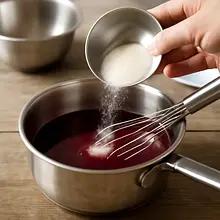
Remove the saucepan from the heat and wait 1–2 minutes for the liquid to cool slightly (it should be warm, not hot). Check if the gelatin has a smooth, moist consistency after blooming. Pour a few tablespoons of the warm (not boiling) wine mixture into the bowl with the bloomed gelatin and vigorously mix with a fork or a small whisk to dissolve the gelatin without lumps. Then pour the dissolved gelatin back into the saucepan and mix thoroughly until completely homogeneous — there should be no visible gelatin granules.
Ingredients:
Gelatin (powder), Red wine, Water (cold, for soaking gelatin)
Use a small whisk or spoon. If there are lumps, strain later through a fine sieve. If you are using agar-agar instead of gelatin: mix the agar (3 g) directly into the cold mixture and bring everything to a boil, cooking for 1–2 minutes to activate the agar — this is a different process than gelatin.
Finishing the base
5
After mixing, check the taste and add lemon juice (15 ml) — this will add fresh acidity and enhance the aromas of the wine. Stir for 30 seconds. Remove the cinnamon sticks and vanilla pod (if used) with a slotted spoon or strainer.
Season gradually with lemon juice — too much can overpower the flavor. Use a strainer to remove spice pieces and any undissolved elements.
Pouring into containers
6
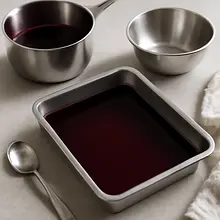
Prepare the molds or serving dishes (e.g., small glasses, bowls, or individual silicone molds). Strain the liquid through a fine sieve into a clean jug or bowl to remove aromatic residues and small bubbles. Then, slowly pour into the dishes, leaving about 1 cm of space from the top edge (the jelly will slightly shrink while cooling).
Ingredients:
Red wine
Use a fine sieve and a funnel or ladle to control the pouring. It's best to place the containers on a tray — this will make it easier to transfer to the fridge.
Cooling and Setting
7
Leave the containers filled with jelly on the countertop to cool to room temperature (about 20–30 minutes), then place them in the refrigerator for at least 4 hours (preferably 6 hours) to set completely. To test readiness: gently shake the container — the jelly should move nicely, be firm, and not release any liquid phase.
Ingredients:
Red wine
Make sure that the containers are standing evenly in the fridge. Do not move or loosely cover them before they set, as this may cause unevenness on the surface.
Removing and serving
8
If you served the jelly in glasses – serve without removing. If you used molds for inverting: dip the bottom of the mold for 1–2 seconds in warm (not hot) water, then quickly invert onto a plate — the jelly should come out easily. Decorate the top with freshly grated orange zest and a mint leaf (optional). Additionally, you can serve a bit of whipped cream or a teaspoon of natural yogurt on the side.
Ingredients:
Orange zest (optional)
To unmold, use a flat plate and a gentle touch — do not hold the mold in water for more than a few seconds. If the jelly does not want to come out, check if it has set long enough.
Vegan variant (if you are using agar-agar)
9
If you chose agar-agar as an alternative: instead of soaking gelatin, mix agar-agar (3 g) with a small amount of wine or water, add it to the pot with the heated liquid before removing it from the heat. Bring the mixture to a boil and cook for 1–2 minutes, stirring to ensure the agar completely dissolves. Then proceed as in steps 4–7 (strain, pour into containers, cool).
Agar agar requires boiling; otherwise, it won't work. Do not allow it to boil violently, but boiling for 1–2 minutes is necessary. Note: agar gives a slightly firmer jelly than gelatin.
Fun Fact
💡
Jellies with wine and spirits have a long history in French and English cuisine — as early as the 19th century, wine was combined with gelatin as an elegant form of dessert for parties. The use of spices and citrus was typical to balance the flavor of the alcohol.
Serve the chilled jelly in small glasses or bowls. For contrast, add a dollop of whipped cream, Greek yogurt, or fresh raspberries. A decoration of thin orange peel and a mint leaf adds aroma and an impressive appearance.
🥡Storage
Store in the refrigerator in an airtight container or covered glasses for up to 3 days. Do not freeze — the texture will be ruined. If the jelly becomes very firm after longer storage, take it out 15–20 minutes before serving to let it soften slightly.
Desserts are a sweet ending to a meal that brings joy to both children and adults. In this category, we present recipes for a variety of sweets - from simple creams and mousses, to elegant panna cottas, and exquisite fruit tarts. Our desserts include both classics of Polish cuisine - fruit jelly,...
European cuisine is a mosaic of culinary traditions from the Old Continent - from Spain to Scandinavia. Valencian paella and tapas from Spain - sunshine on a plate. Boeuf bourguignon and ratatouille from France - elegance and finesse. Wiener schnitzel and strudel from Austria - Central European c...
Comments (0)
Be the first to comment on this recipe!
Add a comment