Prepare all the ingredients and tools. Weigh the flour, butter, and water. Make sure the butter is cold but pliable (take it out of the fridge 5–10 minutes before use only if it is too hard). Prepare: a large bowl, a rolling surface or a large board for rolling, a rolling pin, parchment paper, plastic wrap, a knife, tongs or a spoon for mixing, a cool place in the fridge. Preheat the oven only at the end of the preparations.
Description
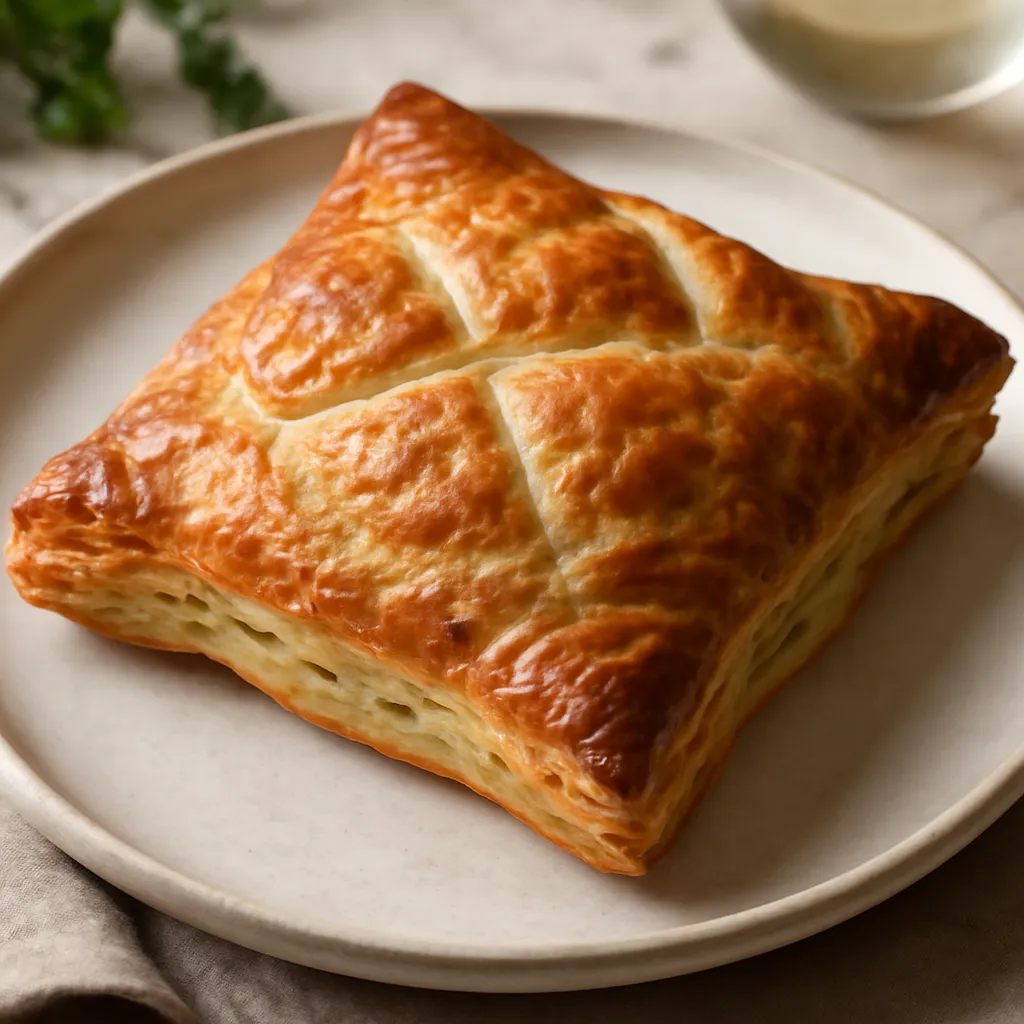
Puff pastry (pâte feuilletée) is a classic, multilayered dough made from butter and flour that, when baked, creates crispy, golden, and distinctly separated layers. It originates from French cuisine and is the basis for many sweet and savory baked goods: croissants, tarts, vol-au-vent, and pastries. Its value lies in its rich, buttery flavor and light, flaky texture with numerous "leaves" (layers). Ready-made sheets can be used for casseroles, snacks, or desserts; it looks beautiful when baked (golden color and visible layering). The recipe guides beginners step by step — from preparing the dough (détrempe), to preparing the butter (beurrage), through laminating (folding/"turns") to baking.
Składniki (5)
- Wheat flour 500 g
- Butter 350 g
- Water (cold) 250 ml
- 🌿 Przyprawy
- Salt 10 g
- ✨ Opcjonalne
- Egg (for glazing) 1 szt.
💡 Kliknij na składnik aby oznaczyć jako użyty
Preparation steps
Preparation and organization
Dough (détrempe)
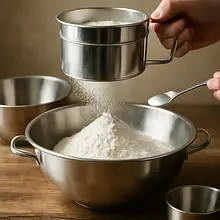
Prepare the détrempe (basic sketch dough). In a large bowl, sift 500 g of flour and add 10 g of salt, mixing with a dry spoon. Cut 50 g of butter (taken from a total of 350 g) into very small cubes (about 1 cm). Add the butter cubes to the flour and quickly rub them in with your fingers or a kitchen knife until the mixture resembles coarse sand with a few larger lumps of butter (do not rub to a powder).
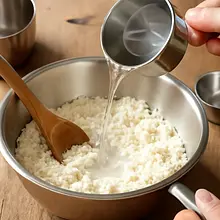
Pour 200–250 ml of very cold water into the flour and butter mixture gradually, starting with 200 ml. Stir with a wooden spoon or by hand until a thick, uneven, chunky dough forms (the dough does not need to be smooth). If the mixture is too dry after 200 ml, add the remaining 50 ml. The goal is to achieve a compact, slightly moist mass that holds together in uniform pieces but is not sticky.
Form a rectangle from the dough with a thickness of 2–3 cm (do not knead for too long): first, gather the dough into a ball, then flatten it into a rectangle with a few hand movements. Wrap it in plastic wrap and place it in the refrigerator for 30 minutes. The dough should be cool and flexible after chilling, but not hard as a rock.
Preparing the butter (beurrage)
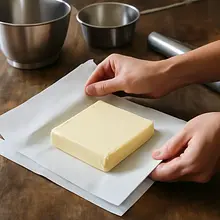
Prepare the butter for the layers: place the remaining 300 g of butter on a sheet of parchment paper, cover it with another sheet of parchment paper, and hit it with a rolling pin or the bottom of a saucepan to flatten and spread the butter into a rectangle measuring about 18–20 cm × 12–15 cm and about 1–1.5 cm thick. The goal is to create a flat, even block of butter with similar proportions to the rolled-out dough. Roll vigorously, but do not warm the butter — work quickly.
Lamination — combining dough and butter
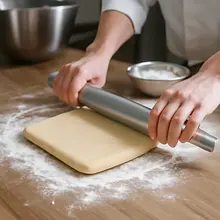
Take the chilled détrempe and lightly dust the work surface with flour (a little). Roll out the détrempe into a rectangle slightly larger than the block of butter (about 25–22 cm). Remove any excess flour from the surface. Place the prepared block of butter centrally on the rolled-out dough so that the longer side of the butter is parallel to the longer side of the dough. Fold the shorter edges of the dough over the butter (like an envelope) so that the butter is completely enclosed — the edges should overlap and adhere well. If there are cracks, gently moisten the edges with your finger and press them together.
Laminating — first rolling
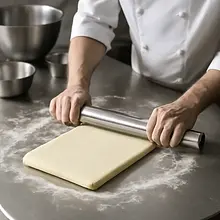
After closing the butter, gently press the folded package with your hand to seal the edges. Make sure the seams are on the bottom. Lightly sprinkle the work surface with flour and gently roll the folded package into a rectangle about 60 cm long and 20 cm wide — always roll from the center outwards to avoid pushing the butter out of the dough. Rolling should take 1–2 minutes until you achieve a smooth rectangle; if the dough starts to stick or the butter is protruding too much, place it in the refrigerator for 10–15 minutes.
Laminating — first fold (tour: fold into three)
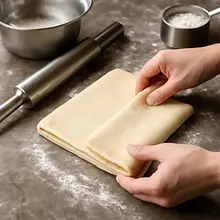
Make a three-fold (called 'tour simple'): Imagine a rectangle divided into three equal parts along the longer side. Fold the top third into the middle, then fold the bottom third over it (like a letter). This is one fold. Rotate the dough 90° (with the shorter side facing you), wrap it in plastic wrap or parchment paper, and place it in the refrigerator for 30 minutes to cool and firm up the butter. After chilling, the edges should be smooth and easy to roll out further.
Lamination — folding repetitions
Repeat the cycle: take out the dough, turn it (shorter side towards you), roll it out into a rectangle 60×20 cm, make the next fold into thirds, turn it 90° and chill for 30 minutes. Perform a total of 3 folds (that is, rolling out and folding into thirds three times), each ending with chilling. After the third chilling, the dough is ready to use or for longer chilling.
Finishing and Shaping
After the final cooling, roll out the dough to the desired thickness: about 3–4 mm for a tart sheet, 2–3 mm for croissants or palmiers. If you need to shape it, use a sharp knife or pastry wheel, cutting with a decisive motion (do not tear). If you want to achieve a glossy surface, beat 60 g of egg (1 piece) and brush the top just before baking — this is an optional step. Additionally, you can sprinkle sugar on top if you are making a sweet pastry.
Baking
Preheat the oven to 200–220°C (with fan 200°C, without fan 220°C). Line a baking sheet with parchment paper. Arrange the prepared items (sheets, croissants, pastries) on the baking sheet, leaving space between them (the dough rises high). If you are baking a full sheet: place it in the preheated oven and bake for 12–20 minutes, until the dough is puffed up and golden. If the items are thicker (e.g. closed vol-au-vent), bake for 20–30 minutes. Remove when the top is intensely golden and noticeably crispy — the bottom layers should also be baked (check with the bottom of a knife).
Cooling and Serving
After baking, transfer the cake to a wire rack to cool, so the bottom doesn't steam (the crispness is best then). Wait 5–10 minutes before cutting smaller pieces, longer for larger shapes. Serve warm or at room temperature depending on the application.
Storage and Freezing
Unused raw dough (after laminating and before final rolling) can be tightly wrapped in plastic wrap and frozen for up to 1 month. After thawing, place it in the refrigerator for a few hours before use. Baked goods can be stored in a closed container in the refrigerator for up to 2 days — before serving, refresh in the oven for 5–8 minutes at 180°C to regain crispness.
Fun Fact
Although the name says 'French', the history of puff pastry is complex: similar laminating techniques were known earlier in Arab and Italian kitchens. Pâte feuilletée as a technique developed and was codified in France in the 18th-19th century.
Best for
Tips
Serve the baked pieces immediately after cooling to keep the layers crispy. For fruit or cream tarts, spread a thin layer of jam or pudding on the bottom to prevent moisture from causing separation. For savory snacks, use a filling that has been pre-cooked (e.g., sautéed vegetables) to prevent the dough from absorbing excess moisture.
Raw, packaged puff pastry can be frozen for 1 month; thaw in the refrigerator for 6–12 hours before use. Baked products can be stored for a maximum of 48 hours in an airtight container; to restore crispness, heat in the oven for 5–8 minutes at 180°C instead of using the microwave (the microwave will make the pastry soggy).
📸 Ugotowane przez społeczność
Zaloguj się, aby dodać zdjęcieDodaj zdjęcie gotowej potrawy
Po zatwierdzeniu przez moderatora otrzymasz 10 punktów doświadczenia.
Nikt jeszcze nie dodał zdjęcia. Bądź pierwszy!
Comments (0)
Be the first to comment on this recipe!
Add a comment