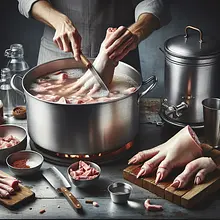
Rating and cleaning: inspect the trotters and hock. Remove any visible dirt, and use tweezers or singe the hairs with a knife over the flame. If the butcher hasn't cut the meat, slice larger pieces in half to fit in the pot. Rinse with cold water.
Description
Cold feet is a traditional Polish snack made from long-cooked pork parts rich in collagen, which form a jelly when cooled. The dish has roots in folk cuisine — all parts of the animal were used to avoid waste. For Christmas Eve, cold feet work well as a hearty, aromatic appetizer with a distinct meaty-spicy flavor and a hint of vegetables and garlic — they attract attention with their appearance: a transparent, golden jelly with pieces of meat, carrots, and egg. They are served chilled, sliced, often with horseradish, vinegar, or fresh parsley.
Składniki (16)
- Pork hocks 1200 g
- Pork knuckle (without excessively fatty skin) 500 g
- Water 3500 ml
- Carrot 2.5 szt.
- Parsley (root) 150 g
- Celeriac 100 g
- Onion 1 szt.
- Garlic 3 ząbki
- Parsley (for decoration) 1 pęczek
- Hard-boiled eggs 3 szt.
- 🌿 Przyprawy
- Bay leaf 10 szt.
- Allspice 4 g
- Black pepper (whole) 3 g
- Salt 12 g
- ✨ Opcjonalne
- Gelatin (powder, optional) 10 g
- Spirit vinegar 10% (optional, to taste) 30 ml
💡 Kliknij na składnik aby oznaczyć jako użyty
Preparation steps
Meat preparation
Blanching
In a large pot (min. 6–8 l), place the cleaned shanks and knuckle, and cover with cold water so that the water covers the meat by about 2–3 cm. Slowly heat to a boil over high heat. When the water starts to boil, cook for 8–10 minutes, skimming off the foam with a slotted spoon. After 10 minutes, drain all the water, rinse the meat under cold running water, and wash the pot.
Cooking the broth
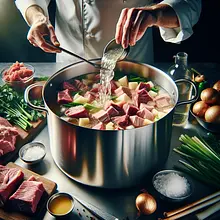
Place the cleaned pot back on the heat with the meat and cover it with 3.5 liters of cold water. Add the chopped carrots, parsley, celery, and the whole onion. Add bay leaves, allspice, and peppercorns. Heat slowly until boiling, then reduce the heat to very low, maintaining a gentle simmer (small, even bubbles). Partially cover the pot and cook for 150 minutes (2.5 hours). For the first 30–40 minutes, regularly skim off the foam and impurities to keep the broth clear.
Seasoning
After about 90 minutes of cooking, taste the broth (with a small spoon) and add salt — a total of about 12 g, but it's better to add it gradually and season at the end. In the last 20 minutes of cooking, add crushed garlic cloves for a fresher aroma.
Checking the gelation of the broth
Turn off the heat and remove the piece of meat. Strain a portion of the broth (about 50–100 ml) into a small bowl and place it in the refrigerator for 10–15 minutes to check if the broth sets (gelatinizes). If after this time the broth is jelly-like — the natural amount of collagen is sufficient. If the broth remains liquid, prepare the gelatin: dissolve 10 g of gelatin in about 60 ml of cold water, let it sit for 10 minutes (bloom), and then add it to the warm — not boiling — broth, stirring until completely dissolved.
Separating the meat and straining
Remove the meat and vegetables from the broth. Strain the broth through a sieve lined with cheesecloth or a very fine strainer into a clean pot to remove any small impurities. Set the broth aside until it cools enough to be poured (about 20–30 minutes). Separate the meat from the bones: use two forks or a knife — the meat should come off easily if it has been cooked long enough. Cut the carrot into slices for decoration (you can save part of the carrot for arranging in the molds).
Preparing the molds and arranging
Prepare the molds: you can use small bowls, muffin tins, or one large baking dish. Arrange slices of boiled egg, slices of carrot, and finely chopped parsley at the bottom of the molds. Evenly distribute the chopped meat on top — arrange it nicely, as it will be visible after it sets. If you want, you can skim a bit of clear fat from the surface of the broth with a spoon to make the jelly more transparent.
Pouring the broth and cooling
Slowly pour the warm (not boiling) broth into the molds, being careful not to disturb the arranged decorations. If you used gelatin, make sure it is well mixed. Leave the molds to cool at room temperature (30–60 minutes), then place them in the refrigerator for at least 6–8 hours, preferably overnight (10–12 hours), for the jelly to set completely.
Removing from the mold and serving
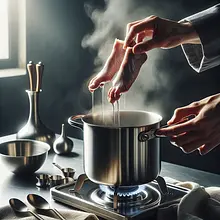
To remove the cold jellied legs from the mold, quickly dip the bottom of the mold for 2–3 seconds in a bowl of warm (not hot) water — just the edge of the mold, so the jelly loosens. Invert the mold onto a plate and gently lift it. Serve chilled, with horseradish and/or vinegar to taste, and fresh parsley.
Serving and accompaniments
Slice the cold jellied meat into pieces (if you prepared a large baking dish) or serve individual portions. On the plate, arrange slices of fresh bread or rolls, optionally serve grated horseradish and vinegar in a separate dish — everyone can season to their liking.
Fun Fact
The tradition of preparing dishes based on collagen (such as cold feet, feet in jelly, or tripe) dates back to rural cuisine, where the ability of certain parts of the animal to create natural jelly was valued — it was a method for a filling, inexpensive meal.
Best for
Tips
Serve very chilled, garnished with fresh parsley and slices of cooked carrot and egg. Set out vinegar and grated horseradish on the table so guests can season the dish to their liking. Cold legs are best sliced using a wide knife, serve with dark bread.
Store in the refrigerator in an airtight container for 3-4 days. The jelly loses clarity with longer storage. You can freeze portions of meat (without the jelly) and prepare fresh jelly later; the thawed product will not have the same texture as freshly set jelly. Reheating does not apply — it is a dish served cold.
📸 Ugotowane przez społeczność
Zaloguj się, aby dodać zdjęcieDodaj zdjęcie gotowej potrawy
Po zatwierdzeniu przez moderatora otrzymasz 10 punktów doświadczenia.
Nikt jeszcze nie dodał zdjęcia. Bądź pierwszy!
Comments (0)
Be the first to comment on this recipe!
Add a comment