Pichcik.pl

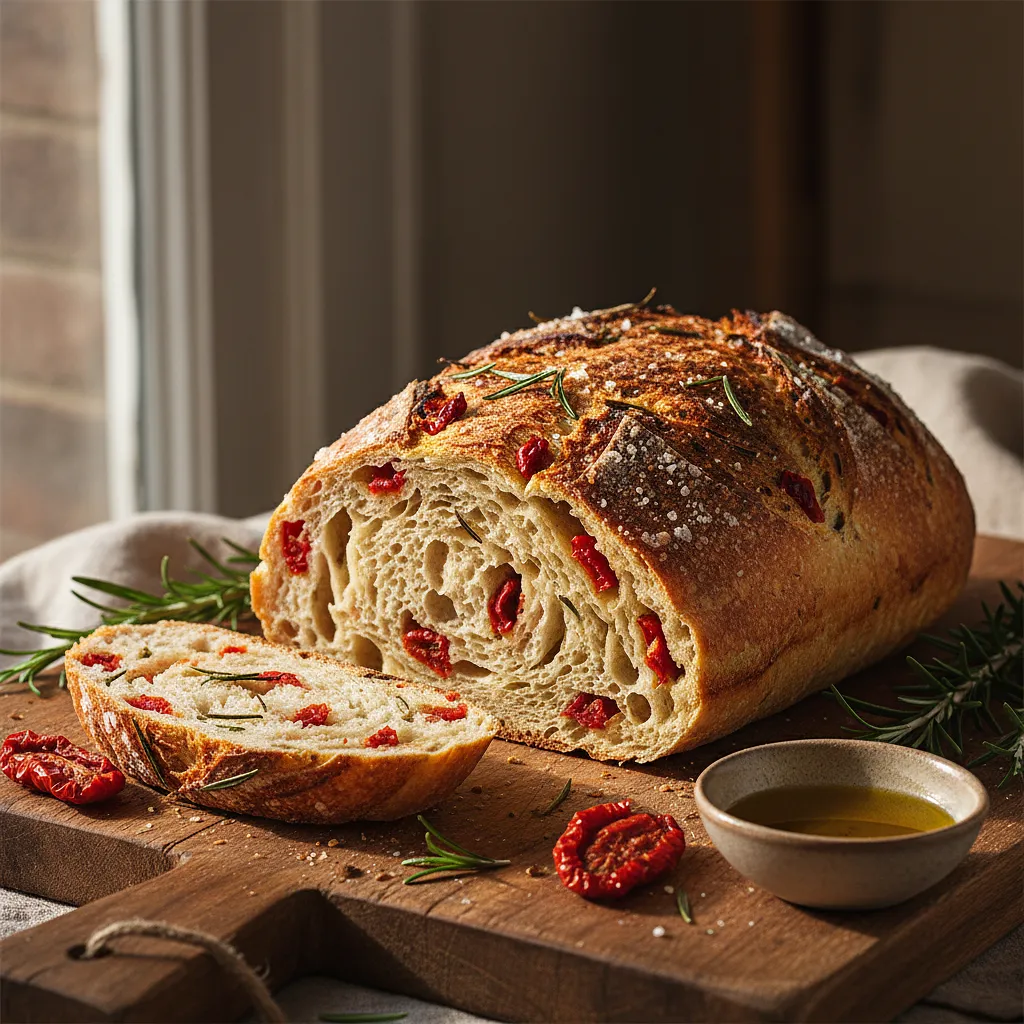
Homemade sourdough bread with sun-dried tomatoes and rosemary

Cakes and Bakes Additions Vegetarian Dishes 780 min Easy 9 wyświetleń ~11.32 PLN - (0)
Rate:
(0)

Description

Discover the magic of homemade bread with this incredibly aromatic sourdough loaf that smells of sunshine and a herb garden. This recipe is designed for beginner bakers – it's a 'no-knead' method that requires only patience and a love for good flavors. The bread features a crispy, golden crust and an incredibly moist, elastic crumb, hiding intense pieces of sun-dried tomatoes and sprigs of fresh rosemary. This combination, inspired by Mediterranean cuisine, makes every bite full of flavor. It pairs perfectly as an accompaniment to soups, salads, cheese and charcuterie boards, but is best enjoyed warm, spread with just a bit of butter or dipped in high-quality olive oil. Its rustic appearance makes it a centerpiece for any table.

Ingredients (8)

Servings:
12
  • Bread flour type 750 500 g
  • Water 380 ml
  • Active rye sourdough 100 g
  • Sun-dried tomatoes in oil 100 g
  • Fresh rosemary 10 g
  • Extra virgin olive oil 0.2 łyżek
  • 🌿 Przyprawy
  • Kłodawa uniodized salt 2 łyżeczki
  • ✨ Opcjonalne
  • Nutritional yeast flakes 15 g
💰 Szacowany koszt dania: ~11.32 PLN (0.94 PLN/porcję)

💡 Kliknij na składnik aby oznaczyć jako użyty

Preparation steps

Preparing the dough (no-knead method)

1

In a large glass or ceramic bowl, place the sifted bread flour and salt. If you are using yeast flakes, add them now. Thoroughly mix the dry ingredients with a whisk or spoon to evenly distribute the salt. Even distribution of salt is important for controlling fermentation.

Ingredients: Bread flour type 750, Kłodawa uniodized salt, Nutritional yeast flakes
Use a bowl with a capacity of at least 4 liters, as the dough will rise significantly. Sifting the flour will aerate it, contributing to a lighter bread structure.
2

In a separate bowl, combine room temperature water, active rye sourdough starter, and olive oil. Mix everything with a fork or a small whisk until the sourdough partially dissolves in the water, creating a cloudy, uniform suspension. It doesn't have to be perfectly smooth.

Ingredients: Water, Active rye sourdough, Extra virgin olive oil
Remember that the sourdough must be 'active' - fed a few hours earlier and full of bubbles. If the sourdough is straight from the fridge and not active, the bread will not rise. The water cannot be too hot or too cold.
3

Pour the mixture of wet ingredients into the bowl with the dry ingredients. Using a wooden spoon or silicone spatula, mix everything just until the ingredients are combined and no dry flour is visible. The dough will be very sticky and loose – this is normal for this method. Do not knead it! The goal is a gentle combination.

The most important mistake at this stage is mixing too vigorously. We only want to moisten the flour. Mixing should take no more than 1-2 minutes. Cover the bowl with plastic wrap or a damp cloth and set aside for 30 minutes. This process is called autolyse and allows the flour to absorb the water.
4

Meanwhile, prepare the toppings. Remove the sun-dried tomatoes from the marinade and drain them thoroughly on a paper towel. Excess oil will make the dough too heavy. Cut them into smaller pieces (about 1 cm). Strip the needles from the rosemary sprigs and chop them finely. After 30 minutes of autolyse, add the chopped tomatoes and chopped rosemary to the dough. Gently mix by making a few folding motions with a spatula from the edges to the center to evenly distribute the toppings.

Ingredients: Sun-dried tomatoes in oil, Fresh rosemary
Use a sharp knife to chop the rosemary to release as much aroma as possible. Don't throw away the oil from the tomatoes - you can use it for salads or frying.

First rising (pre-fermentation)

5

Cover the bowl tightly with plastic wrap or a lid and set it in a warm place, away from drafts, for about 8-12 hours (e.g., overnight). The rising time depends on the room temperature. The dough is ready when it has doubled in size, bubbles appear on the surface, and the texture is light and airy.

The ideal temperature is 22-25°C. If it’s cooler in the house, the process may take longer. You can place the bowl in the turned-off oven with the light on. Don’t rush at this stage; it’s key to the flavor and texture of the bread.

Shaping and second rising

6

Prepare a work surface by generously dusting it with flour. Using an oiled spatula or dough scraper, gently transfer the risen dough onto the surface. It will be very loose and sticky. Sprinkle a little flour on top of the dough. Gently stretch the dough into a rectangle, then fold it like a letter: first, fold the right 1/3 into the center, then fold the left 1/3 on top. Next, roll the dough from top to bottom, creating tension on the surface. Finally, shape it into a neat ball by tucking the edges underneath.

Ingredients: Bread flour type 750
Work with the dough gently to avoid squeezing out all the air. The goal is to create surface tension that will help the bread maintain its shape during baking. Use a dough scraper to make it easier to handle the sticky mass.
7

Prepare a proofing basket (banneton) or a round bowl (about 20 cm in diameter) lined with a clean kitchen towel. Generously dust both the basket and the towel with flour (preferably rice flour, if you have it, as it prevents sticking). Transfer the shaped loaf to the basket seam side up. Dust the top with flour, cover with a towel or plastic wrap, and set aside for the second rise.

Don't skimp on flour for dusting the basket/cloth! If the dough sticks, all your effort will be in vain. Placing the dough seam side up will ensure that when you flip it onto the baking sheet, the smooth side will be on top, ready to be scored.
8

The second rise can take place in two ways: 1) At room temperature for 1-2 hours, until the loaf slightly rises and becomes fluffier. 2) In the fridge for 8-16 hours (the so-called cold fermentation), which will deepen the flavor of the bread. To check if the dough is ready, perform the 'finger test': gently press the surface of the dough. If the indentation slowly springs back, the dough is ready. If it springs back immediately - it needs more time. If it stays - it is overproofed.

Cold fermentation in the fridge is very convenient and recommended for better flavor. You can leave the dough in the fridge overnight and bake the bread in the morning.

Baking

9

About 45-60 minutes before the end of the rising time, place a cast iron pot with a lid (known as a Dutch oven) in the oven and preheat the oven to 230°C (convection). The pot must be very hot – this is key to achieving a crispy crust and a good 'oven spring' of the bread.

Use thick kitchen gloves! The pot will be extremely hot. If you don't have a cast iron pot, you can use a covered baking dish or a pizza stone with a dish of hot water at the bottom of the oven to create steam.
10

Carefully remove the hot pot from the oven. Line it with a piece of parchment paper. Gently turn the basket with the dough upside down and transfer the loaf onto the paper in the pot. With a quick, confident motion, score the top of the bread with a very sharp knife, a razor blade, or a special bread knife. You can make one long cut or a cross. Cover the pot with a lid and place it back in the oven.

Scoring the bread is not just for decoration. It controls where the bread will crack during the rapid rise in the oven. The depth of the cut should be about 0.5-1 cm.
11

Bake the bread covered for 20 minutes. The steam trapped in the pot will keep the crust flexible and allow the bread to rise maximally. After 20 minutes, carefully remove the lid (watch out for the hot steam!) and continue baking for another 20-25 minutes, until the bread has a deep golden-brown color.

To check if the bread is baked, carefully remove it from the pot and tap the bottom. It should make a hollow, dull sound. If the sound is muffled, bake for another 5-10 minutes uncovered.

Cooling

12

Immediately remove the baked bread from the hot pot and transfer it to a metal rack to cool completely. This is an absolutely crucial step! Slicing hot bread will result in a gummy and undercooked crumb. The bread needs to 'rest' for at least 2-3 hours for the structure inside to stabilize.

I know the smell is tempting, but be patient! Cooling on a rack allows air circulation from all sides, ensuring the bottom of the bread doesn't steam and stays crispy. While cooling, you might hear a soft 'crackling' of the crust - that's a sign that the bread is perfect.

Fun Fact

💡

Sourdough bread is one of the oldest types of bread, with a history that dates back to ancient Egypt. Sourdough fermentation not only leavens the dough but also partially digests the phytic acid present in the flour, making minerals such as iron, zinc, and magnesium more absorbable by our bodies.

Best for

Tips

🍽️ Serving

Serve the bread sliced into thick pieces. It tastes best with garlic butter, avocado spread, or simply dipped in high-quality olive oil with a pinch of salt and pepper. It also makes an excellent base for sandwiches with mozzarella, arugula, and fresh tomatoes.

🥡 Storage

To keep bread fresh and maintain a crispy crust, store it in a linen or cotton bag, or wrapped in a cloth, at room temperature for up to 3-4 days. Avoid plastic bags, as they make the crust chewy. To refresh stale bread, lightly sprinkle it with water and place it in an oven preheated to 180°C for 5-7 minutes.

📸 Ugotowane przez społeczność

Zaloguj się, aby dodać zdjęcie
Dodaj zdjęcie gotowej potrawy

Po zatwierdzeniu przez moderatora otrzymasz 10 punktów doświadczenia.

🍲

Nikt jeszcze nie dodał zdjęcia. Bądź pierwszy!

Comments (0)

Be the first to comment on this recipe!

Add a comment

You might also like

Recipe Categories

Homemade cakes and pastries are the heart of Polish culinary tradition - sweet memories from childhood. In our collection, you will find recipes for classic yeast cakes, shortcrust, sponge, and cheesecake. Apple pie, poppy seed cake, gingerbread, Easter babka, chocolate cake, and New York cheesec...

See all recipes in this category
Additions
Additions in: Christmas Eve Dinner

Side dishes complement main courses and influence the overall meal experience. In this category, we present recipes for potatoes, grains, rice, dumplings, and salads. Our dishes include classic Polish sides - kopytka, Silesian dumplings, mashed potatoes. You will also find modern alternatives - q...

See all recipes in this category

Vegetarian cuisine is a wealth of flavors without meat - healthy, colorful, and filling. Plant-based proteins: lentils, chickpeas, beans, peas, and soy take center stage. Cheeses and dairy: feta, halloumi, ricotta, and mascarpone in main dishes. Eggs in various forms: omelets, frittata, shakshuka...

See all recipes in this category
Appetizers
Appetizers in: Christmas Eve Dinner

Appetizers open the meal and prepare the palate for the following dishes. In this category, we present elegant and tasty appetizers for every occasion. Our recipes include carpaccio, tartare, bruschetta, antipasti, and skewers. You will find both cold and warm appetizers here. We pay special atte...

See all recipes in this category
Reklama