Menu

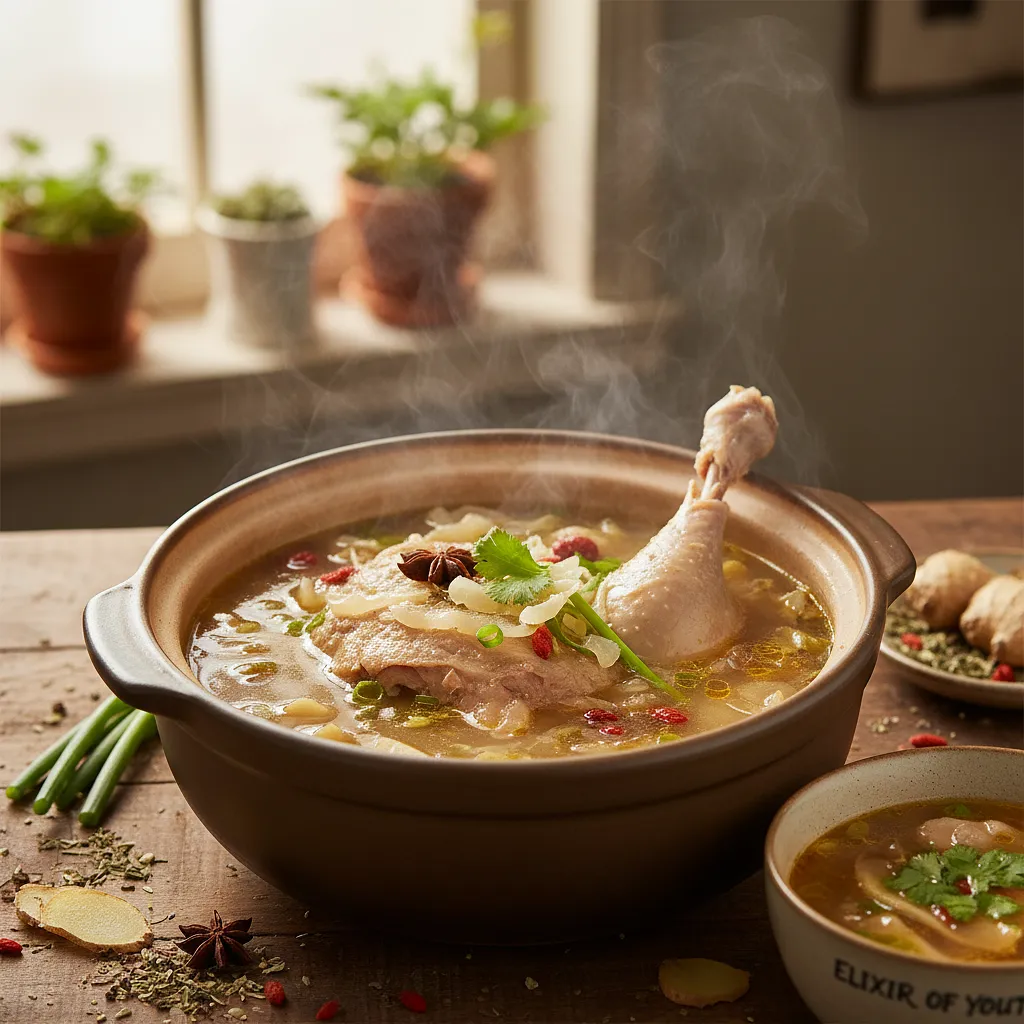
Elixir of Youth: Long-Cooked Collagen Broth with Goose

Pikantne Soups Dishes for Special Occasions Additions 630 min Medium 4 wyświetleń ~46.59 PLN - (0)
Rate:
(0)

Description

This is not an ordinary broth; it is a true elixir of health and flavor, prepared using traditional methods that allow the best of the goose to shine through. Long, slow cooking over minimal heat for more than 8 hours causes the bones, cartilage, and skin to release huge amounts of collagen, amino acids, and minerals. The result is an essential, deeply flavored, and incredibly aromatic liquid that, when cooled, solidifies into a nutritious, amber jelly. This broth, inspired by the philosophy of eating straight from nature, serves as a foundation for boosting immunity, improving the condition of skin, hair, nails, and supporting joints. It can be consumed on its own as a warming, restorative drink, or used as an unmatched base for soups, sauces, risottos, or grain dishes, imparting extraordinary depth to the dishes. Its preparation is a ritual that teaches patience and respect for the product, and the final effect is a reward for the body and senses.

Składniki (18)

Servings:
12
  • Goose carcass with neck 1 szt.
  • Goose feet 4 szt.
  • Carrot 3.8 szt.
  • Parsley root 2 szt.
  • Celeriac 250 g
  • Leek 200 g
  • Onion 2 szt.
  • Garlic 10 ząbków
  • Apple cider vinegar 30 ml
  • Filtered water 4000 ml
  • Lubczyk świeży 30 g
  • 🌿 Przyprawy
  • Bay leaf 3.3 szt.
  • Allspice 2 g
  • Pieprz czarny w ziarnach 3 g
  • Kłodawa uniodized salt 3 łyżeczki
  • Parsley 1 pęczek
  • ✨ Opcjonalne
  • Dried boletus mushrooms 20 g
  • Fresh turmeric root 10 g
💰 Szacowany koszt dania: ~46.59 PLN (3.88 PLN/porcję)

💡 Kliknij na składnik aby oznaczyć jako użyty

Preparation steps

Preparation of ingredients

1

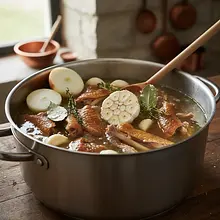
Thoroughly wash the goose carcass and feet under cold running water. Remove any remaining feathers or impurities. Place all meat parts in a very large pot (with a capacity of at least 8-10 liters).

Ingredients: Goose carcass with neck, Goose feet
Use the largest pot you have, preferably with a thick bottom that distributes heat evenly. This will prevent the ingredients from sticking during long cooking times.
2

Peel the root vegetables (carrot, parsley root, celery) using a peeler and wash them. Cut them into large, 3-4 centimeter pieces. Cut the leek in half lengthwise and rinse thoroughly under water to remove any dirt between the leaves. Use only the white and light green parts.

Ingredients: Carrot, Parsley root, Celeriac, Leek
Do not chop the vegetables too finely. Large pieces will slowly release their flavor during long cooking and will not break down into mush, which could cloud the broth.
3

Cut the onions in half, leaving the outer dry skin on. Cut the head of garlic in half crosswise. Skewer the onion halves with a fork and char them directly over the flame of a gas stove or on a dry, well-heated skillet until the skins turn black and charred. Do the same with the garlic, placing it cut side down. This process caramelizes the sugars in the onions and gives the broth a deep color and flavor.

Ingredients: Onion, Garlic
Be careful not to burn yourself. It's best to use metal tongs to turn the onions. If you have an induction stove, use a dry cast iron or steel pan heated to maximum power.

First cooking - extraction

4

Add all the prepared vegetables to the pot with the meat: carrot, parsley root, celery, leek, and charred onion and garlic. Add the spices: bay leaves, allspice, and peppercorns. If using, also add dried mushrooms and sliced turmeric root. Pour in the apple cider vinegar. Cover everything with 4 liters of cold, filtered water. The water should cover all the ingredients by about 5-7 cm.

Ingredients: Carrot, Parsley root, Celeriac, Leek, Onion, Garlic, Apple cider vinegar, Bay leaf, Allspice, Pieprz czarny w ziarnach, Filtered water, Dried boletus mushrooms, Fresh turmeric root
Always cover the broth ingredients with cold water. Slow heating allows for the gradual release of proteins and flavors, resulting in a clearer and more flavorful stock. Hot water would cause the proteins on the surface of the meat to coagulate quickly and trap the flavor inside.
5

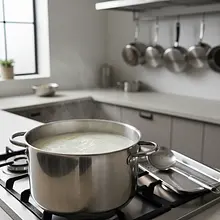
Place a pot on the stove and, over medium heat, very slowly bring the contents to just before boiling. When the first bubbles start to appear on the surface, immediately reduce the heat to the absolute minimum. The broth should not boil vigorously; it should only gently 'wink' or 'pop' (single bubbles appearing every few seconds).

This is the most important step for the clarity of the broth! Boiling vigorously causes the fat to emulsify and the ingredients to break down, leading to a cloudy stock. Use the smallest burner on the lowest setting. You can also use a special diffusion plate that disperses the heat.
6

During the first hour of cooking, gray foams, known as scum, will form on the surface. These are coagulated proteins. Regularly and gently skim them off with a slotted spoon or a small sieve. Try not to stir the contents of the pot to avoid clouding the liquid. After about an hour, the scum will stop appearing.

Be patient and precise. Removing the scum is crucial for achieving a crystal-clear broth. Discard the collected foam, do not mix it back into the broth.
7

Cover the pot with a lid, leaving a small gap of 1-2 cm for steam to escape. Cook the broth in this gentle 'simmering' state for a minimum of 8, ideally 10-12 hours. The longer it cooks, the more collagen and flavor will be extracted. Check occasionally to see if the water level has dropped too much. If so, replenish with a bit of boiling water.

The lid slightly ajar prevents rapid boiling and allows for a slow reduction of the broth, which concentrates the flavor. Only add boiling water to avoid interrupting the cooking process.

Second cooking - flavoring

8

About 45 minutes before the end of cooking, add whole bunches of washed lovage and parsley to the pot along with salt. Gently submerge them in the liquid. Do not stir. Allow the herbs to slowly release their aroma.

Ingredients: Lubczyk świeży, Parsley, Kłodawa uniodized salt
Herbs and salt are added at the end because long cooking of herbs can impart bitterness, and adding salt at the beginning makes it harder to extract flavor from the meat and vegetables.

Finalizing and storing

9

After cooking is finished, turn off the heat. Using tongs and a slotted spoon, very gently remove all solid ingredients from the pot: meat, bones, and vegetables. Do this slowly to avoid disturbing the sediment at the bottom. Strain the remaining liquid through a fine sieve lined with a double layer of cheesecloth or a clean cotton cloth. Pour the broth into a clean container or jars.

Double filtration through a sieve and cheesecloth is the secret to perfect clarity. Do not press the vegetables or meat in the sieve, as this can also cause cloudiness. Just let the broth flow freely.
10

To ensure the safety and longevity of the broth, it should be cooled as quickly as possible. Place the pot with hot broth in a sink filled with cold water and ice (known as an ice bath). Stir the broth occasionally to speed up the cooling. Once it reaches room temperature, place it in the refrigerator for at least 8 hours, preferably overnight.

Quick cooling prevents the growth of bacteria. Do not place a hot pot directly in the refrigerator, as it will raise the internal temperature and may spoil other products.
11

After a night in the fridge, a thick layer of solidified white goose fat will form on the surface of the broth. Use a spoon to remove the entire layer of fat. You can keep it and use it for frying (it's valuable goose lard) or discard it. Beneath the fat, you should find your goal: perfectly clear, amber, firm jelly.

If the broth did not thicken into a jelly, it means it was cooked for too short a time or there were not enough collagen-rich elements (bones, cartilage, feet) in it. Nevertheless, it is still valuable and tasty. The retained goose fat is excellent for roasting potatoes.
12

Store the prepared collagen broth in the refrigerator in tightly sealed jars for 5-7 days. To keep it longer, you can freeze it. Pour the broth into ice cube trays, and after freezing, transfer the cubes to ziplock bags. You can also freeze it in larger portions in plastic containers.

Freezing in cubes is very practical. A few cubes of broth can instantly enhance the flavor of any sauce, soup, or stew. Remember to leave some space in the containers, as the liquid expands when freezing.

Fun Fact

💡

In traditional Polish cuisine, goose was a symbol of abundance and hospitality, and its feast falls on November 11, the day of Saint Martin. Nothing from the goose went to waste – roasts were made from the meat, pâtés from the offal, valuable lard was rendered from the fat, and broths were cooked from the bones and scraps, which were meant to nourish and heal during the winter months.

Best for

Tips

🍽️ Serving

Serve as a warming drink in a mug, slightly heated, with a pinch of Himalayan salt and freshly ground pepper. You can add chopped parsley, dill, or a bit of grated ginger. It serves as an ideal, nutritious base for cream soups (e.g., pumpkin), clear soups with noodles (like broth), and for cooking grains and risotto, adding depth of flavor and nutritional value.

🥡 Storage

After cooling and skimming off the fat, the broth can be stored in the refrigerator in tightly sealed jars for 5-7 days. When chilled, it should have a jelly-like consistency. It can also be frozen in containers or ice cube trays for up to 6 months. Broth cubes are perfect for quickly adding flavor to dishes.

📸 Ugotowane przez społeczność

Zaloguj się, aby dodać zdjęcie
Dodaj zdjęcie gotowej potrawy

Po zatwierdzeniu przez moderatora otrzymasz 10 punktów doświadczenia.

🍲

Nikt jeszcze nie dodał zdjęcia. Bądź pierwszy!

Comments (0)

Be the first to comment on this recipe!

Add a comment

You might also like

Recipe Categories

Soups are the essence of home cooking - they warm, satisfy, and comfort in any weather. In this category, we present recipes for Polish soups - chicken broth, sour rye soup, borscht, tomato soup, cucumber soup, and pea soup. Our dishes also include cream soups, cold soups, and broths. You will fi...

See all recipes in this category

Dishes for special occasions are culinary masterpieces for birthdays, anniversaries, and holidays. Grilled beef steak with herb butter - restaurant quality at home. Beef Wellington - beef in puff pastry with duxelles. Roast duck with apples - a holiday tradition in a new edition. Pink salmon with...

See all recipes in this category
Additions
Additions in: New Year's Eve

Side dishes should complement the main courses, introducing variety and color to the New Year's table.

See all recipes in this category
Reklama