Menu

Beef goulash with red wine (Hungarian style)

Pikantne Main Dishes European cuisine 90 min Hard 17 wyświetleń ~55.00 PLN - (0)
Rate:
(0)

Description

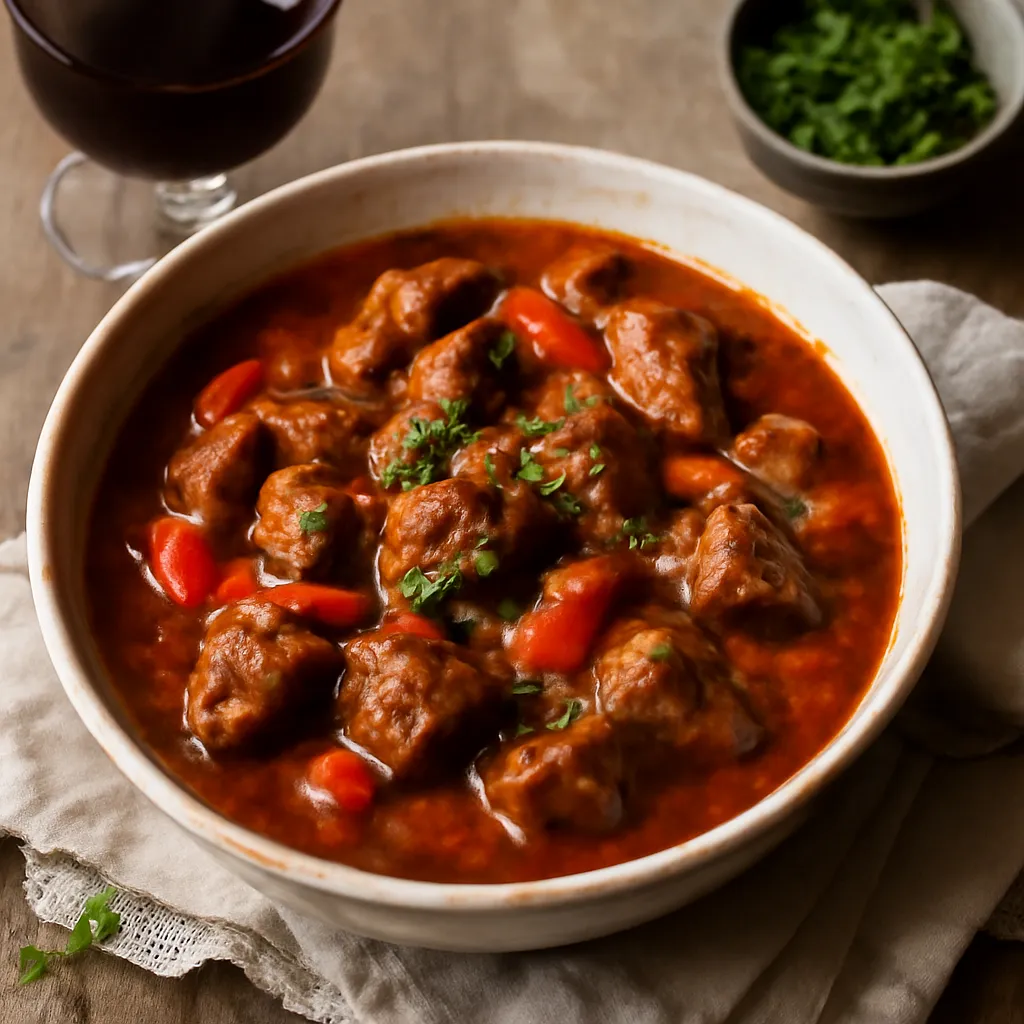
A traditional beef goulash inspired by Hungarian cuisine, enriched with the aroma of red wine and sweet paprika. This hearty, deeply flavorful dish is prepared by slow-cooking pieces of beef shoulder with onions, carrots, and peppers, resulting in meat that is tender and almost melts in your mouth, along with a thick, glossy sauce with a sweet and spicy character. The Hungarian roots of the goulash are highlighted by paprika and caraway; the wine adds acidity and elegance, while the tomato paste provides depth. Serve with dumplings (e.g., nokedli), mashed potatoes, buckwheat, or fresh bread; garnish with sour cream and chopped parsley for contrast. This dish is perfect as a main course for a family dinner or gathering, making an impression with its classic, rustic flavor and appetizing appearance.

Składniki (19)

Servings:
4
  • Beef (shoulder) 1000 g
  • Onion 2 szt.
  • Garlic 3 ząbki
  • Carrot 1.9 szt.
  • Red bell pepper (pink) 150 g
  • Tomato paste 30 g
  • Canned tomatoes (diced) 400 g
  • Dry red wine 200 ml
  • Beef broth 500 ml
  • Wheat flour 20 g
  • Rapeseed oil 30 g
  • 🌿 Przyprawy
  • Sweet paprika powder 5 łyżeczek
  • Cumin (whole or ground) 2 g
  • Bay leaf 6.7 szt.
  • Salt 6 g
  • Black pepper 4 szczypty
  • ✨ Opcjonalne
  • Smoked bacon 100 g
  • Sour cream 18% 100 g
  • Chili powder 5 g
💰 Szacowany koszt dania: ~55.00 PLN (13.75 PLN/porcję)

💡 Kliknij na składnik aby oznaczyć jako użyty

Preparation steps

Preparation

1

Prepare all the ingredients: pat the meat dry with a paper towel, trim off larger pieces of fat, and cut the meat into cubes measuring 2-3 cm. Peel the onion and slice it into thin wedges (3-4 mm thick). Peel the carrot and slice it into 5 mm thick rounds. Clean the bell pepper of seeds and cut it into strips 1 cm wide. Finely chop the garlic or press it through a garlic press. Measure out all the spices and liquids.

Ingredients: Beef (shoulder), Onion, Carrot, Red bell pepper (pink), Garlic
Use a sharp knife and a cutting board. Even pieces of meat ensure even braising. Drying the meat before frying helps achieve a nice, brown crust.
Sautéing (optionally with bacon)

2

If you are using bacon: heat a wide cast-iron pot or heavy saucepan with a capacity of at least 3-4 l over medium heat. Add the chopped bacon and fry for 4-6 minutes until the fat starts to render and the pieces become slightly crispy. Then remove the bacon with a slotted spoon and set it aside on a plate — it will be added back later.

Ingredients: Smoked bacon, Rapeseed oil
Use a wide pot (e.g., cast iron) with a diameter of 24-28 cm. If you don't have bacon, skip this step and use only oil. Do not fry on too high heat to avoid burning.

Searing the meat

3

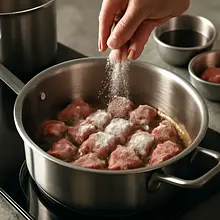
Heat oil in a pot over medium-high heat. Dust the meat with flour (coating the pieces evenly) and fry in batches to avoid overcrowding the pot — fry each batch for 3-4 minutes, until the surface of the meat is browned (dark brown spots). Once fried, transfer the meat to a plate.

Ingredients: Beef (shoulder), Wheat flour, Rapeseed oil
Use a wooden spatula or tongs. Frying in batches prevents steaming and allows for better caramelization. The meat should have a brown, dry crust — if there is too much liquid in the pot, raise the temperature and drain the excess.

Frying onions and vegetables

4

In the same pot, over medium heat, add any rendered bacon fat or 15 g of oil. Add the onion and sauté for 8-12 minutes, stirring every 1-2 minutes, until the onion is soft, translucent, and slightly golden. Add the carrot and bell pepper, and sauté for another 4-5 minutes. At the end, add the garlic and sauté for 30 seconds, until it becomes fragrant.

Ingredients: Onion, Carrot, Red bell pepper (pink), Garlic, Rapeseed oil
Use a wooden spoon. The onion should be soft and lightly caramelized — it should not be raw. Be careful not to burn the garlic (it becomes bitter).

Adding paprika powder

5

Remove the pot from the heat for 10-15 seconds (it's important that the pepper does not reach too high a temperature). Add sweet paprika powder and, if using, hot paprika. Stir vigorously for 20-30 seconds with the vegetables, so that the paprika 'spreads' and begins to release its aroma, but does not burn.

Ingredients: Sweet paprika powder, Chili powder, Onion, Carrot
This is a crucial moment — the pepper will blacken and become bitter if it is burned. Therefore, remove the pot from direct heat before adding the powder, and then quickly continue cooking.

Deglazing and combining ingredients

6

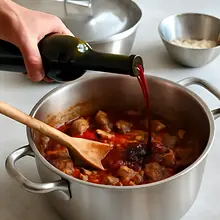
Pour the red wine into the pot (carefully, it may bubble up) and vigorously scrape the burnt bits from the bottom of the pot with a wooden spoon — this is called deglazing, which releases a lot of flavor. Cook for 2-3 minutes until some of the alcohol evaporates. Add the previously browned pieces of meat (and any bacon), canned tomatoes, tomato paste, cumin, and bay leaf. Pour in the broth to cover the ingredients — it should reach about 2/3 the height of the meat.

Ingredients: Dry red wine, Beef (shoulder), Canned tomatoes (diced), Tomato paste, Cumin (whole or ground), Bay leaf, Beef broth
Use a spatula to scrape up the brown bits (fond) — this is the foundation of deep flavor. If the sauce seems too acidic after deglazing, add a small pinch of sugar (no more than 2 g).

Stewing

7

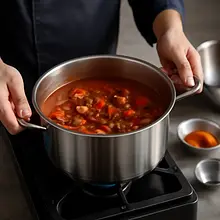
Bring the stew to a gentle boil over medium heat, then reduce the heat to low so that the dish simmers gently. Partially cover the pot with a lid (leaving a small gap for steam) and simmer for 60-70 minutes, stirring every 10-15 minutes. The meat should become tender and easily pierced with a fork. If the liquid evaporates significantly during cooking, add a bit of hot broth or water.

Ingredients: Beef broth, Beef (shoulder), Canned tomatoes (diced)
Use a kitchen thermometer if you have one — the meat will be tender at an internal temperature of about 88-95°C after long braising. Do not rush the process by increasing the heat, as the meat may toughen.

Thickening and finishing

8

When the meat is tender, remove the lid. If you want to thicken the sauce: in a small bowl, mix 20 g of flour with 40 ml of cold water to create a smooth paste (to prevent lumps). Pour the mixture into the hot stew, stirring vigorously to prevent lumps. Cook for another 3-5 minutes until the sauce thickens and no longer tastes of raw flour. Season with salt and pepper to taste. If you used bacon, add it back in and mix.

Ingredients: Wheat flour, Salt, Black pepper, Smoked bacon
Use a whisk or spoon to thoroughly distribute the mixture. If you prefer a more natural thickening, skip the flour and cook uncovered longer to evaporate the excess liquid.

Serving

9

Before serving, check the seasoning: add more salt or pepper to taste. Transfer the goulash to a platter or serve portions on plates. You can top it with a spoonful of sour cream and chopped parsley. Serve with nokedli (dumplings), mashed potatoes, groats, or fresh bread.

Ingredients: Sour cream 18%
If you are adding cream, temper it: mix 1 tablespoon of hot sauce with 1 tablespoon of cream, then pour it back into the pot — this will prevent curdling.

Control and waste

10

Remove the bay leaf and any larger pieces of tough fibers. Check if the pieces of meat are tender and have not completely fallen apart — the stew should have a chunky consistency, and the meat should be tender but intact.

Ingredients: Bay leaf, Beef (shoulder)
The bay leaf is inedible — remove it before serving. If the meat falls apart too much, next time shorten the braising time.

Fun Fact

💡

Goulash (gulyás) comes from Hungary and was originally a simple dish made by shepherds cooked in a cauldron over an open fire. The name 'gulyás' comes from the Hungarian word 'gulya' meaning a herd of cattle.

Best for

Tips

🍽️ Serving

Serve the hot goulash with nokedli dumplings, mashed potatoes, or fresh, crusty bread. Place a spoonful of sour cream and fresh parsley on the plate for contrast. It pairs well with a medium-tannin red wine.

🥡 Storage

Store the cooled stew in an airtight container in the refrigerator for up to 3 days. The flavors intensify overnight — often the dish tastes better the next day. When reheating, warm it over low heat, adding a little water or broth to prevent the sauce from becoming too thick. Portions can also be frozen for 2-3 months.

📸 Ugotowane przez społeczność

Zaloguj się, aby dodać zdjęcie
Dodaj zdjęcie gotowej potrawy

Po zatwierdzeniu przez moderatora otrzymasz 10 punktów doświadczenia.

🍲

Nikt jeszcze nie dodał zdjęcia. Bądź pierwszy!

Comments (0)

Be the first to comment on this recipe!

Add a comment

You might also like

Recipe Categories

Main Dishes
Main Dishes in: Christmas Eve Dinner

Main courses are the heart of every meal - hearty, delicious, and full of nutrients. Meats: beef, pork, poultry, and lamb in various versions. Fish and seafood: baked, fried, grilled, and stewed. Vegetarian dishes: tofu, tempeh, legumes as the main protein. Casseroles: pasta, potato, vegetable wi...

See all recipes in this category

European cuisine is a mosaic of culinary traditions from the Old Continent - from Spain to Scandinavia. Valencian paella and tapas from Spain - sunshine on a plate. Boeuf bourguignon and ratatouille from France - elegance and finesse. Wiener schnitzel and strudel from Austria - Central European c...

See all recipes in this category
Reklama