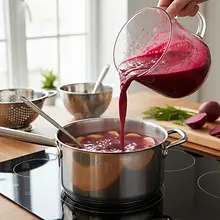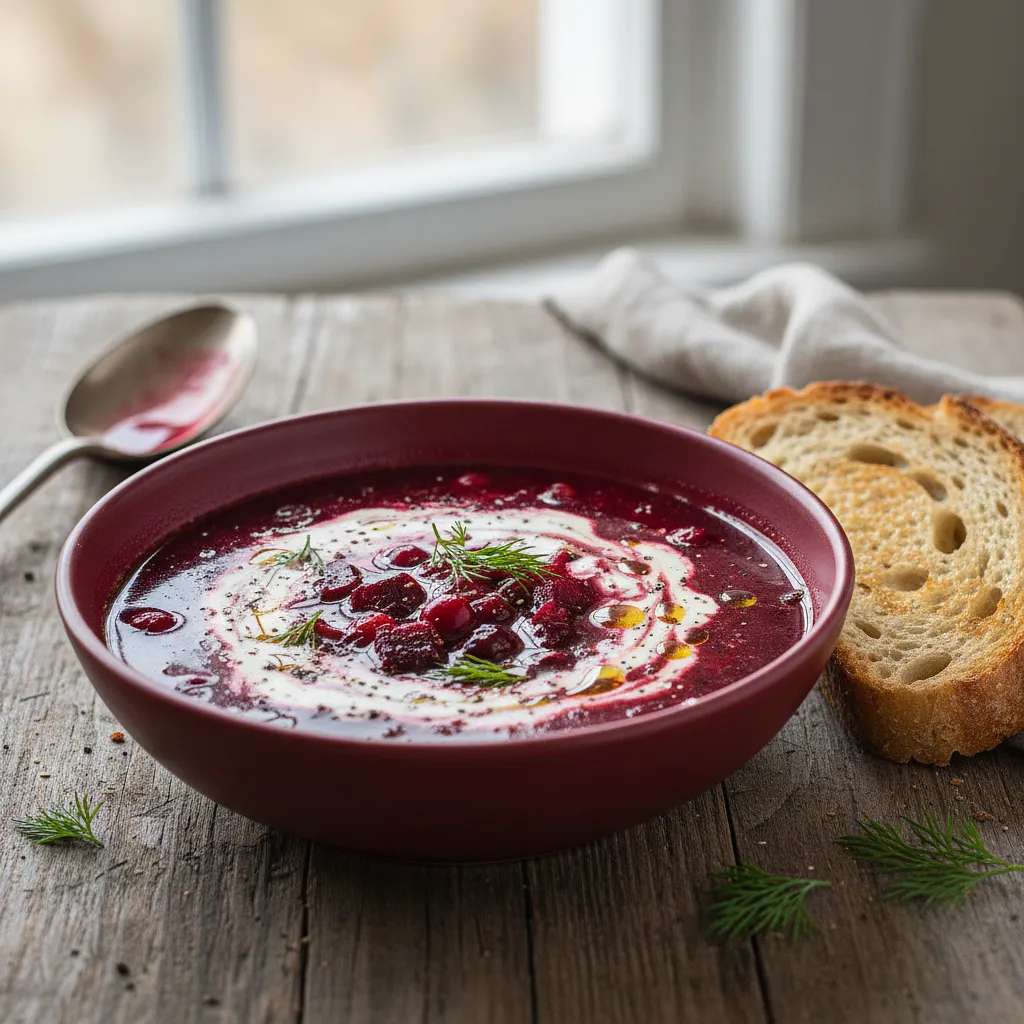
Menu

Royal Red Borscht with Fermented Roasted Beets and a Hint of Cranberry

Pikantne Christmas Eve Soups Soups Vegetarian Dishes 180 min Medium 11 wyświetleń ~25.44 PLN - (0)
Rate:
(0)

Description

This is not an ordinary borscht – it is the essence of holiday tradition in a modern, elegant form. Its deep, ruby color and crystal clarity are thanks to slow cooking on homemade sourdough and a broth made from roasted vegetables. The flavor is multidimensional: the earthy sweetness of roasted beets perfectly complements the bold acidity of the sourdough, while the addition of fresh cranberries brings a refreshing, slightly tart note that breaks up the richness and adds nobility. The borscht is velvety in taste, warming, and incredibly aromatic due to a carefully selected blend of herbs and spices. Served in small cups with dumplings or in a deep plate with a croquette, it embodies the quintessence of Polish Christmas Eve, but it also works as an exquisite soup for any festive occasion on cold days.

Składniki (17)

Servings:
6
  • Beets 1500 g
  • Filtered water 3500 ml
  • Garlic 5 ząbków
  • Carrot 2.5 szt.
  • Parsley root 1 szt.
  • Celeriac 150 g
  • Onion 1 szt.
  • Dried mushrooms (boletes or porcini) 20 g
  • Fresh cranberry 150 g
  • Apple (e.g. gray renet) 1 szt.
  • Honey or maple syrup 2 łyżki
  • 🌿 Przyprawy
  • Sól kamienna niejodowana 6 łyżeczek
  • Bay leaf 16.7 szt.
  • Allspice 10 g
  • Dried marjoram 2 łyżeczki
  • Pieprz czarny świeżo mielony 2 szczypty
  • ✨ Opcjonalne
  • Smoked dried plums 30 g
💰 Szacowany koszt dania: ~25.44 PLN (4.24 PLN/porcję)

💡 Kliknij na składnik aby oznaczyć jako użyty

Preparation steps

Homemade beet kvass (waiting time: 5-7 days)

1

We start with the heart of our borscht – the sourdough. Thoroughly scrub 1 kg of beets, peel them, and cut them into thick slices about 1 cm thick. Do not use metal tools that may react with the acid. Peel 3 cloves of garlic and gently crush them with the flat side of a knife to release their aroma.

Ingredients: Beets, Garlic
Use a large glass jar (minimum 2 liters) that has been previously sterilized with boiling water. It is very important to prevent the growth of unwanted mold. Use a cutting board that is easy to clean for cutting the beets, as they stain heavily.
2

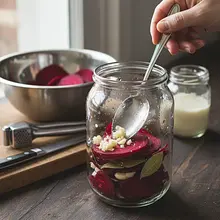
At the bottom of the prepared jar, place a few slices of beets, add crushed garlic, 3 bay leaves, and 5 allspice berries. Then layer the remaining beets, interspersing them with the spices. In a separate container, dissolve 1.5 tablespoons (about 22g) of rock salt in 1.5 liters of lukewarm, boiled, or filtered water. Pour the brine over the beets so that they are completely covered. The liquid should reach about 4-5 cm below the edge of the jar.

Ingredients: Beets, Garlic, Filtered water, Sól kamienna niejodowana, Bay leaf, Allspice
Make sure that no piece of beet is sticking out above the surface of the water, as it will mold. You can press them down with a small plate or a special fermentation stone. Cover the jar with cheesecloth or a linen cloth and secure it with a rubber band. Do not seal it tightly, as fermentation produces gases that need to escape.
3

Set the jar in a warm place (e.g., near a radiator or on the kitchen counter, away from direct sunlight) for 5 to 7 days. Every day, gently stir the contents with a clean wooden spoon or move the jar to prevent mold from forming. After 2-3 days, a foam should appear on the surface, and the smell will become pleasantly sour – this is a sign that fermentation is proceeding correctly. After 5-7 days, the sourdough is ready. Strain it through a fine sieve or cheesecloth into clean bottles, cap them, and store in the refrigerator.

If a white film (fermentation scum) appears on the surface, it's a normal occurrence – just scoop it off with a clean spoon. However, if mold appears (colored, hairy spots), unfortunately, the entire batch must be discarded and you need to start over. The finished sourdough should have a deep, ruby color and a refreshing, sour taste.

Aromatic vegetable broth

4

Preheat the oven to 200°C (fan). Peel the remaining 500g of beets, carrots, parsley, and celery, and cut them into large cubes. Cut the onion in half, but do not peel it from the outer dry skin. Spread the vegetables on a baking sheet lined with parchment paper, drizzle lightly with oil (optional), and roast for 30-40 minutes until they are slightly caramelized and fragrant.

Ingredients: Beets, Carrot, Parsley root, Celeriac, Onion
Roasting vegetables before cooking is the key to a deep, rich flavor in the broth. Caramelization brings out their natural sweetness. Don't skip this step! By leaving the skin on the onion, the broth will take on a beautiful golden color.
5

Transfer the roasted vegetables to a large pot (with a capacity of about 4-5 liters). Add dried mushrooms, 2 bay leaves, 5 allspice berries, and optionally smoked dried plums. Pour everything with 2 liters of cold water. Bring to a boil, then reduce the heat to the minimum so that the broth only gently 'bubbles'. Cook covered for at least 1.5 hours.

Ingredients: Dried mushrooms (boletes or porcini), Bay leaf, Allspice, Filtered water, Smoked dried plums
Use a heavy-bottomed pot that distributes heat evenly. The broth should not be boiled vigorously – a slow 'simmer' allows for the full flavor of the ingredients to be extracted and keeps the liquid clear. Do not add salt yet.

Combining flavors and cooking borscht

6

When the broth is ready, strain it very carefully through a fine sieve lined with cheesecloth to make it perfectly clear. You can use the vegetables from the broth to prepare a vegetable salad. Pour the clear broth back into a clean pot. Peel the apple, remove the core, and grate it on a coarse grater. Add the grated apple to the broth.

Ingredients: Apple (e.g. gray renet)
Double straining (through a sieve and then cheesecloth) is the secret to crystal clear borscht. It's worth taking a moment for this. Do not squeeze the vegetables while straining; let the broth flow freely – this will help you avoid cloudiness.
7

Into the pot with the broth and apple, pour 1 liter of the previously prepared beetroot sourdough. Heat everything on a very low flame. Now the most important rule: THE BORSCHT MUST NOT BOIL! Heat it to a temperature of about 70-80°C, that is, until it is very hot but not boiling yet. Boiling will cause the borscht to lose its beautiful ruby color and become dull.

Watch the soup closely. When the first small bubbles begin to appear at the edges of the pot and an intense steam rises from the soup, it's a sign that it's ready. Immediately remove the pot from the heat. This is an absolutely crucial moment for preserving the color.

Final seasoning and serving

8

Remove the borscht from the heat. Now it's time to season. In a small saucepan, place fresh cranberries, add 2 tablespoons of water, and heat until the fruits start to burst and release juice. Strain them through a sieve to obtain a smooth puree. Gradually add the cranberry puree to the borscht, one teaspoon at a time, stirring and tasting each time. Add honey (or maple syrup) to balance the acidity. Finally, add crushed marjoram and freshly ground pepper and salt to taste.

Ingredients: Fresh cranberry, Honey or maple syrup, Dried marjoram, Pieprz czarny świeżo mielony, Sól kamienna niejodowana
Seasoning the borscht is an art of balancing sweet, sour, and salty flavors. Add spices in batches and taste after each addition. Each sourdough has a different strength, so the amount of sweetener and salt will vary. The goal is to achieve harmony of flavors.
9

Cover the pot and let the borscht sit for at least 30 minutes, preferably for a few hours, to allow the flavors to meld. Before serving, gently reheat it (making sure not to bring it to a boil!). Serve in warmed cups or deep plates, either plain or with mushroom dumplings.

Borscht, like many soups, gains flavor over time. If you are preparing it for Christmas Eve, it's best to make it the day before. Store it in the refrigerator. Warming the cups before pouring the soup (e.g., by pouring hot water into them for a moment) will help the borscht maintain its temperature longer.

Fun Fact

💡

The word 'borscht' comes from a plant called common hogweed (Heracleum sphondylium), whose fermented leaves and stems were the basis of sour soup long before beets became popular in Poland. It was only in the 18th century that the beet became the main ingredient, giving the soup its iconic red color.

Best for

Tips

🍽️ Serving

Serve the borscht very hot. For a 'wow' effect, you can decorate each serving with a dollop of thick plant-based cream (e.g., cashew cream) and a few fresh marjoram leaves. It pairs perfectly with cabbage and mushroom pastries, croquettes, or traditional dumplings.

🥡 Storage

Once completely cooled, the borscht can be stored in the refrigerator in an airtight container for 4-5 days. With each passing day, its flavor will deepen. It can also be frozen in portions. To reheat, do so slowly over low heat, avoiding boiling to preserve its beautiful color.

📸 Ugotowane przez społeczność

Zaloguj się, aby dodać zdjęcie
Dodaj zdjęcie gotowej potrawy

Po zatwierdzeniu przez moderatora otrzymasz 10 punktów doświadczenia.

🍲

Nikt jeszcze nie dodał zdjęcia. Bądź pierwszy!

Comments (0)

Be the first to comment on this recipe!

Add a comment

You might also like

Recipe Categories

Christmas Eve soups are a traditional start to the festive dinner - warming and aromatic. Clear red borscht with mushroom dumplings - a classic of Polish Christmas Eve. Mushroom soup made from dried porcini and boletus - a forest aroma in a bowl. Christmas Eve fish soup made from carp, pike, or a...

See all recipes in this category

Soups are the essence of home cooking - they warm, satisfy, and comfort in any weather. In this category, we present recipes for Polish soups - chicken broth, sour rye soup, borscht, tomato soup, cucumber soup, and pea soup. Our dishes also include cream soups, cold soups, and broths. You will fi...

See all recipes in this category

Vegetarian cuisine is a wealth of flavors without meat - healthy, colorful, and filling. Plant-based proteins: lentils, chickpeas, beans, peas, and soy take center stage. Cheeses and dairy: feta, halloumi, ricotta, and mascarpone in main dishes. Eggs in various forms: omelets, frittata, shakshuka...

See all recipes in this category

Regional cuisine for Christmas Eve features local traditions from various corners of Poland. Christmas Eve pierogi ruskie from Podkarpacie - with potatoes, cheese, and onions. Carp in Kashubian style - in horseradish sauce with raisins and almonds. Silesian żurek on sourdough - with mushrooms ins...

See all recipes in this category
Reklama