Menu

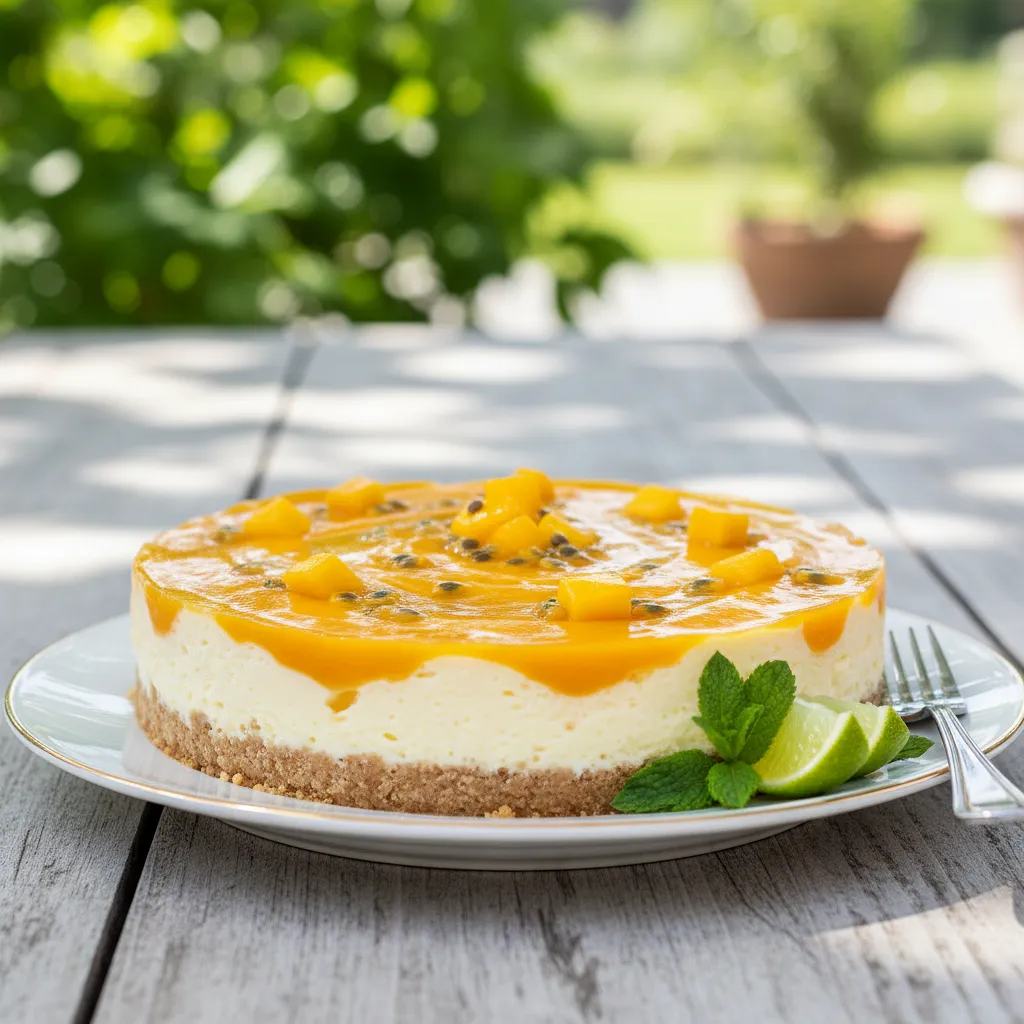
Summer Yogurt Cheesecake with Mango-Passion Fruit Mousse

Desserts Cakes and Bakes Dishes for Special Occasions 75 min Medium 9 wyświetleń ~69.69 PLN - (0)
Rate:
(0)

Description

Here’s a dessert that is the essence of summer – light, refreshing, and absolutely stunning. No-bake cheesecake based on thick, creamy Greek yogurt is a healthier and lighter alternative to classic cheesecakes. Its velvety, slightly tangy filling pairs perfectly with the crunchy, aromatic base made from oatmeal cookies with a hint of cinnamon. However, the real star is the intensely fruity layer on top – a silky mousse made from ripe, sweet mango and exotic, slightly tart passion fruit. This combination of flavors transports you to tropical regions, and the vibrant orange color of the mousse creates a beautiful contrast with the white yogurt filling. The dessert is perfect for hot days, garden parties, or as an elegant finish to a festive dinner. It requires no baking, and while its preparation is divided into stages, it is simple and relaxing.

Składniki (13)

Servings:
8
  • Gluten-free oatmeal cookies 200 g
  • Butter 80 g
  • Greek yogurt 10% fat 1000 g
  • Erythritol 120 g
  • Powdered gelatin 30 g
  • Cold water 130 ml
  • Vanilla extract 5 g
  • Grated lemon zest 1 szt.
  • Pulp from ripe mango 400 g
  • Passion fruit pulp 100 g
  • Lime juice 15 ml
  • ✨ Opcjonalne
  • Ground cinnamon 2 g
  • Listki świeżej mięty 5 g
💰 Szacowany koszt dania: ~69.69 PLN (8.71 PLN/porcję)

💡 Kliknij na składnik aby oznaczyć jako użyty

Preparation steps

Cookie crust

1

Prepare a 24 cm diameter springform pan. Line the bottom of the pan with parchment paper. To do this, place a sheet of paper on the bottom of the springform pan, then attach and close the ring, trimming any excess paper with scissors. Do not grease the sides.

Use a springform pan, which will make it much easier to remove the finished cheesecake. Lining the bottom with parchment paper will prevent sticking and make it easier to transfer the cake to a serving platter.
2

Place the oatmeal cookies in a food processor (kitchen robot with an 'S' blade). Blend for about 30-60 seconds on high speed until you achieve a wet sand consistency. If desired, you can add optional cinnamon at this point and blend for another 5 seconds.

Ingredients: Gluten-free oatmeal cookies, Ground cinnamon
If you don't have a food processor, place the cookies in a strong, resealable plastic bag. Remove the air, seal it, and crush the cookies with a rolling pin or the bottom of a heavy pot until finely ground.
3

Place the butter in a small saucepan and heat it on low power until it completely melts. Be careful not to burn it – it should be liquid and clear. Remove from heat.

Ingredients: Butter
Butter can also be melted in the microwave. Place it in a microwave-safe bowl and heat in 30-second intervals, stirring in between, until it is liquid.
4

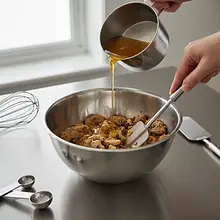
Pour the crushed cookies into a medium bowl. Slowly pour in the melted butter, mixing everything with a spoon or spatula until all the crumbs are evenly moist. The mixture should resemble wet sand and stick together when squeezed in your hand. Transfer the mixture to the prepared springform pan and spread it evenly. Then press it firmly to the bottom using the bottom of a glass or a spoon, creating an even and compact base. Place the springform pan in the refrigerator for at least 30 minutes to let the base set.

Ingredients: Gluten-free oatmeal cookies, Butter
A precise and firm pressing of the mixture to the bottom is key to prevent the base from crumbling when cutting. Chilling it in the fridge will cause the butter to set and further bind the cookies.

Yogurt dough

5

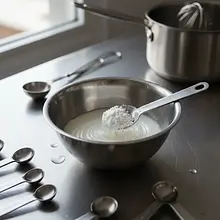
Prepare the gelatin for the yogurt mixture. In a small bowl, add 20g of gelatin (about 4 level teaspoons) and pour in 80 ml of cold water. Mix well and set aside for 10 minutes to swell. The gelatin will absorb all the water and become a thick, rubbery mass.

Ingredients: Powdered gelatin, Cold water
Always use cold water. Pouring hot water over gelatin will cause lumps to form that cannot be dissolved. This is the most important step that determines the consistency of the cheesecake!
6

In a large bowl, place 1000g of Greek yogurt (it should be at room temperature), add erythritol, vanilla extract, and freshly grated lemon zest. Using a whisk, gently mix everything together, just until the ingredients are combined into a smooth, uniform mixture. Do not mix for too long to avoid overly aerating the mixture.

Ingredients: Greek yogurt 10% fat, Erythritol, Vanilla extract, Grated lemon zest
Taking the yogurt out of the fridge 30-60 minutes before preparation will prevent the mixture from curdling after adding warm gelatin. The temperature difference is the main cause of lumps forming.
7

Soak the gelatin and then heat it until it becomes liquid. You can do this in the microwave (heat for 5-10 seconds, remove, stir, and repeat until it is liquid) or in a water bath (place a bowl with gelatin over a pot of gently simmering water). The gelatin must be completely dissolved and liquid, but not hot. It should not be boiled, as it will lose its gelling properties.

Ingredients: Powdered gelatin
The most common mistake is overheating the gelatin. If it is too hot, set it aside for a minute to cool down. It should be warm to the touch, but not burning.
8

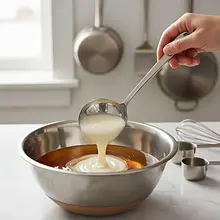
Now temper the gelatin. In a bowl with liquid, warm gelatin, add 2-3 large tablespoons of the prepared yogurt mixture and whisk vigorously until you achieve a smooth blend. Then pour the gelatin mixture into a large bowl with the remaining yogurt mixture, while continuously mixing with a whisk. Do this quickly and energetically to ensure the gelatin is evenly distributed throughout the mixture.

Ingredients: Greek yogurt 10% fat, Powdered gelatin
Tempering (gradually equalizing temperatures) is key to avoiding the formation of gelatin 'threads' or lumps in the cheesecake. Never pour hot gelatin directly into cold yogurt mixture.
9

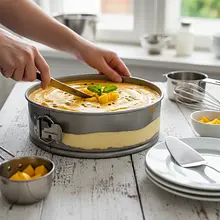
Remove the springform pan with the chilled base from the fridge. Gently pour the prepared yogurt mixture onto the cookie base. Smooth the surface using a spatula or the back of a spoon. Place the cheesecake in the fridge for at least 2-3 hours, or preferably until the mixture is completely set and firm to the touch.

To check if the mixture has set, gently touch its surface with your finger. It should be firm and not sticky. The setting time depends on the power of the refrigerator.

Fruit mousse

10

When the yogurt mixture has thickened, prepare the mousse. Peel the mango, separate the flesh from the pit, and cut it into smaller pieces. Cut the passion fruit in half and use a spoon to scoop out all the flesh with the seeds into a separate bowl. Set aside one tablespoon of the flesh with seeds for decoration.

Ingredients: Pulp from ripe mango, Passion fruit pulp
Use very ripe fruits so that the puree is naturally sweet and aromatic. Don't worry about the passion fruit seeds in the puree - after blending, they will be almost imperceptible and will add an interesting texture.
11

Place the mango flesh, passion fruit pulp (without the reserved for decoration), and lime juice in a blender jar. Blend on high speed for 1-2 minutes until you achieve a perfectly smooth, velvety puree.

Ingredients: Pulp from ripe mango, Passion fruit pulp, Lime juice
Use a high-power blender to achieve a perfectly smooth puree. If you don't have a jug blender, an immersion blender (hand blender) will also work, but it may take a little longer.
12

Prepare the gelatin for the mousse. In a small bowl, add 10g of gelatin (about 2 level teaspoons), pour in 50ml of cold water, mix, and set aside for 10 minutes to swell. Then gently heat it (in the microwave or in a water bath) until it becomes liquid, as in step 7.

Ingredients: Powdered gelatin, Cold water
Since there is less mousse than yogurt mass, we use a correspondingly smaller amount of gelatin and water. However, the process of preparing the gelatin is identical.
13

Harden the gelatin with the fruit puree. Add 3-4 tablespoons of fruit puree to the liquid gelatin and mix vigorously. Then pour the mixture into the remaining puree and quickly but thoroughly mix with a spatula to combine.

Ingredients: Powdered gelatin
Fruit puree is usually at room temperature, so the risk of lumps forming is lower than with cold yogurt, but tempering is still a good practice to ensure perfect smoothness.

Finishing and Decoration

14

Remove the set cheesecake from the refrigerator. Gently and slowly pour the prepared fruit mousse over the yogurt layer. Spread it evenly to create a smooth layer. Place the cheesecake back in the refrigerator for another 2-3 hours, until the mousse layer is completely set.

Pour the mousse slowly, preferably over the back of a spoon, to avoid creating a dent in the yogurt layer. The total cooling time for the cheesecake is a minimum of 4-6 hours, but ideally, it should be left overnight.
15

When the cheesecake is fully set, carefully remove it from the mold. Run a thin, sharp knife along the inner edge of the ring to separate the cake from the mold, then gently unfasten and remove the ring. Before serving, decorate the top with the reserved passion fruit pulp and optionally with fresh mint leaves.

Ingredients: Passion fruit pulp, Listki świeżej mięty
To achieve perfectly smooth edges, you can heat the knife under hot water, wipe it dry, and then run it along the edge. This will melt a minimal amount of the mixture and allow the ring to come off smoothly.

Fun Fact

💡

Cold cheesecakes gained immense popularity in the United States in the 1930s, alongside the increasing availability of refrigerators and the commercialization of powdered gelatin. They were promoted as quick and modern desserts that do not require the use of an oven, which was a great advantage during the summer heat.

Best for

Tips

🍽️ Serving

Serve the cheesecake always well chilled, straight from the fridge. For cutting, use a long, sharp knife dipped for a moment in hot water and dried before each cut – this will give you perfectly even and clean portions. The dessert pairs wonderfully with a glass of chilled Prosecco or a light, fruity white wine.

🥡 Storage

Store the cheesecake in the refrigerator, covered (e.g., in a cake container or with plastic wrap), to prevent it from absorbing odors. It will stay fresh for 2-3 days. The dessert is not suitable for freezing, as the gelatin may release water upon thawing, and the mixture will lose its creamy consistency.

📸 Ugotowane przez społeczność

Zaloguj się, aby dodać zdjęcie
Dodaj zdjęcie gotowej potrawy

Po zatwierdzeniu przez moderatora otrzymasz 10 punktów doświadczenia.

🍲

Nikt jeszcze nie dodał zdjęcia. Bądź pierwszy!

Comments (0)

Be the first to comment on this recipe!

Add a comment

You might also like

Recipe Categories

Desserts
Desserts in: Christmas Eve Dinner

Desserts are a sweet ending to a meal that brings joy to both children and adults. In this category, we present recipes for a variety of sweets - from simple creams and mousses, to elegant panna cottas, and exquisite fruit tarts. Our desserts include both classics of Polish cuisine - fruit jelly,...

See all recipes in this category

Homemade cakes and pastries are the heart of Polish culinary tradition - sweet memories from childhood. In our collection, you will find recipes for classic yeast cakes, shortcrust, sponge, and cheesecake. Apple pie, poppy seed cake, gingerbread, Easter babka, chocolate cake, and New York cheesec...

See all recipes in this category

Dishes for special occasions are culinary masterpieces for birthdays, anniversaries, and holidays. Grilled beef steak with herb butter - restaurant quality at home. Beef Wellington - beef in puff pastry with duxelles. Roast duck with apples - a holiday tradition in a new edition. Pink salmon with...

See all recipes in this category
Reklama