Prepare the dry ingredients. In a large bowl, sift the all-purpose flour and powdered sugar. Sifting will aerate the flour and remove any lumps, making the dough lighter. Add a pinch of salt and mix everything with a dry whisk or fork to evenly distribute the ingredients.
Description
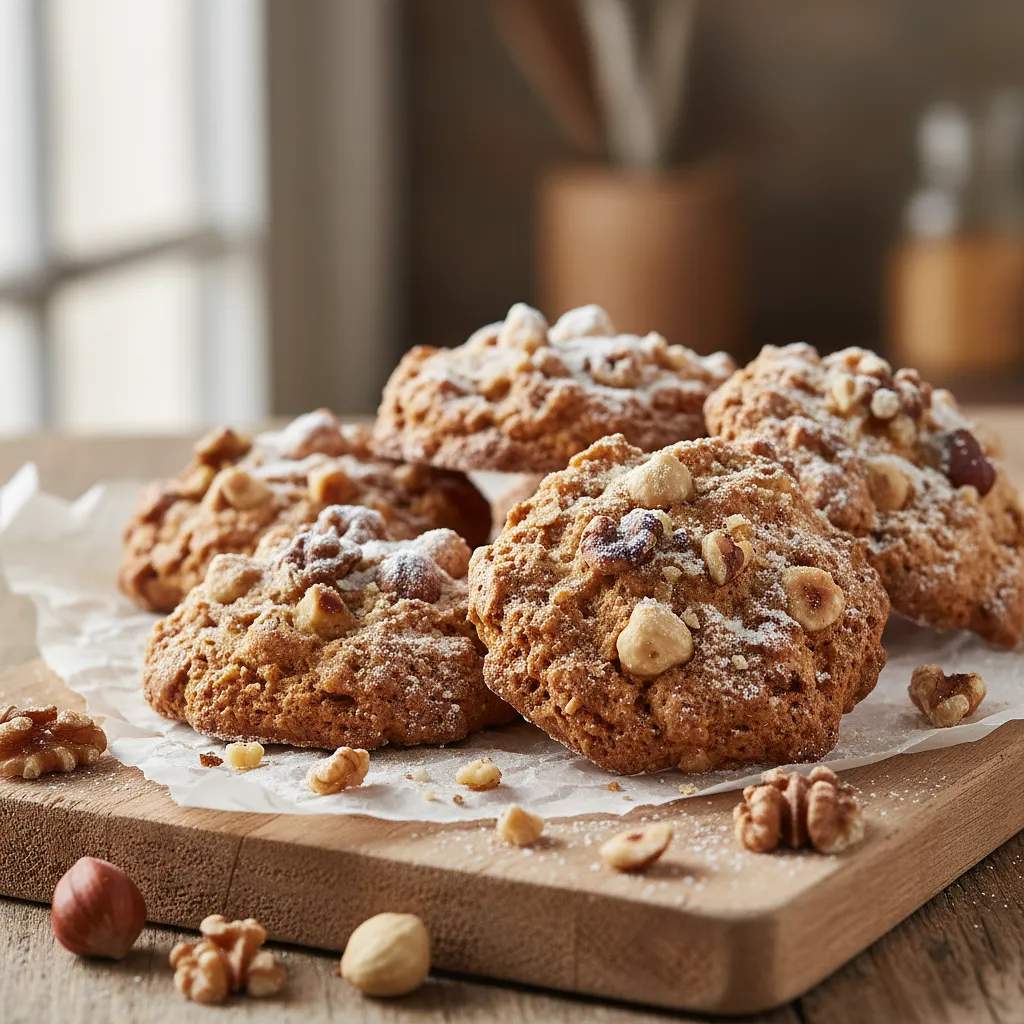
Nutty Kisses are exquisite, two-layer cookies that pay tribute to classic confectionery. Their base is a perfectly crumbly, buttery dough that melts in your mouth, creating a delicate backdrop for the richer-flavored second layer. On top, there is a meringue that is crispy on the outside and slightly chewy on the inside, generously filled with pieces of walnuts. The contrast of textures – the crispness of the base and the lightness of the meringue – is a key element of this bake. The flavor is a harmonious blend of buttery depth, intense, slightly bitter notes of nuts, and the sweetness of the meringue. Visually, they are incredibly appetizing: the golden base and beautifully browned, cracked meringue create small works of art. Perfect for afternoon coffee, as a sweet element of the holiday table, or an elegant, homemade gift.
Składniki (10)
- Mąka pszenna tortowa (typ 450) 250 g
- Butter 150 g
- Powdered sugar 50 g
- Żółtko jaja kurzego 2 szt.
- Egg white 2 szt.
- Cukier drobny do wypieków 8 łyżek
- Walnuts 100 g
- Potato flour 5 g
- 🌿 Przyprawy
- Salt 0.0 szczypt
- ✨ Opcjonalne
- Vanilla extract 5 g
💡 Kliknij na składnik aby oznaczyć jako użyty
Preparation steps
Shortcrust pastry (base)
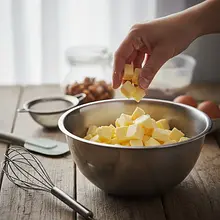
Add cold butter. Take the butter straight from the fridge and cut it into small cubes (about 1x1 cm). Toss the butter cubes into the bowl with the dry ingredients. Now, using only the tips of your fingers (they are the coolest), quickly rub the butter into the flour until the mixture resembles wet sand or crumbs. Try to work quickly so that the butter doesn't warm up.
Add the egg yolks and knead the dough. Make a small indentation in the center of the crumble. Crack two egg yolks into it (set the egg whites aside in a separate, clean bowl for the meringue). If using, add the vanilla extract now. Quickly and efficiently knead everything into a uniform, smooth ball of dough. Do not knead for too long – just until the ingredients are combined.
Chill the dough. Formed into a ball, slightly flatten the dough to create a disk about 2-3 cm thick. Wrap it tightly in plastic wrap and place it in the refrigerator for at least 30 minutes, preferably for an hour. This step is absolutely essential for the butter in the dough to firm up again, which will ensure perfect flakiness after baking.
Nut meringue (topping)
Prepare the nuts and the oven. Chop the walnuts into medium-sized pieces using a sharp knife. Do not grind them into a powder – we want to feel their crunchiness in the meringue. Meanwhile, preheat the oven to 170°C with fan (or 180°C in top-bottom mode). Prepare two large baking sheets by lining them with parchment paper.
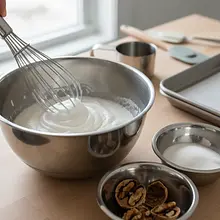
Start whipping the egg whites. Pour the previously set aside egg whites into a perfectly clean and dry bowl (preferably glass or metal). Make sure there is not a trace of yolk in the egg whites. Begin whipping them with a mixer on medium speed. After about 2-3 minutes, when the egg whites turn into a white, fluffy foam (known as 'soft peaks' - the foam forms a peak that soon collapses), you can move on to the next step.
Add sugar. Increase the mixer speed to high and start adding the fine sugar, one tablespoon at a time, at intervals of several seconds. Patience is key here. Whip the mixture for about 8-10 minutes, until the meringue becomes very thick, stiff, and shiny, and all the sugar is completely dissolved. To check this, rub a bit of the meringue between your fingers – you should not feel any sugar crystals.
Combine with the additions. To the finished, glossy meringue, add the sifted potato starch and chopped walnuts. Now set aside the mixer and very gently fold the ingredients together using a large silicone spatula, making motions from the bottom to the top. The goal is to disturb the fluffy structure of the meringue as little as possible. Mix only until the ingredients are combined.
Shaping and baking
Prepare the bases. Take the chilled dough out of the fridge. On a lightly floured surface or countertop, roll it out into a sheet about 3-4 mm thick. Using a round cookie cutter (about 5 cm in diameter), cut out circles. Carefully transfer them to the prepared baking sheets, leaving small gaps between them.
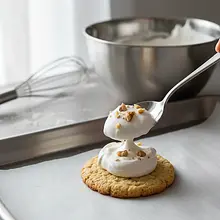
Spread the meringue. On each crumbly base, place a portion (about one heaping teaspoon) of the meringue mixture. You can do this using two teaspoons or a piping bag with a round tip for a more aesthetic effect. Try to leave a small margin (about 2-3 mm) from the edge of the cookie.
Bake the cookies. Place both trays in the preheated oven. Bake for about 20-25 minutes. The cookies are ready when the crisp bottoms are slightly golden at the edges, and the meringue is dry on top and has an appetizing beige-golden color. Halfway through baking (after about 10-12 minutes), you can swap the trays (move the top one to the bottom and vice versa) to ensure the cookies bake evenly.
Cooling. Remove the trays from the oven and leave the cookies on them for about 5 minutes. After this time, using a wide, flat spatula, gently transfer them to a wire rack to cool completely. Hot cookies are very delicate and may break.
Fun Fact
Meringue, known worldwide, has its roots in a dispute between Switzerland, Italy, and France over its origin. One theory suggests that it was invented in the Swiss town of Meiringen by the Italian pastry chef Gasparini around 1720. Its combination with a crumbly pastry and nuts is a classic Central European variation, especially popular during the holiday season.
Best for
Tips
The cookies taste best at room temperature. Serve them on an elegant platter, lightly dusted with powdered sugar for a 'snowy' effect. They make a perfect addition to a cup of bitter coffee, which balances the sweetness of the meringue, or to aromatic black tea.
Store in a tightly sealed metal or glass container at room temperature for up to 7 days. Avoid plastic containers, as they can cause the crispy base to soften. Over time, the meringue may become more 'chewy' in the center, which is a benefit for many.
📸 Ugotowane przez społeczność
Zaloguj się, aby dodać zdjęcieDodaj zdjęcie gotowej potrawy
Po zatwierdzeniu przez moderatora otrzymasz 10 punktów doświadczenia.
Nikt jeszcze nie dodał zdjęcia. Bądź pierwszy!
Comments (0)
Be the first to comment on this recipe!
Add a comment