Menu

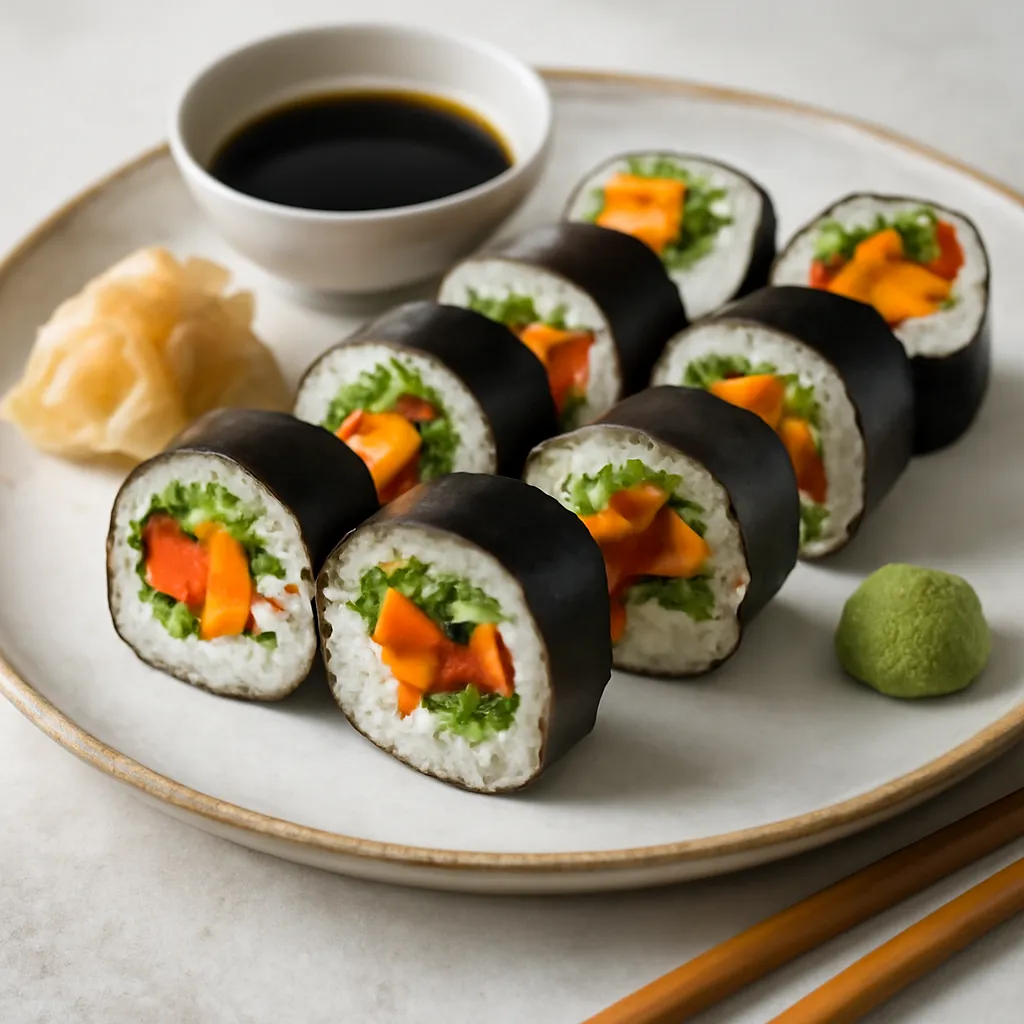
Vegetable sushi

Asian cuisine Vegetarian Dishes Dishes for Special Occasions 90 min Medium 16 wyświetleń ~45.94 PLN - (0)
Rate:
(0)

Description

Vegetable sushi is a light, colorful, and impressive snack originating from Japanese cuisine, prepared without the use of fish or seafood. It consists of sticky rice seasoned with rice vinegar, nori sheets, and fresh vegetables (avocado, cucumber, carrot, bell pepper) along with lightly sautéed tofu as a source of protein. It’s a great option for New Year's Eve 2025 — served on platters, it looks elegant and offers a variety of flavors and textures: creamy avocado, crunchy cucumber and carrot, sweet and sour rice vinegar. It can be served with soy sauce, pickled ginger, and sesame. Vegetable sushi is visually appealing due to its contrasting colors and is easy to adapt for vegetarian and vegan diets.

Składniki (15)

Servings:
4
  • Sushi rice (dry) 300 g
  • Water 450 ml
  • Rice vinegar 60 ml
  • sugar 30 g
  • Nori sheets 8 szt.
  • Avocado 2 szt.
  • Long cucumber (seedless) 1 szt.
  • Carrot 2.5 szt.
  • Red bell pepper 1.1 szt.
  • Smoked tofu 200 g
  • Sesame oil 15 ml
  • 🌿 Przyprawy
  • Salt 6 g
  • ✨ Opcjonalne
  • Soy sauce 60 ml
  • Sesame (seeds) 10 g
  • Marinated ginger (gari) 30 g
💰 Szacowany koszt dania: ~45.94 PLN (11.49 PLN/porcję)

💡 Kliknij na składnik aby oznaczyć jako użyty

Preparation steps

Rice

1

Weigh 300 g of dry sushi rice. Transfer it to a large bowl and cover it with cold water. Stir with your hand (in circular motions) for about 1-2 minutes, until the water becomes slightly cloudy. Drain the water through a fine mesh sieve. Repeat rinsing 4-6 times, until the water is almost clear (this removes excess starch and prevents excessive stickiness).

Ingredients: Sushi rice (dry), Water
Use a fine mesh strainer and a large bowl. The goal is for the rinsing water to be almost clear — this is a sign that the rice is well cleaned.
2

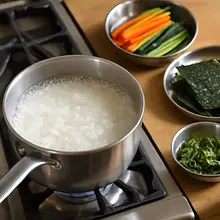
After rinsing, transfer the rice to a heavy-bottomed pot, add 450 ml of water. Let it soak for 30 minutes at room temperature — this is important for even cooking of the grains.

Ingredients: Sushi rice (dry), Water
Use a pot with a tight-fitting lid. Soaking improves the texture of the rice: the grains will absorb water and cook evenly.
3

Bring the pot with rice to a boil over medium-high heat without a lid. Once it starts boiling (large bubbles), immediately reduce the heat to the minimum, cover tightly with a lid, and cook for 12 minutes without lifting the lid. After 12 minutes, remove the pot from the heat and let it sit covered for another 10 minutes (the so-called resting time). Do not stir the rice while cooking.

Ingredients: Sushi rice (dry), Water
Use a small pot with a thick bottom; at the end, leave the rice covered to 'finish cooking'. Do not lift the lid during cooking — you will lose steam and the rice may not cook properly.
4

In the meantime, prepare the vinegar mixture: in a small saucepan, heat 60 ml of rice vinegar with 30 g of sugar and 6 g of salt over low heat, stirring until the sugar and salt completely dissolve (about 1-2 minutes). Do not boil - just heat until the ingredients dissolve. Set aside to cool slightly.

Ingredients: Rice vinegar, sugar, Salt
Use a small saucepan and a wooden spoon. The mixture should be warm and clear, and the sugar dissolved — do not allow it to boil.
5

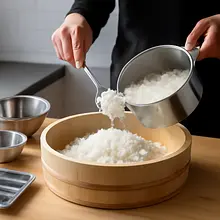
Transfer the hot rice to a wide non-metal bowl (a wooden hangiri bowl or a wide glass bowl). Evenly pour the prepared vinegar mixture over the surface of the rice. Using a wooden spatula (shamoji) or a large wide spoon, gently 'fold' the rice: slide the spatula from the bottom to the top, turning the bowl to avoid crushing the grains — the folding technique keeps the grains separate and shiny. At the same time, fan the rice (with a hand fan or a piece of paper) to cool it down more quickly to a temperature close to room temperature (about 30°C). The rice is ready when it is sticky, shiny, and the grains are separated (not mushy).

Ingredients: Sushi rice (dry), Rice vinegar, sugar, Salt
Use a wooden spatula and a wide bowl. If you don't have a fan, use a piece of paper to fan. The rice should not be hot — cooling it helps to set the shine and texture. This is a key step: properly prepared rice is the foundation of good sushi.

Filling

6

Prepare the vegetables: peel the carrot and cut it into thin sticks (julienne) about 6-8 cm long and 3-4 mm wide. Cut the cucumber in half lengthwise, scoop out the seeds with a spoon, then cut it into sticks of similar length. Clean the bell pepper from the seed pod and cut it into thin strips. Cut the avocado in half, remove the pit, peel it, and slice it into thin slices or long strips. Set all the vegetables aside on a plate.

Ingredients: Carrot, Long cucumber (seedless), Red bell pepper, Avocado
Use a sharp knife and a cutting board. Even strips make rolling easier and provide an aesthetic cross-section when the roll is sliced. If the avocado darkens quickly, drizzle it with a small amount of lemon juice.
7

Cut the tofu into strips about 5-7 mm thick and 6-8 cm long. Heat a pan over medium heat, add 15 g of sesame oil, and fry the tofu strips for 3-4 minutes on each side until lightly browned and golden brown on the outside. Once fried, place on a paper towel to drain excess fat.

Ingredients: Smoked tofu, Sesame oil
Use a non-stick pan with a diameter of 24-28 cm. Fry over medium heat, do not flip too often — allow a golden crust to form. Tofu serves as a source of protein and adds a deeper flavor.

Assembly

8

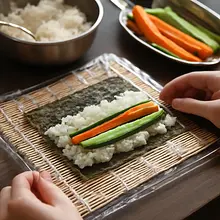
Prepare a bamboo mat (makisu) and optionally a sheet of plastic wrap (to prevent the rice from sticking). Place a sheet of nori on the mat with the shiny side down (the matte side will be on the outside when rolled). Wet your hands with water (with a little rice vinegar to prevent the rice from sticking to your hands). Spread a thin layer of rice on the nori — leave about 2 cm of free edge on the opposite side (this free edge will be used to seal the roll). Use about 60-70 g of rice per sheet (the amount depends on the thickness of the rice). Distribute the rice evenly, without pressing it down too hard.

Ingredients: Nori sheets, Sushi rice (dry)
Use a standard-sized bamboo mat and wrap it in plastic wrap if you're worried about cleaning. The rice should be a thin, even layer — too much rice will make rolling difficult and cause the nori to crack.
9

On the lower third of the spread rice (closer to you), place the vegetable strips: a strip of avocado, cucumber, carrot, bell pepper, and 2-3 strips of sautéed tofu. Don't overdo it with the filling — the roll should be compact but not overflowing.

Ingredients: Avocado, Long cucumber (seedless), Carrot, Red bell pepper, Smoked tofu, Sushi rice (dry)
Leave a free edge of nori (without rice) — this will allow the roll to stick together. Place the filling parallel to the shorter side of the nori sheet.
10

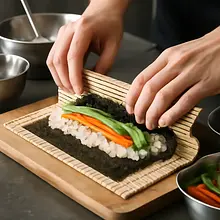
Start rolling the roll: lift the edge of the mat and using the mat, begin to roll the filling, gently pressing the mat to ensure the roll is tight. Roll until the free edge of the nori meets the end of the roll — lightly wet your finger with water and wipe the edge of the nori to 'seal' the roll. If the roll is too loose, unroll and press again.

Ingredients: Nori sheets, Sushi rice (dry), Avocado, Long cucumber (seedless), Carrot, Red bell pepper, Smoked tofu
Use a bamboo mat to achieve even pressure. Do not press too hard (it may push out the filling), but also do not leave it too loose — it should hold its shape.
11

Carefully cut each roll into 6-8 pieces using a sharp knife dipped in warm water before each cut (this prevents the rice from sticking to the blade). Trim the ends of the rolls if they are uneven, so the pieces have a nice, even cross-section.

Ingredients: Nori sheets, Sushi rice (dry)
Use a long, very sharp knife (e.g., a chef's knife) and wipe the blade with a damp cloth after each cut. You can dip the blade in warm water to cut the roll without sticking.

Serving

12

Arrange the sushi pieces on a large platter. Optionally, sprinkle with sesame seeds and serve with pickled ginger and soy sauce in small dipping bowls. Additionally, you can place a small portion of wasabi next to it for those who enjoy spicy condiments.

Ingredients: Sesame (seeds), Marinated ginger (gari), Soy sauce
Use a large platter so the pieces have space and don't stick together. If you're adding sesame, lightly toast it in a dry pan for 1 minute to bring out the flavor (be careful, it burns quickly).
13

Prepare the drinks and serve the sushi immediately or within 1-2 hours. Sushi tastes best fresh — the rice should be slightly warm or at room temperature, and the vegetables crunchy.

Avoid storing sushi in the refrigerator for longer than a few hours, as the rice will lose its proper consistency and become hard after cooling.

Fun Fact

💡

Sushi in Japan originally developed as a way to preserve fish with fermented rice — modern forms of sushi (maki, nigiri) are the result of several hundred years of culinary evolution.

Best for

Tips

🍽️ Serving

Serve sushi on large platters with a bit of pickled ginger, soy sauce, and sesame seeds. For visual effect, arrange the pieces on lettuce leaves or a bamboo mat. Serve with chopsticks or small forks for the convenience of guests.

🥡 Storage

It is best to consume sushi within 1-2 hours after preparation. If you need to store it, place the pieces in an airtight container in the refrigerator for a maximum of 24 hours — however, the rice will lose its proper texture. Reheating in the microwave is NOT recommended — the rice will become rubbery. Instead, you can gently thaw (if frozen) at room temperature.

📸 Ugotowane przez społeczność

Zaloguj się, aby dodać zdjęcie
Dodaj zdjęcie gotowej potrawy

Po zatwierdzeniu przez moderatora otrzymasz 10 punktów doświadczenia.

🍲

Nikt jeszcze nie dodał zdjęcia. Bądź pierwszy!

Comments (0)

Be the first to comment on this recipe!

Add a comment

You might also like

Recipe Categories

Asian cuisine is a variety of flavors from Japan to Thailand - umami, sweet-sour, and spicy. Sushi, ramen, pad thai, pho, and dim sum - iconic dishes from restaurants at home. Wok cooking: stir-fry with vegetables, tofu, and meat in just a few minutes. Asian sauces: soy, fish, oyster, and hoisin ...

See all recipes in this category

Vegetarian cuisine is a wealth of flavors without meat - healthy, colorful, and filling. Plant-based proteins: lentils, chickpeas, beans, peas, and soy take center stage. Cheeses and dairy: feta, halloumi, ricotta, and mascarpone in main dishes. Eggs in various forms: omelets, frittata, shakshuka...

See all recipes in this category

Dishes for special occasions are culinary masterpieces for birthdays, anniversaries, and holidays. Grilled beef steak with herb butter - restaurant quality at home. Beef Wellington - beef in puff pastry with duxelles. Roast duck with apples - a holiday tradition in a new edition. Pink salmon with...

See all recipes in this category
Reklama