Menu

Vanilla-Cinnamon Challah with Crumble

Cakes and Bakes Breakfasts Desserts 180 min Medium 4 wyświetleń ~16.53 PLN - (0)
Rate:
(0)

Description

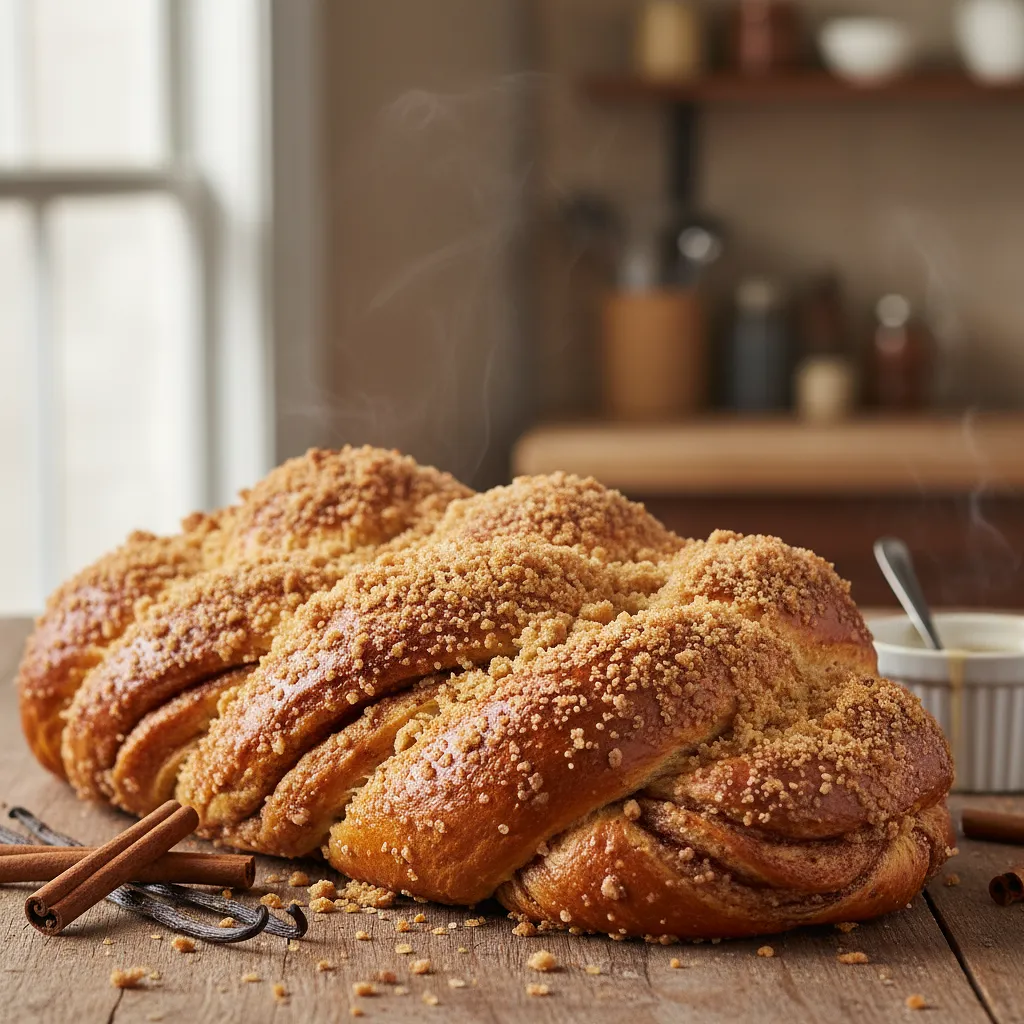
Here is a challah in a completely new, indulgent version. This is not just ordinary yeast bread, but a true culinary poem. Imagine perfectly fluffy, buttery dough, each strand fragrant with real vanilla. Inside, it hides a sweet secret – a swirl of cinnamon filling that creates appetizing twists during baking. The whole is topped with a crunchy, buttery crumble that adds a dessert-like character and a wonderful contrast of textures. This challah is perfect for a lazy weekend breakfast, served warm with a bit of butter or homemade jam. It also works well as an exquisite afternoon snack with a cup of coffee or tea. Its appearance is as impressive as its taste – a golden, intricately braided loaf, sprinkled with crumble, will be a decoration for any table. This is a recipe that will turn your kitchen into the best bakery.

Składniki (11)

Servings:
12
  • Wheat flour type 500 550 g
  • Fresh yeast 25 g
  • Milk 3.2% 200 ml
  • Egg 3 szt.
  • Masło 82% 160 g
  • White sugar 110 g
  • Brown sugar 80 g
  • Vanilla extract 5 g
  • 🌿 Przyprawy
  • Salt 0.2 szczypt
  • Ground cinnamon 4 g
  • ✨ Opcjonalne
  • Almond flakes 30 g
💰 Szacowany koszt dania: ~16.53 PLN (1.38 PLN/porcję)

💡 Kliknij na składnik aby oznaczyć jako użyty

Preparation steps

Yeast starter

1

Start by preparing the starter. In a small saucepan, heat 200 ml of milk. It should be slightly warm, like bath water for a baby (about 37°C). Milk that is too hot will kill the yeast. Crumble 25g of fresh yeast into a large bowl or cup, add 1 tablespoon of sugar (about 15g) from the measured portion, and then pour in the warm milk. Gently mix everything with a fork until the yeast dissolves. Cover with a cloth and set aside in a warm, draft-free place for about 10-15 minutes. The starter is ready when a thick, high foam appears on its surface - this is a sign that the yeast is active and working.

Ingredients: Fresh yeast, Milk 3.2%, White sugar
The best place for the starter to rise is a slightly warmed (up to 30°C) and turned-off oven. If after 15 minutes no foam appears, the yeast is likely inactive and you should start over with a fresh batch.
Cake

2

In a large bowl, sift 500g of wheat flour. Sifting will aerate the flour, making the dough lighter. Add the remaining white sugar (about 65g) and 1 teaspoon of salt (5g). Mix the dry ingredients with a whisk or spoon to distribute them evenly.

Ingredients: Wheat flour type 500, White sugar, Salt
Use a large bowl to have enough space for kneading and rising the dough. Sifting the flour is an important step that shouldn't be skipped – it helps avoid lumps and results in a better dough structure.
3

In a small bowl, beat 2 eggs with a fork. Add the risen starter, the beaten eggs, 80g of melted and slightly cooled butter, and 1 teaspoon (5 ml) of vanilla extract to the dry ingredients. Start mixing the ingredients, initially using a wooden spoon or spatula, until they combine into a loose, sticky mass.

Ingredients: Egg, Masło 82%, Vanilla extract
Make sure that the melted butter is not hot, so it doesn't 'scald' the eggs or harm the yeast. All ingredients should be at a similar room temperature for optimal dough rise.
4

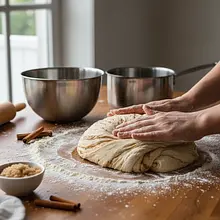
Transfer the dough to a lightly floured surface and start kneading. Knead the dough vigorously for about 10-15 minutes, pushing it away from you with your wrist and folding it in half. Continue until the dough becomes smooth, elastic, and stops sticking to your hands and the surface. The finished dough should slowly return to its shape when pressed with a finger. Alternatively, use a stand mixer with a dough hook and knead on medium speed for 8-10 minutes.

Ingredients: Wheat flour type 500
Do not add too much flour while kneading, even if the dough is sticky at first. Over time, the gluten will develop and the dough will become more cohesive. Too much flour will make the challah hard and dry.
5

Form a ball from the dough. Grease the bowl in which you mixed the ingredients with a thin layer of oil or butter. Place the ball of dough in it and turn it so that it is coated in fat. Cover the bowl with plastic wrap or a clean kitchen towel and set it in a warm place for about 1-1.5 hours, or until the dough has doubled in size.

Greasing the bowl and the dough with fat prevents a dry crust from forming on the surface of the dough during rising. The rising time depends on the ambient temperature – in a warmer place, the dough will rise faster.

Filling and Shaping

6

While the dough is rising, prepare the filling. In a small bowl, place 80g of brown sugar and 2 teaspoons (4g) of cinnamon. Mix well. Also prepare 50g of room temperature butter, it should be very soft so that it can be easily spread.

Ingredients: Brown sugar, Ground cinnamon, Masło 82%
You can adjust the amount of cinnamon to your own preferences. If you like a very intense flavor, add half a teaspoon more. Make sure the butter is really soft, but not melted.
7

Remove the risen dough onto a countertop and gently punch it down to release the gas. Divide the dough into 3 equal parts. It’s best to use a kitchen scale to ensure each portion is identical – this will ensure even baking. Shape each part into a ball and cover with a cloth for 5 minutes to let the dough 'rest'.

Resting the dough after degassing is important. This allows the gluten to relax, making it easier to roll out the dough into thin rectangles without it shrinking.
8

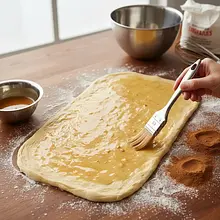
Take one ball of dough and roll it out into a rectangle measuring about 20x30 cm. Spread 1/3 of the softened butter over the surface of the rectangle, leaving about a 1 cm margin along one of the longer sides. Evenly sprinkle 1/3 of the cinnamon mixture. Roll the dough tightly into a log, starting from the longer side without the margin. The margin at the end will 'seal' the log. Repeat the process with the remaining two balls of dough. You will have three cinnamon rolls.

Ingredients: Masło 82%, Brown sugar, Ground cinnamon
Try to roll the roulade as tightly as possible so that many layers of filling are visible in the cross-section. Make sure to seal the end well so that the filling doesn't leak out during baking.
9

Place three rolls next to each other on a countertop lined with baking paper. Join their top ends, pressing them firmly together. Braid them into a classic braid, alternating the outer rolls to the center (right to the center, then left to the center, and so on). Do not braid too tightly, as the challah will rise during baking. Finally, join the bottom ends and tuck them under the challah to give it a nice shape.

If the rolls are too long, you can gently stretch or roll them to even out their length before braiding. Braiding on parchment paper will make it easier to transfer the challah to the baking tray later.

Crumble and Second Rising

10

Prepare the crumble. In a bowl, place 50g of all-purpose flour, 30g of white sugar, and 30g of cold butter cut into small cubes. Use your fingers to rub the ingredients together until they form clumps resembling wet sand. Do not knead for too long to prevent the butter from melting.

Ingredients: Wheat flour type 500, White sugar, Masło 82%
The key to the perfect crumble is using very cold butter. You can also use a pastry cutter or pulse the ingredients in a food processor to avoid warming the butter with your hands.
11

Transfer the challah along with the parchment paper to a large baking tray. Loosely cover it with a clean cloth and set it in a warm place for the second rise for about 30-45 minutes. The challah should noticeably puff up and increase in volume.

The second rise is shorter, but equally important. It makes the structure of the challah even more delicate. You can check if it's ready by gently pressing it with your finger – the indentation should slowly spring back.

Baking

12

At the end of the second rising, preheat the oven to 180°C (fan) or 190°C (top-bottom). In a small bowl, beat the last egg with 1 tablespoon of milk (15 ml) to prepare the glaze (known as egg wash).

Ingredients: Egg, Milk 3.2%
The oven setting depends on its type. Convection ensures more even baking, but it can dry out the dough, so it's worth keeping an eye on the challah. Top-and-bottom baking is more traditional for yeast pastries.
13

When the challah has risen, gently brush the entire surface with the prepared egg mixture using a kitchen brush. Try to reach all the nooks and crannies, but avoid creating puddles of egg. Then generously sprinkle the top with the prepared crumble. Additionally, if using, sprinkle with almond flakes.

Ingredients: Almond flakes
Be very gentle when brushing with egg to avoid destroying the air bubbles in the risen dough. The glaze will give the challah a beautiful, shiny, golden color.
14

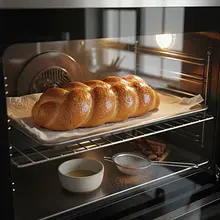
Place the challah in the preheated oven. Bake for about 30-35 minutes. The challah is ready when it has a deep golden-brown color and the crust is nicely browned. To check if it is baked through, you can insert a wooden skewer into the thickest part – it should come out dry. You can also gently tap the bottom of the challah – it should make a hollow sound.

If the top of the challah starts to brown too quickly while the inside is still raw, loosely cover it with a piece of aluminum foil and continue baking. Every oven is different, so keep an eye on the baking time.
15

Remove the baked challah from the oven and carefully transfer it to a metal cooling rack. Leave it to cool completely for at least 1 hour before slicing. Cutting hot challah can cause it to collapse and crush its delicate structure.

Cooling on a rack is key, as it allows air circulation from all sides, preventing the bottom from becoming soggy. Although the aroma is tempting, patience will be rewarded with the perfect texture.

Fun Fact

💡

Traditional Jewish challah is often braided from six strands of dough, which symbolizes the twelve loaves of showbread that were placed in the Temple in Jerusalem – two for each of the twelve tribes of Israel. The braid also symbolizes love, unity, and family.

Best for

Tips

🍽️ Serving

Challah tastes best when it's still slightly warm, on its own or with a bit of butter. It is excellent with homemade jams, honey, or cottage cheese. Stale slices of challah (if there are any left!) can be used to make luxurious French toast or delicious bread pudding.

🥡 Storage

Store the challah at room temperature, tightly wrapped in plastic wrap or in a bread box, for up to 3 days. To refresh it, you can heat slices in a toaster or for a few minutes in an oven preheated to 150°C. The challah can also be frozen – whole or sliced. After thawing at room temperature, it tastes like freshly baked.

📸 Ugotowane przez społeczność

Zaloguj się, aby dodać zdjęcie
Dodaj zdjęcie gotowej potrawy

Po zatwierdzeniu przez moderatora otrzymasz 10 punktów doświadczenia.

🍲

Nikt jeszcze nie dodał zdjęcia. Bądź pierwszy!

Comments (0)

Be the first to comment on this recipe!

Add a comment

You might also like

Recipe Categories

Homemade cakes and pastries are the heart of Polish culinary tradition - sweet memories from childhood. In our collection, you will find recipes for classic yeast cakes, shortcrust, sponge, and cheesecake. Apple pie, poppy seed cake, gingerbread, Easter babka, chocolate cake, and New York cheesec...

See all recipes in this category

Breakfast is the most important meal of the day - energy for a good start and a tasty morning. Scrambled eggs, fried eggs, poached eggs, and omelets - protein classics. Oatmeal with fruits, nuts, and honey - a healthy and filling fit breakfast. American pancakes and French crepes - a sweet start ...

See all recipes in this category
Desserts
Desserts in: New Year's Eve

A sweet ending to the New Year's Eve dinner is a must-have that will put everyone in a joyful mood for the new year.

See all recipes in this category
Reklama