
Menu

Meat Pies

Pikantne Christmas Eve Dinner Snacks 120 min Medium 17 wyświetleń ~24.25 PLN - (0)
Rate:
(0)

Description

Traditional meat pastries are yeast-based, small baked goods filled with a juicy filling of minced meat, onion, and spices. In this version, we will prepare a fluffy yeast dough and a classic pork and beef filling with marjoram — perfect as a snack for Christmas Eve, served both warm and cold. The pastries have a golden, crispy crust and a soft, fluffy interior; visually, they present as even rectangles or triangles, slightly shiny after being brushed with egg, optionally sprinkled with sesame seeds. They are hearty, easy to portion, and work great as an appetizer for borscht or as a warm snack during family gatherings.

Składniki (16)

Servings:
20
  • Wheat flour 500 g
  • Milk 250 ml
  • Fresh yeast 25 g
  • sugar 10 g
  • Butter 80 g
  • Egg 3 szt.
  • Ground meat (pork and beef) 500 g
  • Onion 1 szt.
  • Garlic 2 ząbki
  • Breadcrumbs 50 g
  • Rapeseed oil 15 g
  • 🌿 Przyprawy
  • Salt 12 g
  • Black pepper 4 szczypty
  • Dried marjoram 1 łyżeczka
  • ✨ Opcjonalne
  • Sesame 10 g
  • Parsley 1 pęczek
💰 Szacowany koszt dania: ~24.25 PLN (1.21 PLN/porcję)

💡 Kliknij na składnik aby oznaczyć jako użyty

Preparation steps

Cake

1

Prepare the starter: heat the milk to a temperature of 35-37°C (it should be pleasantly warm, check with your wrist). In a small bowl, crumble the fresh yeast, add sugar, and pour in 60 ml of the warmed milk (you will use the rest of the milk later). Mix only the center part with a fork until the yeast dissolves. Set aside in a warm place for 8–10 minutes — a frothy, white "cap" should appear on the surface, indicating that the yeast is active.

Ingredients: Milk, Fresh yeast, sugar
Use a small glass bowl. If after 10 minutes the yeast mixture is not frothy, the yeast may be inactive — start over with fresh yeast. Do not pour hot milk over the yeast (>45°C).
2

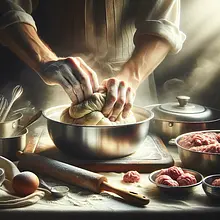
Pour the flour into a large bowl and mix with 2 g of salt (from the total amount of salt). Make a well in the flour. Pour the active starter into the well along with the remaining warm milk (190 ml), add one egg (60 g) and melted, cooled butter (about 60 g from the total amount). Start mixing with a wooden spoon from the center, combining the flour with the liquids until a loose dough forms. Then transfer to a floured surface and knead by hand for 8–10 minutes until the dough is smooth, elastic, and no longer sticky to your hands. Alternatively, use a mixer with a dough hook for 6–7 minutes on medium speed.

Ingredients: Wheat flour, Salt, Milk, Egg, Butter, Fresh yeast
Use a large bowl and a wooden spoon for mixing, and kitchen gloves or a mixer with a hook for kneading. If the dough is too sticky, add 1 tablespoon (15 g) of flour at a time and continue kneading; do not add too much flour — the dough should be soft. Do not knead for more than 10 minutes by hand to avoid overheating the dough.
3

Transfer the kneaded dough to a lightly oiled bowl, cover it with a cloth or plastic wrap, and set it in a warm place for 50–60 minutes. The dough should double in volume — you can check this by gently pressing it with your finger: the indentation should partially spring back, but not completely (this is a sign that it has risen well).

Ingredients: Wheat flour, Egg, Butter, Milk, Fresh yeast
The best place for rising is a turned-off oven with the light on or a warm spot in the kitchen. Do not exceed the rising time — too long of a rise can weaken the structure of the dough.

Filling

4

Prepare the vegetables: peel the onion and finely chop it (about 150 g). Peel the garlic and finely chop it or press it through a garlic press (2 cloves = 10 g).

Ingredients: Onion, Garlic
Use a sharp knife and a cutting board. The chopped onion should be uniform so that it caramelizes evenly while frying.
5

In a pan, heat rapeseed oil (1 tablespoon = 15 g) over medium heat. Add the chopped onion and sauté for 6–8 minutes, stirring occasionally, until the onion becomes soft and slightly golden (translucent and aromatic). Add the garlic and sauté for 30–60 seconds, being careful not to burn it. Add the ground meat (500 g) and break it apart with a wooden spoon, cooking for 8–10 minutes until the meat changes color completely — there should be no visible pink parts. Season the filling with 8 g of salt (remaining from the salt allowance), 2 g of pepper, and marjoram (2 g). Finally, add the breadcrumbs (50 g) and a raw egg (60 g) to bind the mixture, stir, and cook for 1–2 minutes. If the filling is too greasy, drain the excess fat. Transfer the filling to a bowl and let it cool to room temperature (about 20–30 minutes).

Ingredients: Rapeseed oil, Onion, Garlic, Ground meat (pork and beef), Salt, Black pepper, Dried marjoram, Breadcrumbs, Egg
Use a medium frying pan (diameter 24–26 cm). If the filling has a noticeable raw meat taste, cook it longer until it is completely done. The filling should be cool before shaping so that the dough doesn't become too soft and the pastries stick together nicely.

Shaping and baking

6

Prepare a baking tray lined with parchment paper (preferably 2 large trays or bake in batches). Gently deflate the risen dough — tap it lightly with your fist or roll it out with your hand, then transfer it to a lightly floured surface. Roll out the dough with a rolling pin into a rectangle about 4–5 mm thick (approximately 30×40 cm for one batch). Cut the dough into rectangles measuring about 6×8 cm — from this amount, you will get about 20 pastries (depending on thickness and shape). For each piece, place a tablespoon (about 20–25 g) of the cool filling.

Ingredients: Wheat flour, Ground meat (pork and beef)
Use a rolling pin and a ruler or knife for even cutting. If the dough sticks to the rolling pin, lightly dust it with flour. Try not to add too much filling — excess can make sealing the edges difficult.
7

Seal the pastries: fold the rectangle of dough in half over the filling (if making triangles, fold the corners), press the edges with your fingers, and then crimp with a fork to create a nice sealed edge. Arrange the pastries on a baking sheet with about 2 cm of space between them to allow for expansion. Beat the remaining egg and brush the top of each pastry with it — this will give them a nice shine. If you like, sprinkle some with sesame seeds (optional).

Ingredients: Egg, Sesame
Use a metal rack for placement or parchment paper. It's best to use a silicone brush for egg washing. If you don't have a brush, gently use a teaspoon, but even coverage is more difficult then.
8

Let the pastries rest and rise slightly on the baking sheet for 20–25 minutes in a warm place. In the meantime, preheat the oven to 200°C (top-bottom, without fan).

If the oven heats unevenly, swap the trays halfway through baking. A shorter second rise (20-25 min) will make the pastries fluffier after baking.
9

Place the pastries in the preheated oven and bake for 15–20 minutes at 200°C, until the surface is golden and crispy. Rotate the tray halfway through baking to ensure even browning. The pastries are ready when the crust is golden-brown and the bottom is not raw — you can gently press the top; it should be springy.

Ingredients: Egg, Sesame
Use the convection setting only if your oven usually bakes unevenly, but the top-and-bottom setting gives a better crust. If the top browns too quickly, loosely cover it with aluminum foil.

Finishing

10

Remove the pastries from the oven and set them on a rack to cool for 5–10 minutes. Serve slightly warm or at room temperature. For serving on Christmas Eve, prepare a bowl of red borscht — the pastries can be dipped into a spoonful of borscht or served alongside as a snack.

Ingredients: Parsley
Use a cooling rack to prevent the bottoms of the pastries from steaming and to keep them crispy. If the pastries are left warm, their crust may soften — for crispness, cool them completely on the rack.

Fun Fact

💡

Patties have roots in the European tradition of baked goods with fillings; in Poland, they are often served as a snack with borscht. In festive versions, they are sometimes filled with mushrooms or cabbage, but meat patties are popular as a hearty snack at family tables.

Best for

Tips

🍽️ Serving

Serve the pastries on a platter lined with baking paper, alongside a small bowl of hot red borscht. For a change, you can serve them with mustard-honey sauce or horseradish. Sprinkle fresh parsley just before serving for color and freshness.

🥡 Storage

Storage: in the fridge, the pastries will stay fresh for 2–3 days in an airtight container. Freezing: raw shaped, unbaked pastries can be frozen on a tray, and after freezing, transferred to a bag — bake from frozen, extending the baking time by 5–8 minutes. Reheating: an oven at 170°C for 8–10 minutes will restore crispiness; avoid the microwave, as the crust will soften.

📸 Ugotowane przez społeczność

Zaloguj się, aby dodać zdjęcie
Dodaj zdjęcie gotowej potrawy

Po zatwierdzeniu przez moderatora otrzymasz 10 punktów doświadczenia.

🍲

Nikt jeszcze nie dodał zdjęcia. Bądź pierwszy!

Comments (0)

Be the first to comment on this recipe!

Add a comment

You might also like

Recipe Categories

Christmas Eve is the most important evening of the year - a time for tradition, family, and special dishes. Our collection of Christmas Eve recipes includes all 12 traditional dishes: from red borscht with dumplings to poppy seed cake and kutia. Recipes for carp in various versions: fried, baked,...

See all recipes in this category
Snacks
Snacks in: Christmas Eve Dinner

Snacks are small pleasures between meals - savory, sweet, and always delicious. Vegetable chips, seasoned popcorn, and roasted nuts - healthy alternatives. Dips and spreads: hummus, guacamole, tzatziki, and baba ghanoush with vegetables. Skewers, canapés, and finger sandwiches for a party - elega...

See all recipes in this category
Reklama