Sift 500 g of flour into a large, deep bowl (at least 3 l). Make a well in the flour — a 'nest'. In a separate bowl, crack an egg and beat it with a fork.
Description
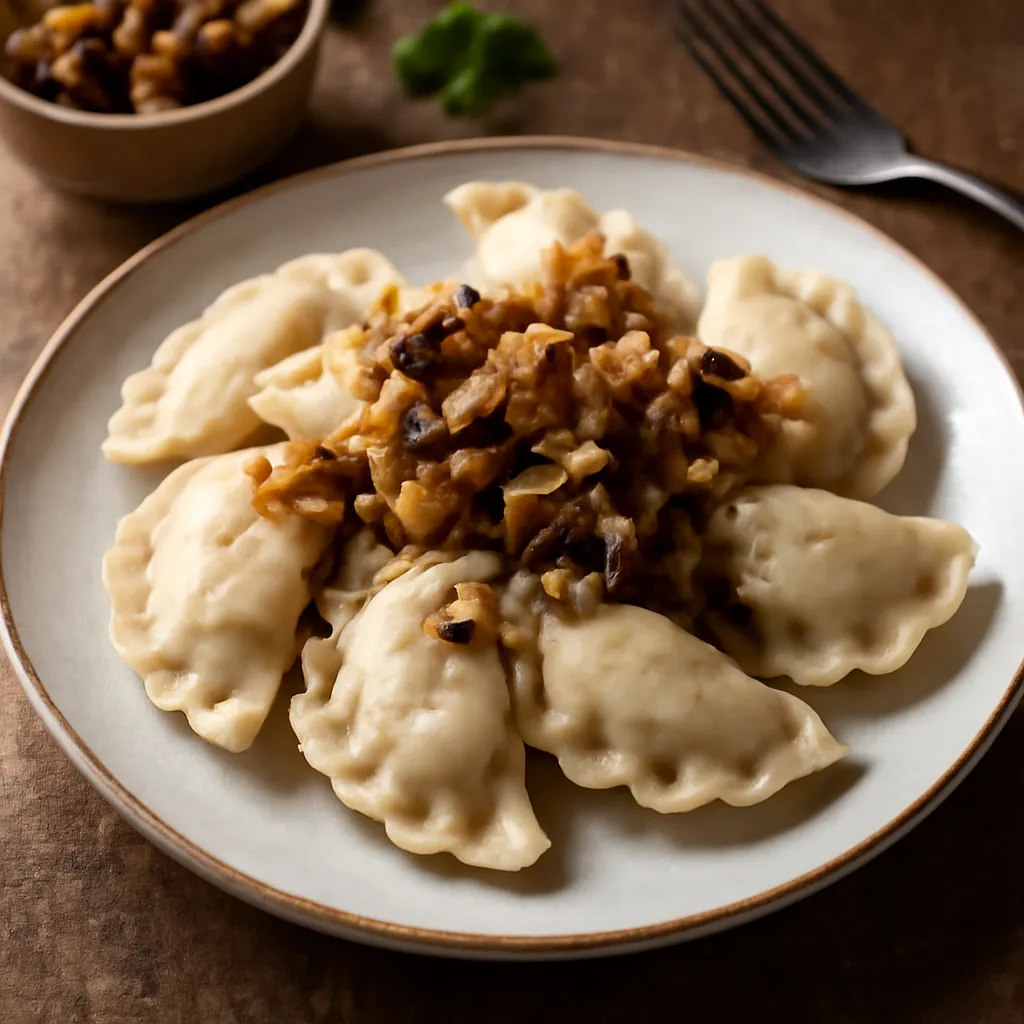
Traditional dumplings with sauerkraut and dried mushrooms are a classic Polish Christmas dish — aromatic, hearty, and full of contrasting flavors: the sour cabbage combines with the earthy, intense taste of mushrooms. Served hot, either on their own or sautéed in butter, they look rustic and festive: the golden edges of the dumplings, slightly glistening from the butter, on a plate with a dollop of sour cream. The recipe is tailored step by step for beginners — it includes detailed instructions on kneading the dough, preparing the filling (including soaking the dried mushrooms), shaping the dumplings, and cooking and optionally sautéing them.
Składniki (13)
- Wheat flour 500 g
- Egg 1 szt.
- Water 200 ml
- Rapeseed oil 15 g
- Dried mushrooms (e.g. porcini) 30 g
- Sauerkraut 600 g
- Onion 1 szt.
- Garlic 2 ząbki
- sugar 10 g
- 🌿 Przyprawy
- Salt 8 g
- Black pepper 4 szczypty
- ✨ Opcjonalne
- Butter (optional, for sautéing) 50 g
- 18% cream (optional, for serving) 200 g
💡 Kliknij na składnik aby oznaczyć jako użyty
Preparation steps
Cake
Into the 'nest', pour 200 ml of warm water (35–40°C), add 15 g of rapeseed oil and 4 g of salt (from the total of 8 g). Pour the beaten egg into the center. Using a fork, mix the central part first — gradually scoop flour from the edges until a sticky mass forms.
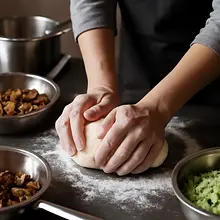
Place the dough on a lightly floured countertop. Knead by hand for 8–10 minutes: keeping your hands together, press and fold the dough, stretch and fold. The dough is ready when it is smooth, elastic, and no longer sticks strongly to your hands.
Form a ball from the dough, lightly dust it with flour, and cover it with a clean cloth or plastic wrap. Set it aside for 30 minutes at room temperature — this will allow the gluten to relax and make rolling easier.
Filling
Prepare the dried mushrooms: transfer 30 g of dried mushrooms to a bowl and pour 250 ml of hot (not boiling) water over them. Let them sit for 30 minutes to rehydrate. After soaking, drain the mushrooms, reserving the soaking water (filter through a sieve lined with cheesecloth). Chop the mushrooms into small cubes.
Chop 150 g of onion into small cubes. Peel and finely chop 10 g of garlic (2 cloves). Heat a pan (preferably 26–28 cm in diameter) with 15 g of oil or 25 g of butter (if using butter — optional). Sauté the onion for 4–5 minutes over medium heat until it becomes translucent and slightly golden.
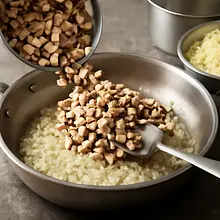
To the sautéed onions, add the chopped mushrooms and fry for 4–5 minutes until most of the water evaporates. Add 600 g of chopped sauerkraut (if it is very sour — briefly rinse and squeeze out thoroughly), 10 g of sugar, the remaining 4 g of salt (carefully), and 2 g of pepper. Pour in 2–3 tablespoons (30–45 ml) of filtered water from soaking the mushrooms, cover, and simmer on low heat for 20–25 minutes, stirring occasionally, until the excess liquid evaporates and the filling becomes compact.
After cooking, remove the filling from the heat and let it cool completely. When it is still warm, taste it and adjust with salt or sugar if necessary — the filling should be aromatic but not too moist (it should be scoopable with a teaspoon and not runny).
Assembling and shaping
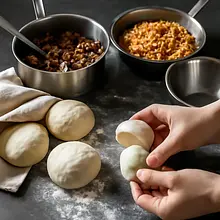
Divide the rested dough into 4 equal parts. Take one part, cover the remaining ones with a cloth to prevent them from drying out. On a floured countertop, roll out the piece of dough to a thickness of about 1.5–2 mm. Cut out circles using a glass or a cutter with a diameter of 7–8 cm.
Place 18–22 g (about 1 full tablespoon) of cooled filling in the center of each circle. Fold the circle in half so that the edges meet. Pinch the edges with your fingers, then seal the edge thoroughly by wetting it with a finger dipped in water (optional) and press with the tines of a fork or crimp the edges to create a ruffled effect.
Cooking and serving
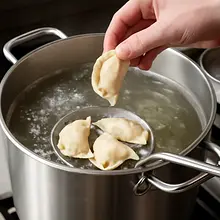
Bring a large amount of water to a boil in a pot (at least 3–4 l). Add 10 g of salt to the water. Place the pierogi in batches (8–12 pieces, depending on the size of the pot), gently stirring with a wooden spoon right after adding them to prevent sticking to the bottom. Cook for an additional 2–3 minutes from the moment the pierogi float to the surface — they should be soft and elastic.
Remove the cooked dumplings with a slotted spoon onto a plate or into a bowl lined with a cloth to drain excess water. If you want to sauté them: heat 25 g of butter or 1 tablespoon of oil in a pan and fry the dumplings in batches for 2–3 minutes on each side until golden and slightly crispy.
Serve the dumplings hot: you can place a few dumplings on a plate, drizzle with melted butter or serve with 18% sour cream on the side. Decoration: freshly ground pepper and a piece of melted butter on top.
Fun Fact
Pierogi have a long history in Poland and are one of the symbols of Christmas. Traditionally, many types of pierogi are prepared for Christmas Eve — those with cabbage and mushrooms are one of the most important and oldest fillings.
Best for
Tips
Serve the dumplings hot, right after cooking or after a brief sauté in butter. Serve with sour cream in a bowl on the side and with caramelized onions. On the festive table, place them on a large platter with a green garnish (parsley) to create a color contrast.
Raw, shaped dumplings can be placed on a tray lined with baking paper and frozen in a single layer. After freezing, transfer to bags and store for up to 3 months. Cooked dumplings can be stored in the refrigerator for up to 2 days. For reheating: boiled — drop frozen directly into boiling water and cook for 4–6 minutes after they float; pan-fried — briefly thaw and fry in butter until golden.
📸 Ugotowane przez społeczność
Zaloguj się, aby dodać zdjęcieDodaj zdjęcie gotowej potrawy
Po zatwierdzeniu przez moderatora otrzymasz 10 punktów doświadczenia.
Nikt jeszcze nie dodał zdjęcia. Bądź pierwszy!
Comments (0)
Be the first to comment on this recipe!
Add a comment