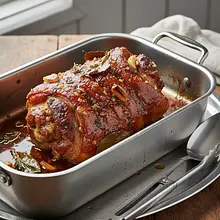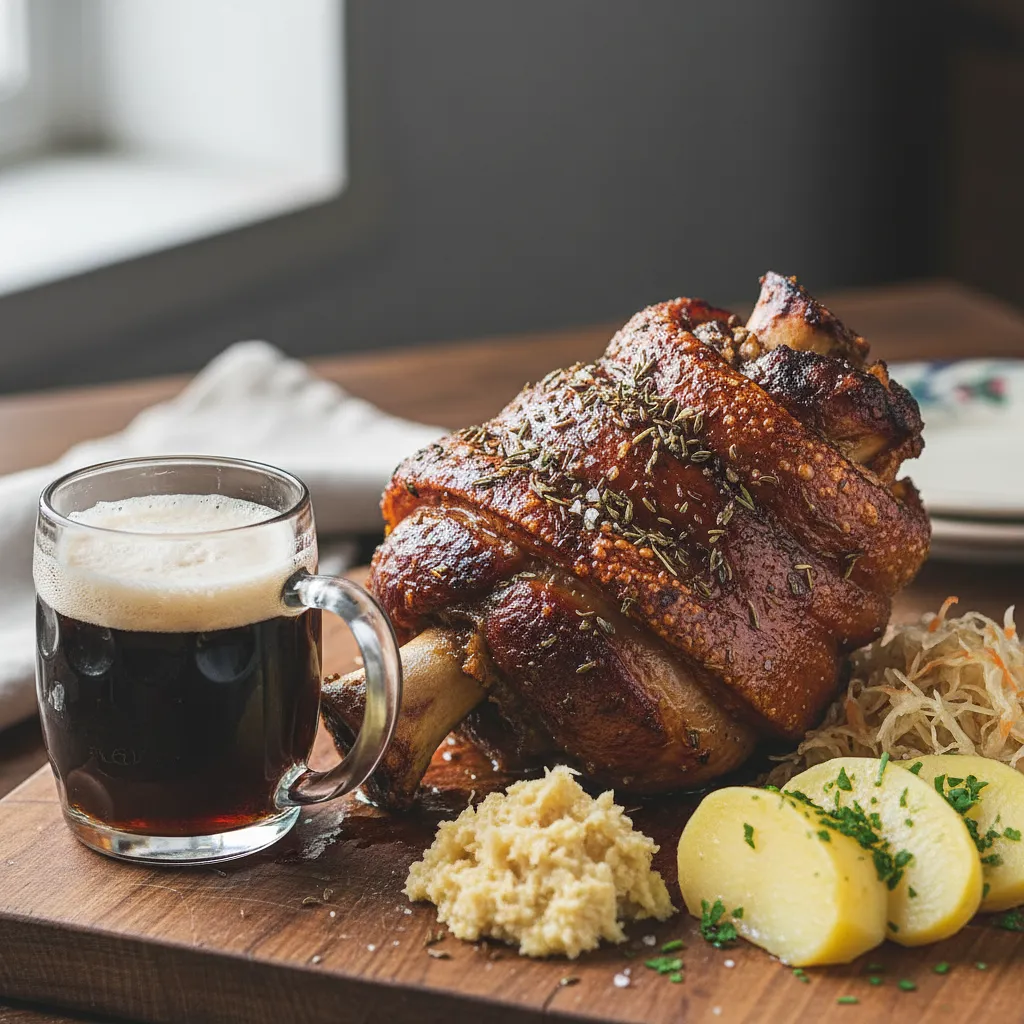
Pork knuckle roasted in beer is the quintessence of Czech festive cuisine, a dish that is both spectacular and incredibly hearty. It is a hefty rear pork knuckle, marinated in garlic and caraway, slowly cooked in an aromatic vegetable broth with dark beer, and then roasted to perfection. The key to success is achieving the perfect contrast of textures: an incredibly crispy, almost crackling skin that breaks under the pressure of a knife, and mind-blowingly tender, juicy meat that falls off the bone. The flavor is deep, rich, and complex – the sweetness of caramelized beer and honey balances the saltiness of the meat and the earthy notes of caraway. Traditionally, it is served whole, often with a knife stuck in the top, on a wooden board alongside sharp mustard, freshly grated horseradish, and pickles. This dish is made for sharing and celebrating, perfect for chilly evenings in the company of friends and a mug of excellent Czech beer.
Thoroughly wash the pork knuckle under cold running water, then dry it with a paper towel. Use a very sharp knife to score the skin and fat in a diamond pattern, creating diamonds about 2-3 cm on each side. Cut deep, but try not to cut into the meat underneath. This step is crucial for the fat to render and the skin to become perfectly crispy.
Ingredients:
Pork hind shank
For scoring the skin, it's best to use a new utility knife (commonly known as a 'tapeciak') or a very sharp small knife. A dull knife will slip on the skin, which is dangerous and won't yield good results.
2
Peel 6 cloves of garlic and crush them using a garlic press or chop them very finely. In a small bowl, mix the crushed garlic with 25g (about 2 generous tablespoons) of coarse salt and 1 tablespoon (8g) of whole cumin seeds. Rub the resulting paste thoroughly over the entire pork knuckle, pressing the spices into the cuts in the skin. Place the pork knuckle in a dish (e.g., glass or ceramic), cover it with plastic wrap, and refrigerate for at least 12 hours, preferably for a full day.
Ingredients:
Pork hind shank, Garlic, Coarse rock salt, Whole caraway seeds
Long marinating is the secret to deep meat flavor. Don't skip this step! If you don't have a garlic press, you can crush the cloves with the flat side of a knife and then finely chop them.
Pre-cooking
3
Take the marinated pork knuckle out of the fridge about 30 minutes before cooking to bring it to room temperature. In the meantime, prepare the vegetables: peel the onions and carrots, then cut them into large pieces (e.g., quarters). Peel the remaining 4 cloves of garlic and lightly crush them with the flat side of a knife.
Ingredients:
Onion, Carrot, Garlic
You don't need to chop the vegetables very finely, as they will cook for a long time. Their purpose is to impart flavor to the broth.
4
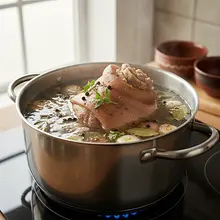
Place the pork knuckle in a large, deep pot (minimum 8 liters). Add the chopped vegetables, crushed garlic, peppercorns, allspice, bay leaves, the remaining tablespoon of caraway seeds (8g), and the remaining 10g of salt. Pour in 500 ml of dark beer and add enough cold water to completely cover the pork knuckle.
Ingredients:
Pork hind shank, Onion, Carrot, Garlic, Pieprz czarny w ziarnach, Allspice, Bay leaf, Whole caraway seeds, Coarse rock salt, Dark lager beer (e.g. Kozel Černý), Water
Use a pot in which the pork knuckle will lie freely, but not have too much space on the sides. This way, the broth will be more concentrated.
5
Place a pot over high heat and bring to a boil. When the water starts to boil, reduce the heat to the minimum so that the liquid just gently 'bubbles' (light, slow simmer). Cover the pot and cook the pork knuckle for about 1.5 to 2 hours. After this time, the meat should be tender when pierced with a fork, but still hold onto the bone.
During cooking, foam (known as scum) may form on the surface. You can skim it off with a slotted spoon to make the broth clearer. It is crucial to cook very slowly - a vigorous boil will make the meat tough.
Baking and glazing
6
Preheat the oven to 180°C (fan) or 190°C (top-bottom). Carefully remove the cooked pork knuckle from the broth and transfer it to a baking dish or a baking tray. Do not discard the broth! Strain about 500 ml of the liquid into a separate container - it will be needed for basting and making the glaze.
Use two large spoons or tongs and a spatula to safely transfer the hot and heavy pork knuckle. The remaining broth is a fantastic base for goulash soup or cabbage soup - you can freeze it.
7
Pour about 250 ml of drained broth into the bottom of the dish with the pork knuckle. Place the pork knuckle in the preheated oven and bake for 60 minutes. Every 20 minutes, open the oven and use a large spoon to baste the pork knuckle with the liquid from the bottom of the dish. This will prevent the meat from drying out.
Be careful when pouring, as the steam from the oven will be hot. Use an oven mitt. If the liquid at the bottom of the dish evaporates too much, add a little of the remaining broth.
8
At the end of the first hour of baking, prepare the glaze. In a small bowl, place the honey and mustard. Pour in 250 ml of dark beer. Using a small whisk or fork, mix everything vigorously until you achieve a smooth, uniform emulsion.
Ingredients:
wildflower honey, Hot mustard (e.g. Dijon), Dark lager beer (e.g. Kozel Černý)
If the honey is crystallized, you can gently heat it for 10-15 seconds in the microwave to make it liquid and easier to mix.
9
After 60 minutes of baking, remove the pork knuckle from the oven. Increase the temperature to 210°C (fan) or 220°C (top-bottom). Using a kitchen brush, generously coat the entire surface of the pork knuckle with the prepared beer-honey glaze. Place it back in the hot oven.
A silicone brush is perfect for this task because it's easy to clean. Make sure the glaze covers all the nooks and crannies in the scored skin.
10
Bake for another 20-30 minutes, until the glaze caramelizes beautifully and the skin becomes dark golden, shiny, and very crispy. Halfway through this time (after about 10-15 minutes), you can brush the pork knuckle with the remaining glaze. Watch the pork knuckle closely towards the end of baking, as the honey in the glaze can burn quickly.
The ideal moment to take the pork knuckle out is when the skin looks like a crispy shell and small bubbles of fat are sizzling on its surface. If it starts to brown too quickly, you can loosely cover the top with a piece of aluminum foil.
Serving
11
Remove the roasted pork knuckle from the oven and carefully transfer it to a large cutting board or platter. Let it rest for 10-15 minutes. This time will allow the juices inside the meat to redistribute evenly, making it even juicier. Serve whole, accompanied by bowls of spicy mustard, freshly grated horseradish, and pickles. Optionally, serve with thick slices of sourdough bread.
Ingredients:
Grated horseradish, Sourdough bread
For a spectacular effect, like in a Czech tavern, you can insert a large, sharp knife into the top of the knuckle just before serving.
Fun Fact
💡
In traditional Czech pubs and restaurants (hospodas), Vepřové koleno is often a flagship dish, ordered by weight. The waiter brings several raw knuckles to the table, and guests choose the one they want to eat, which is then prepared for them. It is a symbol of hospitality and abundance.
It looks best served whole on a large, rustic board. Next to it, arrange small bowls with accompaniments: spicy mustard (e.g. Sarepska or Dijon), freshly grated horseradish, and pickled cucumbers or gherkins. An ideal complement would be a basket of thick slices of sourdough country bread. The dish pairs perfectly with the same dark beer used for cooking, or with a classic Czech pilsner, whose bitterness will beautifully balance the richness of the meat.
🥡Storage
If there are leftovers, separate the meat from the bones and skin. Store it in an airtight container in the fridge for up to 3 days. The meat can be used cold for sandwiches (especially with horseradish and mustard) or reheated. It’s best to reheat portions of meat in a pan with a bit of lard or in the oven to preserve its flavor and juiciness. The crispy skin is best reheated in a hot oven (about 200°C) for a few minutes to regain its crunchiness.
Czech cuisine is a treasure trove of Central European flavors - hearty, aromatic, and full of tradition. Discover classic Czech dumplings - steamed, bread, or potato, served with sauces and braised meat. Svíčková na smetaně, vepřo-knedlo-zelo, smažený sýr, or trdelník are just some of the iconic ...
Dishes for special occasions are culinary masterpieces for birthdays, anniversaries, and holidays. Grilled beef steak with herb butter - restaurant quality at home. Beef Wellington - beef in puff pastry with duxelles. Roast duck with apples - a holiday tradition in a new edition. Pink salmon with...
Lunches are the main meal of the day - filling, balanced, and full of flavor. Traditional two-course lunches: soup and a main dish in Polish tradition. Pork chop with potatoes and cabbage - a classic of Polish lunches. Dumplings with meat, cheese, and fruit - hand-formed delicacies. Beef goulash,...
Comments (0)
Be the first to comment on this recipe!
Add a comment