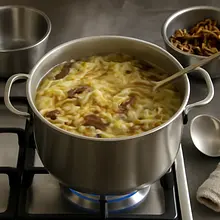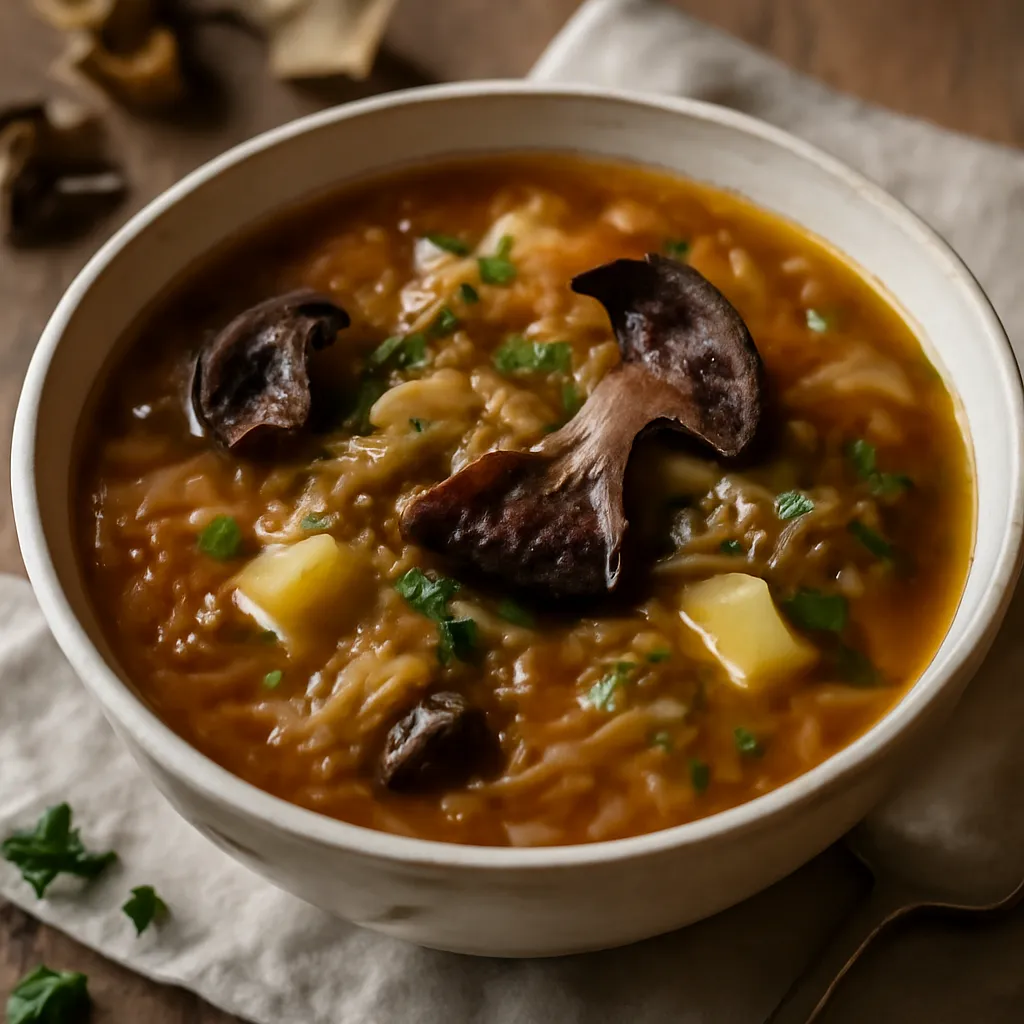

Cabbage soup with dried mushrooms is a traditional, aromatic soup with a distinct, slightly sour taste of sauerkraut, enriched with the depth of flavor from dried mushrooms. It is a dish that perfectly fits into Polish holiday traditions — it is a great addition to the Christmas Eve table, as it combines the simplicity of ingredients with a richness of aromas. The soup has a pleasant, slightly essence-like consistency; served with chopped parsley, it looks appetizing and festive. Cabbage soup can be served with a piece of homemade bread or small dumplings; it also tastes great with the addition of boiled potatoes (optional version). The visual appeal is a golden-amber broth with pieces of cabbage and darker slices of mushrooms, sprinkled with green parsley.
Measure 30 g of dried mushrooms and transfer them to a bowl. Pour 300 ml of hot, boiled water (about half the amount specified in the recipe) so that the mushrooms are completely covered. Leave to soak for 30–40 minutes at room temperature. Occasionally (e.g., after 10–15 minutes) gently stir with a fork to expose the covered parts and even out the hydration process.
Ingredients:
Dried mushrooms (mix of porcini and boletus), Water
Use a glass or ceramic bowl. If the water becomes very dark and has a lot of sand, you can strain it through a sieve into another bowl to separate the sand. The soaked mushrooms should be soft, flexible, and enlarged — if they are hard, give them an additional 10–20 minutes.
2
After the time has passed, drain the mushrooms in a fine sieve over a bowl, keeping the water in which they soaked — this will be an intense aromatic broth. Check the mushrooms for sand; if there is a lot, rinse them briefly under running water and drain again. Slice the mushrooms or cut them into smaller pieces about 3–7 mm wide (depending on the size of the mushrooms).
Ingredients:
Dried mushrooms (mix of porcini and boletus), Water
For draining, use a fine sieve or a cheesecloth-lined sieve. The soaking water contains a lot of flavor — use it as part of the broth (just make sure to collect any sand that may have settled).
Preparing the vegetables
3
Prepare the vegetables: peel and finely chop 300 g of onion (dice about 3–5 mm), peel 200 g of carrot and grate it on a coarse grater or cut it into half-moons, peel 100 g of parsley root and 80 g of celery and cut into small cubes. Also, finely chop 2 cloves of garlic or press them through a garlic press.
Use a cutting board and a sharp chef's knife. If you don't feel confident chopping finely, you can cut slightly larger pieces — they will take longer to stew. For grating the carrot, use a grater with large holes to keep the color and texture visible.
Preparing the cabbage
4
If the cabbage is very sour, quickly rinse it in a colander under cold water (for a short time — 10–20 seconds), then squeeze it well in your hands or by pressing it in the colander. Chop the cabbage with a knife into pieces 1–2 cm wide. If there are large fibers in the cabbage, you can chop them a bit.
Ingredients:
Sauerkraut
Do not rinse the cabbage if you prefer a pronounced sourness — rinsing reduces the intensity of the flavor. Use gloves or a glass bowl and a spoon to squeeze out the excess juice from the cabbage.
Sautéing
5
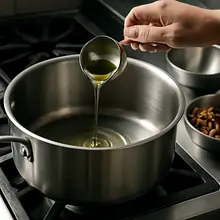
In a large pot with a capacity of at least 4–5 liters, heat 15 g of rapeseed oil over medium heat. Add 30 g of butter and let it melt. Add the chopped onion and sauté for 4–6 minutes, stirring with a wooden spoon, until the onion becomes translucent and slightly golden (do not let it burn). Add the grated carrot, parsley, and celery, along with the garlic, and sauté for another 3–4 minutes, until the vegetables are slightly softened and release their aroma.
Use a large, heavy pot with a thick bottom (preferably enameled or stainless steel) — it distributes heat evenly. When sautéing, stir frequently to prevent the vegetables from burning. If the vegetables start to brown too quickly, reduce the heat.
Adding mushrooms and cabbage
6
Add the chopped, soaked mushrooms and the chopped sauerkraut to the pot. Pour in the reserved soaking liquid from the mushrooms (carefully, as it may contain sediment — if it is very dirty, strain it through cheesecloth). Add the remaining water so that everything is well covered, usually about 1200 ml. Stir all the ingredients with a wooden spoon to distribute them evenly.
Ingredients:
Dried mushrooms (mix of porcini and boletus), Sauerkraut, Water
If you are using very sour cabbage, remember that adding water and a strong broth will mellow the flavor. Make sure that the liquid from the mushrooms is separated from the sediment — if there is a lot of sand, it is worth using a cheesecloth filter.
Cooking the soup
7
Bring the soup to a boil over medium-high heat. Once it starts boiling, reduce the heat to low — it should maintain a gentle, even simmer (small bubbles), not a vigorous boil. Add 2 bay leaves and 3 allspice berries. Cook covered for 50 minutes, stirring every 10–15 minutes to prevent the ingredients from sticking to the bottom.
Ingredients:
Bay leaf, Allspice
Use a pot lid; if you don't cover the pot, the soup will reduce faster and you may lose some liquid. After 30 minutes, check the tenderness of the mushrooms and cabbage — the mushrooms should be soft and aromatic.
Seasoning
8
After 50 minutes, turn off the heat and remove the bay leaves and allspice (they can be easily found and removed with a spoon). Season the soup with 6 g of salt, 2 g of pepper, and 10 g of sugar. Add 4 g of dried marjoram and optionally 30 g of tomato paste (if you want a lighter color and milder sweetness). Mix thoroughly and bring to a boil again for 5–8 minutes on low heat to let the spices harmonize.
Ingredients:
Salt, Ground black pepper, sugar, Dried marjoram, Tomato paste
Add salt gradually: it's better to add a little less at the beginning and adjust the taste at the end. Tomato paste mixes well if you first dissolve it in a small amount of hot soup and then add the rest.
(Optional) Adding potatoes
9
If you want a heartier version, peel and dice 300 g of potatoes into about 1.5–2 cm cubes. Add the raw potatoes to the boiling soup about 20–25 minutes before the end of cooking (if you added potatoes, reduce the initial cooking time to about 30 minutes, then add the potatoes and cook for another 20–25 minutes). The potatoes are ready when they can be easily pierced with a knife or fork.
Ingredients:
Potatoes
Use the knife blade to check the softness of the potato — it should be easy to pierce but not fall apart into mush. If you are cooking the potatoes separately, drain them and add to the soup without water.
Flavor and texture enhancement
10
Taste the soup and adjust the seasoning: if the soup is too sour, you can add another 2–5 g of sugar; if it's not intense enough, add a pinch of salt and a bit of pepper. If you want a thicker consistency, remove some of the cabbage and blend it until smooth, then pour it back into the pot (blend in batches, being careful of the steam).
Ingredients:
sugar, Salt, Ground black pepper
When blending, use an immersion blender and keep it deep in the pot to avoid splattering hot soup. Gradually add the blended portion until you reach the desired consistency.
Serving
11
Pour the soup into deep plates or bowls. Generously sprinkle with chopped parsley (30 g bunch). Serve hot. On the Christmas table, serve the cabbage soup with a slice of rye bread or separately boiled potatoes (if they were not cooked in the soup).
Ingredients:
Parsley
Use a large ladle to serve, making sure to evenly distribute the pieces of mushrooms and cabbage. If the soup sits, its flavors will meld and become more intense — you can prepare it in advance and reheat before serving.
Cleaning and Final Tips
12
After serving, remove any leftover bay leaves and allspice from the pot. Cool the remaining soup to room temperature before placing it in the refrigerator. Wash the used dishes with warm water and soap.
Store the cooled soup in an airtight container. Avoid leaving hot dishes out of the refrigerator for too long — after about 2 hours of cooking, cool it down and place it in a cool spot or the refrigerator.
Fun Fact
💡
Cabbage soup is one of the oldest Polish dishes based on fermented cabbage. Dried mushrooms added during the winter were a way to achieve a "summer" aroma during the cold months, and their intensity made the soup considered a true delicacy.
Serve the cabbage soup hot, freshly seasoned. It pairs well with dark, whole grain bread, as well as separately boiled potatoes for added heartiness. You can add a tablespoon of sour cream (not in the vegan version) just before serving, which will soften the acidity.
🥡Storage
Soup can be stored in the refrigerator for up to 3 days in an airtight container. When reheating, warm it over low heat, adding a little water if the soup has thickened. Frozen soup: it can be frozen for up to 3 months, but the texture of the cabbage may be softer after thawing.
Christmas Eve is the most important evening of the year - a time for tradition, family, and special dishes. Our collection of Christmas Eve recipes includes all 12 traditional dishes: from red borscht with dumplings to poppy seed cake and kutia. Recipes for carp in various versions: fried, baked,...
Soups are a staple of Polish cuisine - warming, filling, and full of flavor all year round. Chicken broth - a golden broth with pasta, the king of Sunday dinners. Żurek with white sausage and egg - a traditional taste of the Polish countryside. Tomato soup with rice or pasta - a favorite soup for...
Comments (0)
Be the first to comment on this recipe!
Add a comment