Deep Dish Pizza with Pepperoni

Pikantne Pizza and Pasta Main dishes 120 min Medium 35 wyświetleń ~41.15 PLN - (0)
Rate:
(0)
Start Cooking

Description

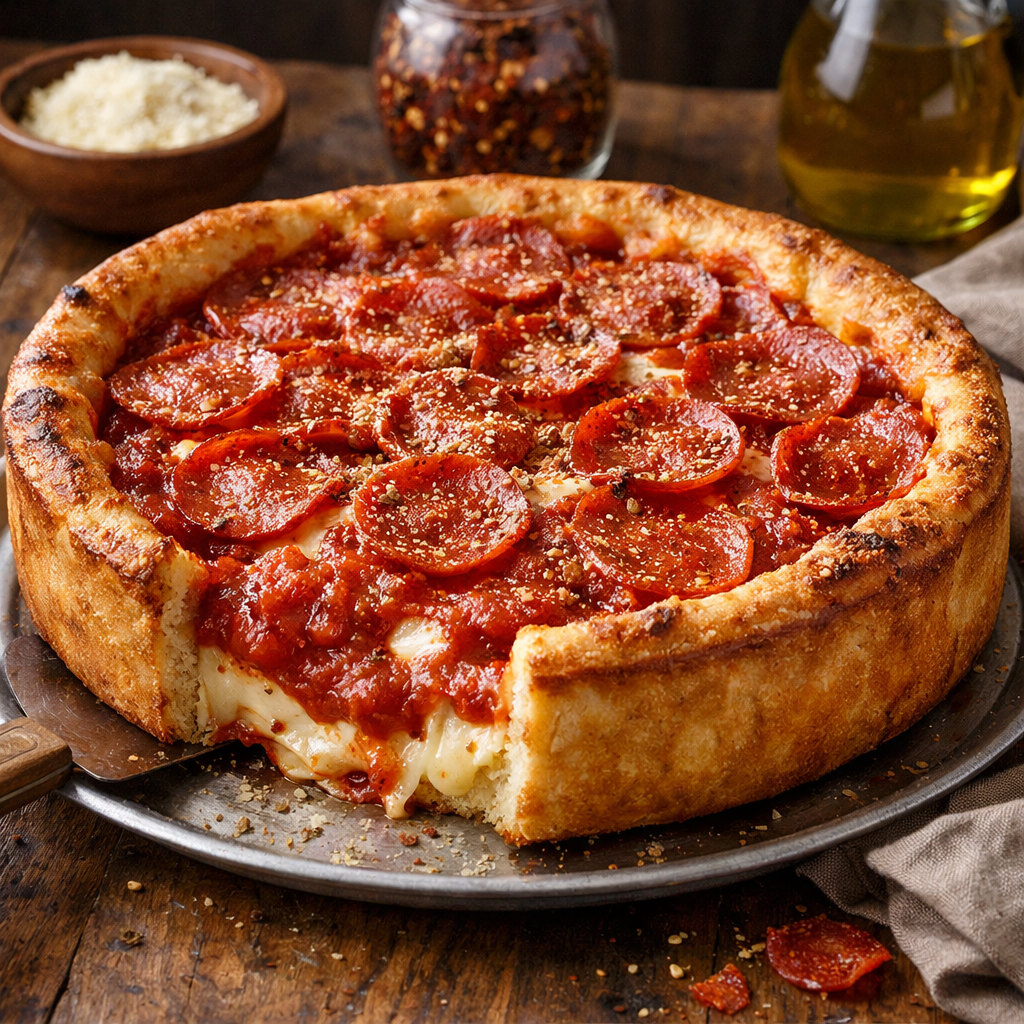
Deep dish pizza with pepperoni is inspired by the Chicago style, a deep pizza with a high, fluffy edge and a thick crust, filled with layers of cheese, spicy salami (pepperoni), and aromatic, lightly seasoned tomato sauce. The dough is soft and buttery-oily, baked in a deep pan, resulting in a moist, hearty interior and a golden, crispy edge. This dish is perfect as a main course for a gathering with family or friends — cut into 4 large portions. It can be served with a simple salad of sauerkraut with apple or spicy pickles, and pairs well with a winter warming beer or dried fruit compote. In flavor, it combines creamy, stretchy mozzarella, salty-spicy salami, and a robust tomato sauce with garlic and oregano; visually, it impresses with layers of cheese and the red of the sauce in a deep, rustic circle.

Ingredients Used

Ingredients (16)

Servings:
4
  • Wheat flour 600 g
  • Fresh yeast 15 g
  • Water 360 ml
  • Rapeseed oil 45 g
  • Sugar 10 g
  • Mozzarella cheese 400 g
  • Salami 200 g
  • Onion 1 szt. (~150 g)
  • Garlic 3 ząbki (~15 g)
  • Dried basil 2 g
  • Butter 20 g
  • Canned tomatoes (diced) 400 g
  • 🌿 Przyprawy
  • Salt 12 g
  • Oregano 4 g
  • ✨ Opcjonalne
  • Corn flour 30 g
  • Parmesan 50 g
💰 Szacowany koszt dania: ~41.15 PLN (10.29 PLN/porcję)

💡 Kliknij na składnik aby oznaczyć jako użyty

Preparation steps

Cake

1

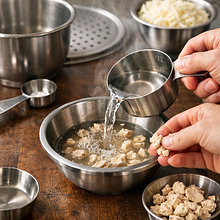
Preparing the starter: in a small bowl, pour in 120 ml of lukewarm water (about 35-38°C), add 15 g of fresh yeast and 5 g of sugar (from the total amount). Gently mix with a fork only in the center until the yeast dissolves. Set aside for 8-10 minutes in a warm place — after this time, a foam (frothy 'cap') should appear on the surface, indicating that the yeast is active.

Use a temperature of 35-38°C — check with the inside of your wrist (it shouldn't be hot). A glass or plastic bowl is best. If after 10 minutes there is no foam, the yeast is inactive — start over.
2

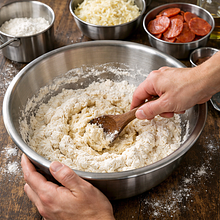
In a large bowl, place 600 g of wheat flour and 12 g of salt — add the salt to the sides of the flour, not directly on the yeast. Make a wide indentation (well) in the flour. Pour the active yeast starter into the indentation, add the remaining 240 ml of lukewarm water, 45 g of rapeseed oil, and 50 ml of milk (if you have it; milk will enrich the dough).

Use a large bowl — the dough needs space for kneading. The salt should not come into direct contact with the yeast during the addition.
3

Kneading the dough: starting from the center, mix the ingredients with a wooden spoon until they come together and a loose dough forms. Then transfer to a lightly floured surface and knead by hand for 8-10 minutes until the dough is smooth, elastic, and no longer sticks to your hands. If you have a mixer with a hook, knead on medium speed for 6-7 minutes.

Use a wooden spoon for the initial mixing, then dust your hands with flour. The dough is ready when it slowly springs back to its original shape after being pressed with a finger and is not overly sticky.
4

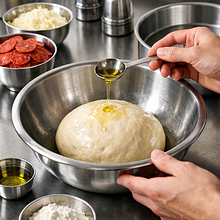
First rising: shape the dough into a ball, brush it with a little oil (about 5 g), place it in a large bowl, and cover it with a cloth or plastic wrap. Set aside in a warm place for 60-75 minutes until the volume doubles. Check: the dough is ready when it slightly indents when you press it with your finger and slowly springs back.

It rises best at a temperature of 24-28°C. Do not place it in a draft or close to a direct heat source; too high a temperature can kill the yeast.

Sauce

5

Prepare the tomato sauce: peel and finely chop 150 g of onion. Heat 15 g of rapeseed oil in a saucepan with a diameter of about 18 cm over medium heat. Add the onion and sauté for 4-5 minutes until it becomes translucent and soft. Add the minced garlic (15 g, which is about 3 cloves) and sauté for 30-40 seconds — the garlic should release its aroma but not brown.

Use a heavy-bottomed saucepan, do not rush the frying over too high heat, as the onion will burn. For frying, a medium frying pan or saucepan of 18-20 cm is best.
6

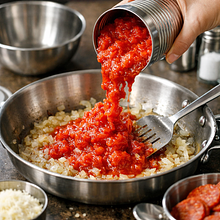
Pour the 400 g of canned tomatoes into the sautéed onions. If you are using whole tomatoes, crush them with a wooden spoon. Add 4 g of oregano, 2 g of dried basil, 5 g of sugar (the remaining amount), and 3 g of salt. Cook on low heat for 12-15 minutes until the sauce thickens and develops a rich flavor. Finally, briefly blend with an immersion blender if you want a smooth consistency.

Cook over low heat, stirring every few minutes to prevent the sauce from sticking. The sauce should be thick but still liquid — it will thicken a bit after cooling.

Stuffing

7

Prepare the toppings: drain excess moisture from the mozzarella (if fresh) and slice it or grate it into thick shreds. Slice the salami thinly (200 g). Grate the Parmesan (50 g) finely — optionally for sprinkling.

For pressing the mozzarella, use cheesecloth or a plate with a weight for 10-15 minutes. Thin slices of salami brown better and roll up nicely.

Assembly and baking

8

Prepare the pan: take a round tart pan or a deep springform pan with a diameter of 26 cm and a height of about 4-5 cm. Grease the interior with 20 g of butter, and lightly sprinkle the bottom and sides with 30 g of corn flour (optional) — the flour will give crunch to the base and make it easier to remove the pizza.

If you don't have corn flour, you can use wheat flour. The best option is a non-stick pan or a well-greased steel pan.
9

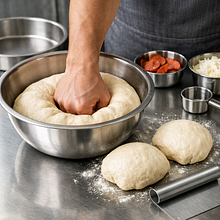
Shaping the crusts: after the second rising (step 4), punch down the dough, divide it into 2 equal parts if you want two smaller pizzas or use the whole dough for one large one. For 4 servings, a single large pan is better. Stretch or roll out the dough to a thickness of about 1.5-2 cm, so that when placed in the pan, it creates high edges. Place the dough in the pan, pressing the bottom and sides with your fingers; the edges should be thick and even.

Use your fingers to shape the edges, not a knife — fingers give a natural shape and do not break the layers. If the dough shrinks a lot, let it rest for 5 minutes and try again.
10

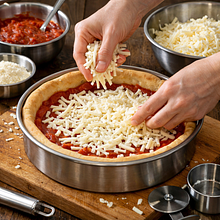
Layering: evenly spread about 250-300 g of mozzarella on the bottom of the dough (a layer of cheese underneath), then spread a thick tomato sauce (about 200-250 g) — do not pour too much, the sauce should be thick. Place slices of salami evenly on the sauce, and then add the remaining mozzarella (100-150 g). You can sprinkle grated parmesan (50 g) on top if you are using it. Brush the edges of the dough with melted butter for a nice color.

The order (cheese on the bottom, sauce in the middle, cheese on top) is a classic deep dish trick — it prevents the bottom from getting soggy and gives a creamy texture. Make sure the edges are well sealed.
11

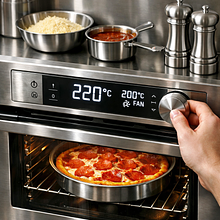
Baking: preheat the oven to 220°C (200°C with fan if available). Place the dish on the middle rack and bake for 25-30 minutes until the cheese melts, the top turns golden, and the edges are browned. If the edges are browning too quickly, gently cover with aluminum foil for the last 8-10 minutes.

The best position for the baking tray is lower in the oven; if you have a pizza stone, use the bottom shelf. Use an oven thermometer if you have one — 220°C is the optimal temperature for a thick crust.

Serving

12

Resting and slicing: after baking, remove the pizza from the oven and let it sit for 8-10 minutes so the cheese can firm up slightly, making it easier to slice. Then, use a wide spatula to gently separate the pizza from the sides of the pan and transfer it to a cutting board. When slicing, use a sharp knife or pizza cutter, cutting with a confident, strong motion to avoid tearing the layers.

Do not cut the pizza right after taking it out — the hot cheese will ooze out and the layers will fall apart. Let it rest for 8-10 minutes; this is crucial.
13

Serving: serve each portion hot, garnished with fresh basil or arugula (optional) and with a simple salad of sauerkraut with apple as a flavor contrast. For drinking, I recommend warming light beer or dried fruit compote in the winter season.

Additionally, you can add parmesan on top to enhance the flavor. The pizza tastes best fresh, on the day it is baked.

Fun Fact

💡

Deep dish pizza was popularized in Chicago in the 1940s as a local response to the thin Italian crust; in this version, Polish salami was used instead of classic pepperoni for a stronger, local touch.

Best for

Tips

🍽️ Serving

Serve on a large wooden platter or directly in the dish, cutting into 4 large portions. Add a serving of sauerkraut salad for a contrast of acidity and the richness of the pizza. If you want to serve it more elegantly, add fresh arugula and balsamic vinegar before serving.

🥡 Storage

Store in the refrigerator for up to 48 hours in an airtight container or wrapped in foil. To reheat, place in an oven preheated to 180°C for 8-10 minutes — the bottom will be crispy again. Avoid reheating in the microwave if you want to maintain the crispiness of the bottom.

📸 Ugotowane przez społeczność

Zaloguj się, aby dodać zdjęcie
Dodaj zdjęcie gotowej potrawy

Po zatwierdzeniu przez moderatora otrzymasz 10 punktów doświadczenia.

🍲

Nikt jeszcze nie dodał zdjęcia. Bądź pierwszy!

Comments (0)

Be the first to comment on this recipe!

Add a comment

You might also like

Recipe Categories

Pizza and pasta are the perfect duet - Italian flavors that have conquered the whole world. Neapolitan pizza: thin crust, tomato sauce, mozzarella, and fresh basil. Roman pizza with a crispy edge and abundant toppings. Pizza dough: yeast-based with a long rising time for the best flavor. Pasta fr...

See all recipes in this category

Main courses are the heart of every meal - hearty, nutritious, and full of flavor. In this category, we present a rich selection of recipes for lunches and dinners that will satisfy even the most discerning palates. From classic Polish pork chops to aromatic chicken dishes, to exquisite steaks an...

See all recipes in this category
Reklama