Pickled Cucumber Jam with Dill and Garlic

Pikantne Additions Regional Cuisine of Poland 90 min Medium 9 wyświetleń ~11.56 PLN * - (0)
Rate:
(0)
Start Cooking

Description

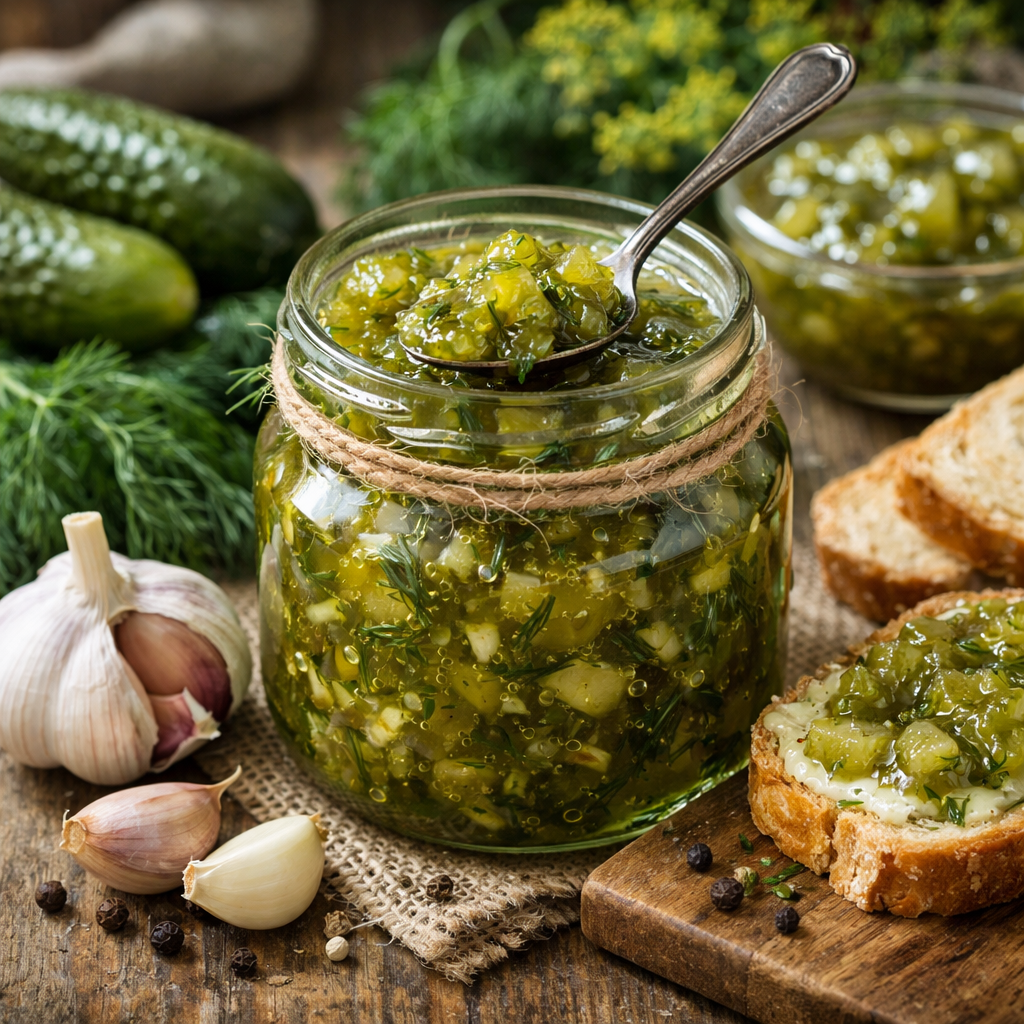
Pickled cucumber jam with dill and garlic is an unusual Polish addition — a sweet and spicy preserve made from a vegetable typical of winter pantries. The base is well-drained pickled cucumbers, which, after a short cooking with gelling sugar and lemon, lose some of their sharpness while gaining a sweet-sour, slightly garlicky flavor. Fresh dill adds a spring touch, making the jam a great balance for heavier winter dishes: it pairs well with roasted meats (pork, duck), potato pancakes, as part of a cheese platter, or as an original addition to sandwiches with cottage cheese. The jam stores well and is an excellent way to use winter preserves in a new, fresh form.

Ingredients Used

Ingredients (8)

Servings:
6
  • Pickled cucumber 8 szt. (~800 g)
  • Gelling sugar 400 g
  • Garlic 3 ząbki (~15 g)
  • Lemon 1.3 szt. (~100 g)
  • Water 50 ml
  • 🌿 Przyprawy
  • Dill 1.5 pęczki (~30 g)
  • ✨ Opcjonalne
  • Salt 1 g
  • Black pepper 4 szczypty (~2 g)
💰 Szacowany koszt dania: ~11.56 PLN (1.93 PLN/porcję)
* Brak cen dla niektórych składników

💡 Kliknij na składnik aby oznaczyć jako użyty

Preparation steps

Preparation of ingredients

1

Prepare the cucumbers: drain the cucumbers from the brine in a large colander over a bowl (save the brine for possible seasoning). If the cucumbers are very salty/sour, rinse them quickly under cold water for 10–15 seconds and drain again. Then slice the cucumbers into thin slices of 3–4 mm or into small cubes (about 5 mm) — smaller pieces will release flavors faster and thicken better in the jam. Cut them evenly so they cook evenly.

Ingredients: Pickled cucumber
Use a sharp knife and a cutting board. If you can't cut evenly, first slice the cucumber in half lengthwise, place the flat side on the board, and cut into slices. Rinsing depends on the level of saltiness — it's better to rinse less than too much, so as not to lose the characteristic pickling flavor.
2

Peel and crush the garlic cloves with a knife, then finely chop or press them through a garlic press. Chop the dill very finely: keep the stems in a bunch and slice them into thin strands. Squeeze the juice from the lemon into a small bowl (if there are many seeds, squeeze it through a strainer). Measure the water.

Ingredients: Garlic, Dill, Lemon, Water
Use a garlic press or a fine knife. For squeezing lemon juice, it's best to use a manual juicer to separate the seeds. Add the dill later in the process to preserve its fresh aroma.

Cooking the jam

3

Pour the gelling sugar into a wide, heavy pot (preferably with a thick bottom), add water, and heat over low heat, stirring with a wooden spoon until the sugar is completely dissolved (about 3–5 minutes). Do not bring to a boil at this stage — we want to dissolve the sugar, not caramelize it.

Ingredients: gelling sugar, Water
Use a non-stick pot or one with a thick bottom (bottom diameter about 20–24 cm). Stir frequently to prevent the sugar from sticking. If the sugar starts to burn, reduce the heat and remove the pot from the burner.
4

Add the chopped cucumbers and garlic to the melted sugar. Increase the heat to medium-high and bring to a boil. Once boiling, reduce the heat to medium and simmer gently, stirring every 2–3 minutes to prevent the cucumbers from sticking. Cook for 20–30 minutes, until the cucumber pieces become translucent and the liquid starts to thicken.

Ingredients: Pickled cucumber, Garlic
Use a wooden or silicone spoon to gently stir — a metal spoon can scratch the bottom of the pot. The reduction time depends on the thickness of the pieces; monitor the transparency and viscosity of the syrup.
5

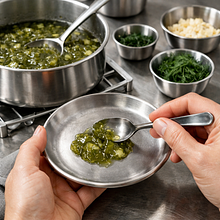
After 20 minutes, test the gelling stage: place a cold plate in the freezer for 3–4 minutes before the test. Scoop a teaspoon of hot jam and set a small dollop on the plate. Wait 1–2 minutes, then run your finger through it — if the surface wrinkles and does not run quickly, the jam is gelled. If it runs, cook for another 5–10 minutes and repeat the test. Add lemon juice halfway through cooking (after the first test or earlier if using gelling sugar according to the manufacturer's instructions).

Ingredients: Pickled cucumber, Lemon, Black pepper, Salt
This is a crucial step — the cold plate test is the most reliable method. Use a small amount, as hot liquids can burn. If you are adding black pepper or salt, do it now and taste.

Finishing

6

When the consistency is satisfactory, remove the pot from the heat and immediately stir in the finely chopped dill — adding dill after cooking will preserve a brighter, fresh aroma. Taste and season minimally with salt or pepper if needed (optional).

Ingredients: Dill, Salt, Black pepper
Add the dill only after removing from heat, so it doesn't lose its color and aroma. Use a wooden spoon for stirring. If the flavor is too strong, wait a few hours — the flavors will harmonize.

Sterilizing jars

7

Prepare the jars and lids: wash the jars in hot soapy water, rinse well. Sterilize using one of the methods: a) in the oven: place the jars on a baking sheet, preheat the oven to 120°C and hold for 15–20 minutes; b) in a pot: immerse the jars and lids in a large pot of boiling water for 10 minutes. Prepare tongs or grips for removing hot jars.

Use kitchen gloves or jar tongs. Sterilized jars should be hot at the time of filling — cold jars will cause the jam to cool quickly and may affect the quality of pasteurization.

Filling and pasteurization

8

Fill the hot, sterilized jars with hot jam, leaving about 0.8–1 cm of headspace below the rim. Wipe the rim of the jar thoroughly with a damp, clean kitchen towel, place the lids on, and screw them on. Place the jars in a large pot lined with a cloth, fill with water up to 2/3 of the height of the jars, and bring to a boil. Pasteurize for 10 minutes from the moment of boiling (for jars of 200–300 ml). After this time, turn off the heat and carefully remove the jars, placing them on a towel to cool at room temperature — do not place them on a cold surface.

Ingredients: Pickled cucumber
Use a slotted spoon or tongs to remove them. Do not try to lift the lids with your fingers immediately — the jars will be hot. Leave the jars to cool completely (at least 8–12 hours) — the lids should 'click' indicating a proper seal.

Cooling and Storage

9

After cooling, check the seal: the lid should be concave and not move when pressed. Label the jars with the date and contents. Store in a cool, dark place (pantry, cellar) for up to 12 months. Once opened, keep in the refrigerator and use within 2–3 weeks.

If any jar is not sealed (the lid is not concave), store it in the refrigerator and use it within a few days. Never consume preserves that show signs of mold, an unpleasant smell, or a changed color.

Fun Fact

💡

In Poland, vegetable preserves have a long tradition — using pickles in new recipes was a way for households to diversify their winter menu. Pickled cucumber jam is a modern technique that utilizes the contrast between sweet and sour.

Best for

Tips

🍽️ Serving

Serve chilled as a side dish to roasted pork or goose, alongside potato pancakes or goat cheese on toast. It’s also great as a spicy touch to cottage cheese or on a sandwich with cold cuts. Before serving, you can add fresh dill and a few drops of oil for shine.

🥡 Storage

Store jars in a cool, dark place for up to 12 months. Once opened, keep in the refrigerator and consume within 2–3 weeks. If the jar has not been properly sealed (no vacuum), store in the refrigerator and use within a few days.

📸 Ugotowane przez społeczność

Zaloguj się, aby dodać zdjęcie
Dodaj zdjęcie gotowej potrawy

Po zatwierdzeniu przez moderatora otrzymasz 10 punktów doświadczenia.

🍲

Nikt jeszcze nie dodał zdjęcia. Bądź pierwszy!

Comments (0)

Be the first to comment on this recipe!

Add a comment

You might also like

Recipe Categories

Additions
Additions in: Valentine's Day

Delicious additions that will enhance the main dishes and enrich the Valentine's table.

See all recipes in this category

Traditional recipes from various regions of Poland that showcase the richness of local flavors and ingredients.

See all recipes in this category
Reklama