Menu

Christmas Kulebiak with Cabbage and Mushrooms

Rate:
(0)

Description

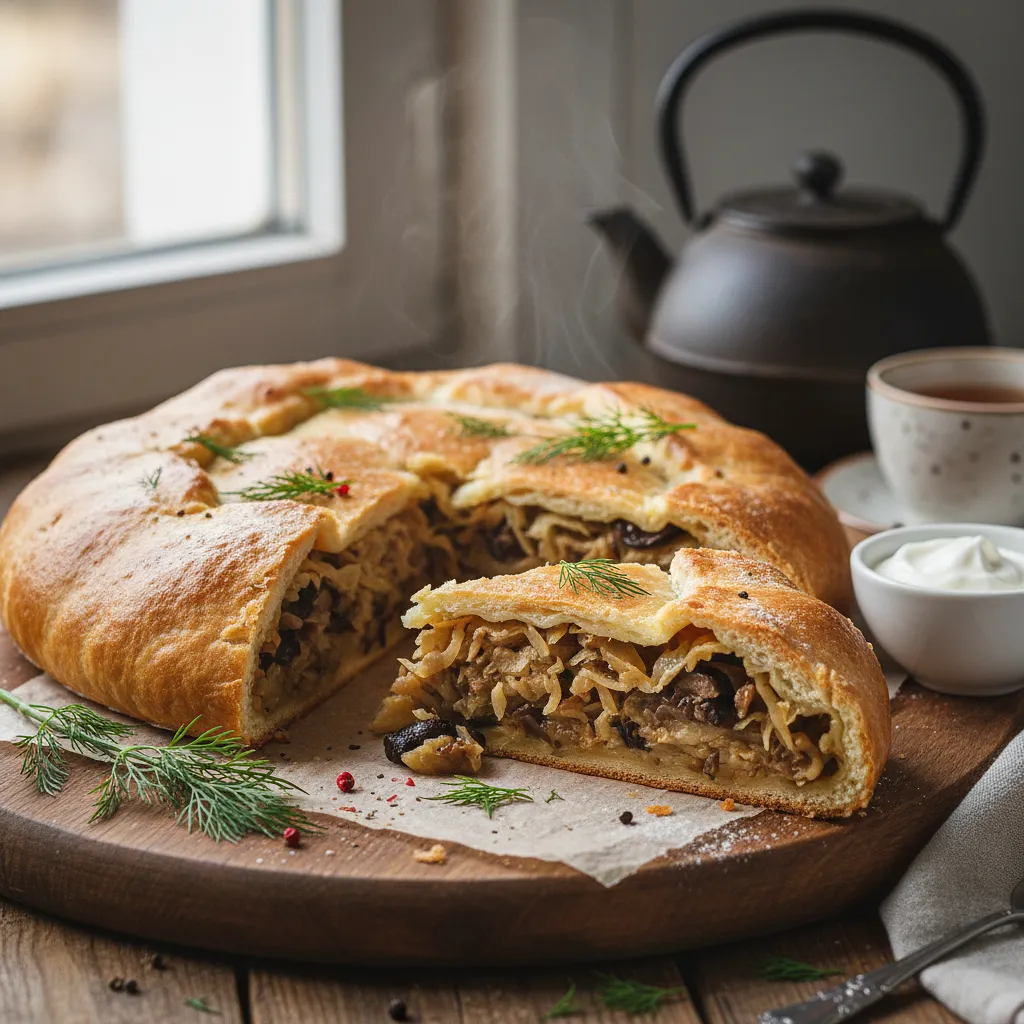
Kulebiak is a traditional dish of Eastern European cuisine that has gained immense popularity in Poland, especially in the eastern parts of the country, becoming one of the gems of the Christmas Eve table. It is a large, baked pie made from yeast dough, filled to the brim with an aromatic filling. In the Christmas version, the filling consists of sauerkraut, dried forest mushrooms, and golden onions, creating a composition with a deep, slightly sour, and intensely mushroom flavor. On the outside, the kulebiak has a crispy, golden crust, often sprinkled with poppy seeds or caraway seeds, while on the inside it is soft and moist. Served warm, sliced into thick pieces, it is a hearty dish on its own or a perfect accompaniment to clear, rich red borscht. Its impressive appearance makes it a true decoration of the festive table.

Składniki (15)

Servings:
8
  • Wheat flour type 500 500 g
  • Fresh yeast 25 g
  • Milk 3.2% 250 ml
  • Butter 75 g
  • Egg 2 szt.
  • sugar 15 g
  • Sauerkraut 500 g
  • Dried forest mushrooms 50 g
  • Onion 2 szt.
  • Rapeseed oil 30 g
  • 🌿 Przyprawy
  • Salt 6 g
  • Bay leaf 6.7 szt.
  • Allspice 3 g
  • Ground black pepper 2 szczypty
  • ✨ Opcjonalne
  • Blue poppy seeds 1 łyżka
💰 Szacowany koszt dania: ~26.96 PLN (3.37 PLN/porcję)

💡 Kliknij na składnik aby oznaczyć jako użyty

Preparation steps

Preparing the filling

1

Start by preparing the mushrooms. Place the dried mushrooms in a sieve and rinse thoroughly under cold running water to remove sand and impurities. Transfer them to a bowl and pour about 500 ml of boiling water over them. Cover the bowl with a plate and set aside for at least 30 minutes to allow the mushrooms to soften and swell.

Ingredients: Dried forest mushrooms
Do not pour out the water after soaking the mushrooms! It is the essence of flavor that we will use for cooking the cabbage. Use a glass or ceramic bowl, as plastic may discolor.
2

After 30 minutes, pour the mushrooms along with the water they soaked in into a small pot. Place over medium heat and cook for about 20-25 minutes, until they are completely soft. Then strain the mushrooms through a fine sieve, keeping all the broth. When the mushrooms have cooled slightly, chop them very finely with a knife.

Ingredients: Dried forest mushrooms
Use a sharp knife and a cutting board. The finer you chop the mushrooms, the better they will blend with the cabbage in the filling, creating a uniform texture.
3

Prepare the sauerkraut. Taste it – if it is very sour, transfer it to a sieve and rinse briefly under cold water. Then squeeze it well in your hands to remove excess juice. Chop the cabbage on a board so that the fibers are not too long. Transfer the cabbage to a pot, add bay leaves, allspice, and pour in the reserved mushroom broth. If the liquid does not cover the cabbage, add a little water. Cook on low heat covered for 40-50 minutes, until the cabbage is soft.

Ingredients: Sauerkraut, Bay leaf, Allspice
Remember to cook the cabbage over low heat so that the flavors meld slowly. Stir occasionally to prevent it from sticking to the bottom of the pot. By the end of cooking, all the liquid should evaporate.
4

In the meantime, peel the onions and chop them into small cubes. In a large skillet, heat the rapeseed oil over medium heat. Add the onion and sauté, stirring, for about 8-10 minutes, until it becomes soft, translucent, and slightly golden. Do not let it burn.

Ingredients: Onion, Rapeseed oil
Use a heavy-bottomed pan that distributes heat evenly. Patient, slow frying of the onions will bring out their natural sweetness, which will balance the acidity of the cabbage.
5

When the cabbage is soft and the moisture has evaporated, remove the bay leaves and allspice. Add the chopped mushrooms and the sautéed onion along with the oil. Mix everything thoroughly. Season with salt and freshly ground black pepper to taste. Set the filling aside to cool completely. This is very important – a hot filling would melt the yeast dough.

Ingredients: Salt, Ground black pepper
You can prepare the filling even a day in advance and store it in the fridge. This way, the flavors will blend even better.

Yeast dough

6

Prepare the starter. In a small saucepan, heat the milk. It should be warm, but not hot (about 37°C, body temperature). In a large bowl, crumble the fresh yeast, add a tablespoon of sugar, a tablespoon of flour, and pour in the warm milk. Mix with a fork until the ingredients are dissolved. Cover with a cloth and set aside in a warm place for 10-15 minutes. The starter is ready when a thick foam appears on the surface.

Ingredients: Fresh yeast, Milk 3.2%, sugar, Wheat flour type 500
This is a crucial step! If the starter doesn't 'activate' (doesn't foam), it means the yeast is inactive or the milk was too hot. You need to start over; otherwise, the dough won't rise.
7

In a large bowl, place the sifted remaining flour and 5 pinches of salt. Make a well in the center. Pour the risen yeast mixture into it. Add one whole egg and melted, slightly cooled butter. Start mixing the ingredients from the center using a wooden spoon, gradually incorporating the flour from the edges.

Ingredients: Wheat flour type 500, Salt, Egg, Butter
Sifting the flour aerates it, making the dough lighter and fluffier. Remember that the butter should not be hot, as it could 'scald' the egg and kill the yeast.
8

When the ingredients are combined, transfer the dough to a floured surface and knead by hand for about 10-12 minutes. Knead vigorously, pushing the dough away from you with the heel of your hand and folding it back. The dough is ready when it is smooth, elastic, and does not stick to your hands. Shape it into a ball.

Alternatively, you can use a stand mixer with a dough hook. Knead on medium speed for 6-8 minutes. Properly kneaded dough should slowly return to its shape when pressed with a finger.
9

Grease a bowl where the dough will rise with a thin layer of oil. Place the ball of dough in it, turning it so that it is coated in fat all over. Cover the bowl with a clean kitchen towel and set it in a warm, draft-free place for about 1-1.5 hours. The dough should double in size.

The ideal place for the dough to rise is a slightly warmed oven (turned off, with the light on) or a spot near a radiator.

Shaping and baking the kulebiak

10

When the dough has doubled in size, punch it in the center to deflate it. Transfer it to a lightly floured surface and knead briefly. Using a rolling pin, roll out the dough into a large rectangle measuring about 40x30 cm and about 0.5 cm thick.

Try to roll the dough evenly so that it has the same thickness across the entire surface. This will ensure even baking.
11

On the rolled-out dough, evenly spread the completely cooled filling, leaving a free margin of about 2 cm along all edges. Roll the dough along the longer side into a tight log, similar to a roulade. Seal the edges thoroughly, pressing them firmly with your fingers to prevent the filling from leaking during baking.

You can gently brush the edges of the dough with water, which will help them stick better. Make sure the seam is secure.
12

Prepare a large baking tray and line it with parchment paper. Carefully transfer the kulebiak to the tray, placing it seam side down. Cover it with a cloth and let it rise for another 30 minutes.

This second, shorter rising time will make the structure of the dough lighter and fluffier after baking.
13

At the end of the rising time, preheat the oven to 180°C (fan) or 190°C (top-bottom). In a small bowl, beat the second egg with a tablespoon of water using a fork. Brush the entire surface of the risen kulebiak thoroughly with a kitchen brush. If you like, sprinkle the top with poppy seeds.

Ingredients: Egg, Blue poppy seeds
Brushing with egg (the so-called glaze) gives the kulebiak a beautiful, shiny, golden-brown color. Additionally, it helps the poppy seeds stick.
14

Place the baking tray with the kulebiak in the preheated oven. Bake for about 35-45 minutes. The kulebiak is ready when its top is deeply golden and the bottom, when tapped, makes a hollow sound. If the top browns too quickly, loosely cover it with aluminum foil.

Every oven bakes differently, so keep an eye on the kulebiak towards the end of baking. You can check for doneness with a toothpick – when inserted into the dough (not the filling), it should come out dry.
15

Remove the baked kulebiak from the oven and carefully transfer it to a metal cooling rack. Leave it to cool for at least 20-30 minutes before slicing. Cutting a hot kulebiak may cause the pastry to collapse.

Cooling on a rack is important because it allows air circulation from the bottom, preventing the kulebiak from becoming soggy and damp.

Fun Fact

💡

Kulebiak (rus. кулебя́ка) arrived in Poland from Russian cuisine in the 19th century. Its name likely comes from the word 'kulebiaczyć', which meant 'to shape by hand'. In the classic Russian version, kulebiak often had several layers of different fillings, separated by thin pancakes.

Best for

Tips

🍽️ Serving

Kulebiak tastes best when warm, sliced into thick pieces (about 2-3 cm wide). It is traditionally served as a standalone dish or, most commonly in Poland, as an accompaniment to clear red borscht served in a cup. Its rich, mushroom and cabbage flavor pairs perfectly with the soup's acidity.

🥡 Storage

Once completely cooled, the kulebiak can be stored in the refrigerator, wrapped in aluminum foil or in an airtight container, for up to 3 days. It can be reheated in an oven preheated to 150°C for 10-15 minutes to regain the crispness of the crust. It can also be frozen whole or in portions.

📸 Ugotowane przez społeczność

Zaloguj się, aby dodać zdjęcie
Dodaj zdjęcie gotowej potrawy

Po zatwierdzeniu przez moderatora otrzymasz 10 punktów doświadczenia.

🍲

Nikt jeszcze nie dodał zdjęcia. Bądź pierwszy!

Comments (0)

Be the first to comment on this recipe!

Add a comment

You might also like

Recipe Categories

Regional cuisine for Christmas Eve features local traditions from various corners of Poland. Christmas Eve pierogi ruskie from Podkarpacie - with potatoes, cheese, and onions. Carp in Kashubian style - in horseradish sauce with raisins and almonds. Silesian żurek on sourdough - with mushrooms ins...

See all recipes in this category

Christmas Eve dishes are the heart of Polish holiday tradition - 12 meatless dishes on the table. Fried, baked, jellied, and Jewish-style carp - the main star of Christmas Eve. Dumplings with cabbage and mushrooms - handmade according to grandma's recipes. Small mushroom-filled pockets for borsch...

See all recipes in this category

Homemade cakes and pastries are the heart of Polish culinary tradition - sweet memories from childhood. In our collection, you will find recipes for classic yeast cakes, shortcrust, sponge, and cheesecake. Apple pie, poppy seed cake, gingerbread, Easter babka, chocolate cake, and New York cheesec...

See all recipes in this category
Reklama