Menu

Baked duck legs in plum sauce with Karlovy Vary dumplings

Pikantne Czech Cuisine Main dishes Dishes for Special Occasions 180 min Medium 4 wyświetleń ~60.39 PLN - (0)
Rate:
(0)

Description

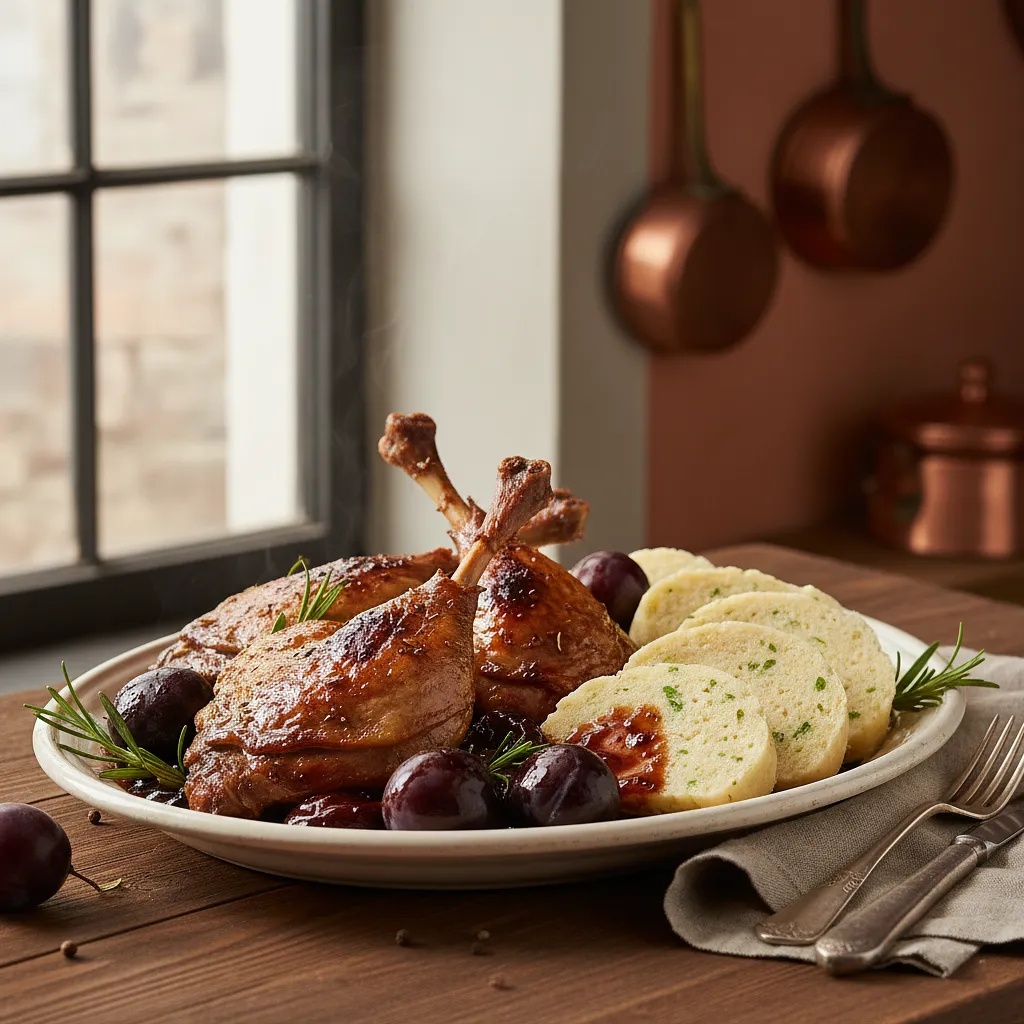
This is the quintessence of Czech cuisine in a modern, seasonal edition. Juicy, slow-roasted duck legs with incredibly crispy skin, served with a velvety, sweet-and-sour sauce made from fresh plums, with a hint of red wine and aromatic spices. Complementing the dish are Karlovy Vary dumplings – fluffy and light, made from stale bread, with the addition of fresh parsley. The dish is extremely aromatic and hearty, perfect for a festive autumn or winter dinner. The contrast of flavors – the richness of the duck, the sweetness of the plums, and the herbal freshness of the dumplings – creates a harmonious and unforgettable composition. It looks incredibly appetizing: the dark, glossy sauce beautifully contrasts with the golden skin of the duck and the light, speckled dumplings.

Składniki (20)

Servings:
4
  • Duck leg 4 szt.
  • Garlic 4 ząbki
  • Hungarian plums 500 g
  • Onion 1 szt.
  • Dry red wine 150 ml
  • wildflower honey 42 g
  • Balsamic vinegar 15 ml
  • Stale wheat rolls 4 szt.
  • Milk 3.2% 200 ml
  • Egg 2 szt.
  • Fine wheat flour 100 g
  • 🌿 Przyprawy
  • Dried marjoram 2 łyżeczki
  • Salt 10 g
  • Ground black pepper 5 szczypt
  • Cloves 1 g
  • Cinnamon stick 1 szt.
  • Parsley 1 pęczek
  • Nutmeg 2 szczypty
  • ✨ Opcjonalne
  • Butter 15 g
  • Fresh marjoram 15 g
💰 Szacowany koszt dania: ~60.39 PLN (15.10 PLN/porcję)

💡 Kliknij na składnik aby oznaczyć jako użyty

Preparation steps

Marinating and roasting the duck

1

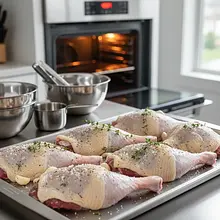
Start by preparing the duck legs. Rinse them thoroughly under cold running water, then dry them very carefully with paper towels. This is a key step to ensure the skin is crispy. Using a sharp knife, score the skin along with the fat in a crosshatch pattern, being careful not to cut into the meat. The slits will allow for better fat rendering and will make the skin perfectly crispy.

Ingredients: Duck leg
Use a small, sharp knife (e.g., for vegetables). Drying the meat is absolutely critical – moist skin will cook instead of roasting to a crisp. Make cuts at intervals of about 1.5 cm.
2

In a small bowl, prepare the marinade. Add salt, freshly ground pepper, and dried marjoram. Peel the garlic and either press it through a garlic press or chop it very finely, then add it to the spices. Mix everything together thoroughly. Rub this mixture thoroughly into each duck leg, making sure to work the spices into the cuts and under the skin where possible.

Ingredients: Dried marjoram, Salt, Ground black pepper, Garlic
Use a garlic press to release as much aroma as possible. Rub the marinade in vigorously to allow the flavors to penetrate the meat. It's best to do this while wearing rubber gloves.
3

Place the marinated thighs in a dish, cover with plastic wrap, and refrigerate for at least 2 hours, preferably overnight. Longer marinating will make the meat more flavorful and tender.

If you don't have much time, even 30 minutes of marinating at room temperature will yield better results than not marinating at all. Make sure the container is tightly covered so the garlic smell doesn't spread throughout the fridge.
4

Preheat the oven to 200°C (fan) or 220°C (top-bottom). Take the thighs out of the fridge about 30 minutes before baking to reach room temperature. Place them skin side up in a baking dish or on a baking sheet. Put them in the hot oven and bake for 20 minutes. After that, reduce the temperature to 160°C (fan) or 180°C (top-bottom) and bake for another 60-70 minutes, until the meat is tender and pulls away from the bone. During baking, baste the thighs with the rendered fat every 20 minutes.

Ingredients: Duck leg
The initial baking at a high temperature aims to 'seal' the meat and lightly brown the skin. Use a deeper baking tray, as a lot of fat will render from the duck. Keep the rendered fat – it's delicious and will be useful for the sauce and for frying other dishes.

Karlovy Vary dumplings

5

While the duck is roasting, prepare the dumplings. Cut the stale bread into cubes about 1-1.5 cm on each side. Spread them out on a large baking tray and place in the oven preheated to 150°C for about 10 minutes, until they become slightly golden and crispy. Then transfer them to a large bowl.

Ingredients: Stale wheat rolls
Use a serrated knife to slice the bread, it will make working with stale rolls easier. Do not burn the toast, they should only dry out and lightly brown. This step prevents the rolls from becoming soggy in the mixture.
6

In a separate bowl, separate the yolks from the whites. Add milk, salt, and freshly grated nutmeg to the yolks. If you are using butter, melt it and let it cool slightly before adding it to the mixture. Whisk everything together thoroughly until the ingredients combine into a smooth mixture. Finely chop the parsley.

Ingredients: Egg, Milk 3.2%, Salt, Nutmeg, Butter, Parsley
Keep the egg whites in a clean, dry bowl – you will whip them later. Make sure the butter is not hot so it doesn't cook the yolks. Use a large bowl to make it easier to mix everything.
7

Pour the prepared milk and egg mixture over the toast in a large bowl. Add the chopped parsley and gently mix everything with a large spoon, so that each piece of toast is coated with the liquid. Let it sit for 10 minutes to allow the bread to absorb the moisture.

Ingredients: Stale wheat rolls, Egg, Milk 3.2%, Parsley
Gently mix to avoid breaking the croutons. The goal is to moisten them, not to turn them into mush. The mixture should be moist but not swimming in liquid.
8

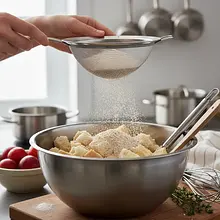
Sift the semolina flour over the soaked bread and gently mix again. In a separate, clean bowl, beat the egg whites with a pinch of salt until stiff peaks form. The meringue is ready when it doesn't fall out when the bowl is turned upside down. Add the beaten meringue to the bread mixture and very gently fold in with a spatula or large spoon, making upward motions to keep the mixture as fluffy as possible.

Ingredients: Fine wheat flour, Egg
Use a hand mixer to whip the egg whites. Make sure the bowl and beaters are perfectly clean and dry, without any trace of fat, otherwise the foam will not whip. Do not mix the foam too vigorously, as it will lose its volume and the dumplings will be dense.
9

Lay a large piece of plastic wrap on the countertop, and on top of it, place a piece of aluminum foil. Grease the aluminum foil with a little butter or oil. Place half of the mixture on it and shape it into a log with a diameter of about 5-6 cm. Wrap it tightly first in aluminum foil, and then in plastic wrap, twisting the ends like a candy. Repeat with the second half of the mixture. You will have two logs.

You can also use a clean kitchen towel. Wet it, place the mixture on it, roll it up, and tie the ends with string. Cooking in a towel is a traditional method. It is important that the rolls are compact and well sealed.
10

In a large, wide pot, bring water to a boil. Gently place the prepared dumpling rolls into the boiling water. The water should cover them. Reduce the heat so that the water is just gently 'bubbling' (not boiling vigorously) and cook covered for 20-25 minutes, turning the dumplings halfway through cooking.

The pot must be large enough for the dumplings to float freely. Boiling too vigorously may cause them to fall apart. After cooking, carefully remove the dumplings from the water and set them aside for a moment before unwrapping from the foil.

Plum sauce

11

When the duck is finishing roasting and the dumplings are cooking, prepare the sauce. Peel the onion and chop it into small cubes. Pour 2 tablespoons of the rendered fat from the dish with the duck into a pan (keep the rest). Heat the fat over medium heat and sauté the onion, stirring occasionally, until it becomes soft and translucent (about 5-7 minutes).

Ingredients: Onion
Use a deeper pan or pot. Duck fat will give the sauce an incredible flavor, do not replace it with oil if possible. Do not burn the onion, it should be sweet, not bitter.
12

Wash the plums, cut them in half and remove the pits. Add them to the sautéed onion. Fry together for about 5 minutes, until the plums start to release their juice and slightly break down. Then pour in the red wine, add honey, balsamic vinegar, cloves, and a cinnamon stick. Mix and bring to a boil.

Ingredients: Hungarian plums, Dry red wine, wildflower honey, Balsamic vinegar, Cloves, Cinnamon stick
Gently stir to avoid crushing the plums right away. After adding the wine, increase the heat for a moment to let the alcohol evaporate, then reduce it.
13

Reduce the heat to the minimum, cover the pan, and simmer the sauce for about 15-20 minutes, until the plums completely break down and the sauce thickens. Stir occasionally to prevent the sauce from burning. Finally, remove the cinnamon stick and cloves.

If the sauce is too thick, you can add a little water or broth. If it's too thin, simmer it a little longer uncovered. Remember to remove the spices before blending!
14

Pour the sauce into a blender or use an immersion blender and blend until smooth and creamy. Taste and season with salt, pepper, or a bit of honey if it's too sour. Keep warm until serving.

Ingredients: Salt, Ground black pepper
Be careful when blending hot sauce – it's best to let it cool slightly. An immersion blender (stick blender) is very convenient because you can blend directly in the pot. A smooth consistency of the sauce is desirable, but if you prefer, you can leave small pieces of fruit.

Final presentation

15

Remove the roasted duck from the oven and let it rest for 5-10 minutes to allow the juices to redistribute evenly. Carefully unwrap the cooked dumplings from the foil and slice them into pieces about 1.5 cm thick. It’s best to do this using a thread – place it under the roll and pull the ends upwards. This way, the slices will be even and won’t crumble.

Resting the meat is very important for its juiciness. Cutting the dumpling with thread is a traditional Czech method that really works! Use strong cotton thread.
16

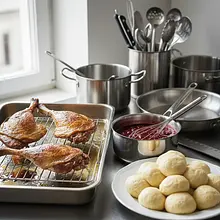
On a large plate, place a portion of warm plum sauce. On the sauce, lay one duck leg. Next to it, arrange a fan of 3-4 slices of dumpling. Garnish with fresh marjoram leaves. Serve immediately while all elements are hot.

Ingredients: Fresh marjoram
Warm plates will help keep the dish's temperature longer. You can heat them in the oven set to a low temperature. The dish pairs wonderfully with warm red cabbage and a mug of good Czech beer.

Fun Fact

💡

Karlovy Vary dumplings (Karlovarský knedlík) are named after the famous Czech spa town of Karlovy Vary. Unlike traditional yeast dumplings, they are made from stale bread and herbs, giving them a lighter, more 'savory' texture, perfectly suited for rich meats and sauces.

Best for

Tips

🍽️ Serving

Serve on large plates, preferably slightly warmed, to keep the dish hot for longer. Next to the duck and dumplings, a portion of red cabbage sautéed with apple pairs perfectly. For drinking, a dark Czech beer (e.g., Kozel Černý) or a glass of dry red wine, the same one used for the sauce, is ideal.

🥡 Storage

Leftover duck can be stored in the refrigerator in a closed container for up to 3 days. To reheat, it's best to place it in an oven preheated to 180°C for 15-20 minutes, which will help restore the crispiness of the skin. Dumplings should be stored wrapped in foil in the refrigerator. They can be reheated in a steamer (the best method) or sautéed in butter. Store the sauce in a jar in the refrigerator for up to 4 days and heat it in a saucepan before serving.

📸 Ugotowane przez społeczność

Zaloguj się, aby dodać zdjęcie
Dodaj zdjęcie gotowej potrawy

Po zatwierdzeniu przez moderatora otrzymasz 10 punktów doświadczenia.

🍲

Nikt jeszcze nie dodał zdjęcia. Bądź pierwszy!

Comments (0)

Be the first to comment on this recipe!

Add a comment

You might also like

Recipe Categories

Czech cuisine is a treasure trove of Central European flavors - hearty, aromatic, and full of tradition. Discover classic Czech dumplings - steamed, bread, or potato, served with sauces and braised meat. Svíčková na smetaně, vepřo-knedlo-zelo, smažený sýr, or trdelník are just some of the iconic ...

See all recipes in this category
Main dishes
Main dishes in: New Year's Eve

Main dishes for New Year's Eve should be hearty and impressive to satisfy the palates of all guests.

See all recipes in this category

Dishes for special occasions are culinary masterpieces for birthdays, anniversaries, and holidays. Grilled beef steak with herb butter - restaurant quality at home. Beef Wellington - beef in puff pastry with duxelles. Roast duck with apples - a holiday tradition in a new edition. Pink salmon with...

See all recipes in this category

Lunches are the main meal of the day - filling, balanced, and full of flavor. Traditional two-course lunches: soup and a main dish in Polish tradition. Pork chop with potatoes and cabbage - a classic of Polish lunches. Dumplings with meat, cheese, and fruit - hand-formed delicacies. Beef goulash,...

See all recipes in this category
Reklama