Recipe for: Buttery crescent rolls filled with blackcurrant jam

Cakes and Bakes Regional Cuisine of Poland 180 min Medium 0 views ~15.60 PLN * - (0)
Rate:
(0)
Start Cooking

Description

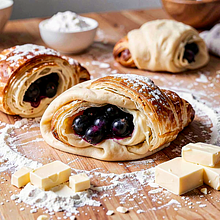
Delicate, buttery croissants inspired by the simplicity of Masuria and a summer bouquet of flavors — a crispy outer crust, a soft, layered interior, and slightly tart blackcurrant jam. The recipe combines classic Polish ingredients available in summer: butter, fresh eggs, and aromatic currants. The croissants are perfect for breakfast, an afternoon snack, or as a dessert with coffee during family gatherings. The recipe describes step by step how to make the yeast dough with butter, shape the croissants, bake them, and provides simple tips for preparing the jam or using a ready-made jar — all designed so that even a beginner baker can achieve excellent results.

Ingredients Used

Ingredients (10)

Servings:
12
  • Wheat flour 500 g
  • Milk 250 ml
  • Fresh yeast 25 g
  • Sugar 80 g
  • Chicken egg 2 pcs (~120 g)
  • Butter 150 g
  • Blackcurrant jam 250 g
  • 🌿 Spices
  • Salt 8 g
  • ✨ Optional
  • Powdered sugar 30 g
  • Lemon zest 5 g
💰 Estimated dish cost: ~15.60 PLN (1.30 PLN/serving)
* Prices missing for some ingredients

💡 Click an ingredient to mark it as used

Preparation steps

Filling

1

If you are using store-bought jam: transfer 250 g of blackcurrant jam to a small saucepan and heat over low heat for 3–4 minutes until it becomes more liquid and homogeneous. Do not allow it to boil vigorously. Remove from heat and set aside to cool slightly — a small spoon should leave uniform traces, which will make it easier to spread on the cake.

Ingredients: blackcurrant jam
Use a small saucepan with a diameter of 14–16 cm and a wooden spoon. Heating makes it easier to spread on the croissants; if the jam is thick, add 1–2 teaspoons of water.
Cake

2

Prepare the yeast mixture: heat 100 ml of milk to a temperature of 35–37°C (it should be warm to the touch, not hot). Crumble 25 g of fresh yeast into a bowl, add 20 g of sugar, and pour in 100 ml of warm milk. Mix with a fork until the yeast dissolves and set aside in a warm place for 10 minutes. After 10 minutes, a foam or 'cap' should appear on the surface — this is a sign that the yeast is active.

Ingredients: Milk, Fresh yeast, Sugar
Use a small bowl and a kitchen thermometer if you have one. If there is no foam after 10 minutes, the yeast may be expired or the milk was too hot — start over with new yeast.
3

In a large bowl, mix 500 g of wheat flour with 8 g of salt. Make a well in the flour and pour in the yeast mixture, add 100 ml of the remaining milk and 60 g (1 piece) of beaten egg. Stir with a wooden spoon until all the ingredients combine into a rough, moist mass.

Ingredients: Wheat flour, Salt, Milk, Fresh yeast
Use a large metal or plastic bowl (min. 3 l). Stir with a wooden spoon to prevent the flour from dusting. Do not knead for long yet — just until the ingredients are combined.
4

Add 100 g of cold butter cut into small pieces to a bowl. Start kneading the dough by hand for 8–10 minutes on a lightly floured countertop or use a mixer with a dough hook for 6–7 minutes on low speed. The dough will be soft, slightly sticky, and elastic — when pressed with a finger, it should slowly return to shape, and the surface should be smooth.

Ingredients: Butter, Wheat flour
Use a mixer with hooks if you have one; if not, knead by hand vigorously for the specified time. Do not add more flour than necessary — the dough should be soft.
5

Form a smooth ball from the dough, lightly grease the inside of a bowl with a teaspoon of butter, and place the dough inside. Cover the bowl with a clean cloth or plastic wrap and set it in a warm place for 60–90 minutes, until the dough doubles in volume.

Ingredients: Butter, Wheat flour
The best place is one without drafts, for example, near a slightly warm oven. The dough is ready when the imprint slowly springs back after being pressed with a finger, and the volume has significantly increased.

Shaping

6

Prepare a lightly floured work surface. Place the risen dough on it and gently flatten it with your hand. Roll out the dough with a rolling pin into a rectangle measuring about 40×30 cm — do this gently to avoid squeezing out all the air. The thickness should be about 4–5 mm.

Ingredients: Wheat flour
Use a rolling pin and sprinkle minimally with flour to prevent the dough from sticking. If the dough shrinks a lot, set it aside for 5 minutes to let the gluten rest.
7

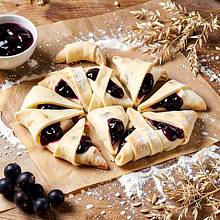
Divide the rectangle into 12 equal triangles (first into three long strips, then make diagonal cuts), so that each triangle has a base of about 10–11 cm. On each base, spread 15–20 g of slightly cooled blackcurrant jam (use a teaspoon), leaving about 1 cm margin at the edges. Roll the triangle from the wide base towards the tip, gently stretching the dough to achieve a nice crescent shape. Tuck the end underneath to keep the croissant shape.

Ingredients: blackcurrant jam, Wheat flour
Use a sharp knife or pastry wheel for even cutting. If the jam mixture is very runny, first strain it through a sieve or chill it in the refrigerator.
8

Arrange the croissants on a baking sheet lined with parchment paper, leaving at least 3–4 cm between them. Cover loosely with a cloth and let them rest for 20–30 minutes to rise slightly — they should feel gently puffy to the touch.

Ingredients: Wheat flour
The baking tray should be large (e.g. 40×30 cm). If the croissants are too close to each other, they may stick together while rising.

Baking

9

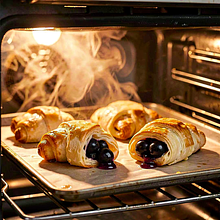
Preheat the oven to 190°C (top-bottom) or 175°C with fan. Beat the second egg with 1 tablespoon of water and gently brush the surface of each croissant with a pastry brush. Place the tray on the middle rack and bake for 15–18 minutes, until the croissants are golden — the top should be evenly browned, and the bottom slightly toasted.

The best is a coated or dark baking tray; the oven may bake unevenly — after 10 minutes, turn the tray if you see uneven browning. Use a silicone pastry brush.

Decoration

10

After baking, take the croissants out of the oven and immediately brush them lightly with melted butter (if there is any left). Set aside on a rack to cool completely (about 20–30 minutes). Once they are cool, sift 30 g of powdered sugar through a fine sieve and optionally sprinkle 5 g of grated lemon zest on each croissant for freshness.

Ingredients: Powdered sugar, Lemon zest, Butter
Use a cooling rack to prevent the bottom from becoming soggy. If you are adding lemon zest, do so sparingly — a small amount is enough to enhance the flavor of the jam.

Serving

11

Arrange the croissants on a plate or board. Serve slightly warm or at room temperature with a side of fresh tea or coffee. The croissants taste best on the same day when the dough is still soft and buttery.

Ingredients: blackcurrant jam
For serving, use a flat plate with a diameter of 24–28 cm for 6 croissants or a larger tray for all 12. Additionally, you can serve a portion of jam on the side for adding.

Fun Fact

💡

In Mazurian tradition, simplicity and local fruits were key — black currant is a classic summer fruit in Poland, often used for preserves that remind us of summer during winter.

Best for

Tips

🍽️ Serving

Serve the croissants with a cup of strong coffee or a mug of buttermilk for contrast. For a 'Masurian table' effect, serve alongside a jar of homemade jam and a platter of fresh forest fruits.

🥡 Storage

Store in an airtight container at room temperature for up to 24 hours. After a longer period, they can be heated in the oven for 5–7 minutes at 160°C to regain their crispness. It is not recommended to store in the refrigerator — they will harden more quickly.

📸 Cooked by the community

Log in to add a photo
Add a photo of the finished dish

After moderator approval, you will receive 10 experience points.

🍲

No one has added a photo yet. Be the first!

Comments (0)

Be the first to comment on this recipe!

Add a comment

You might also like

Recipe Categories

Homemade cakes and pastries are the heart of Polish culinary tradition - sweet memories from childhood. In our collection, you will find recipes for classic yeast cakes, shortcrust, sponge, and cheesecake. Apple pie, poppy seed cake, gingerbread, Easter babka, chocolate cake, and New York cheesec...

See all recipes in this category

Traditional recipes from various regions of Poland that showcase the richness of local flavors and ingredients.

See all recipes in this category
Advertisement