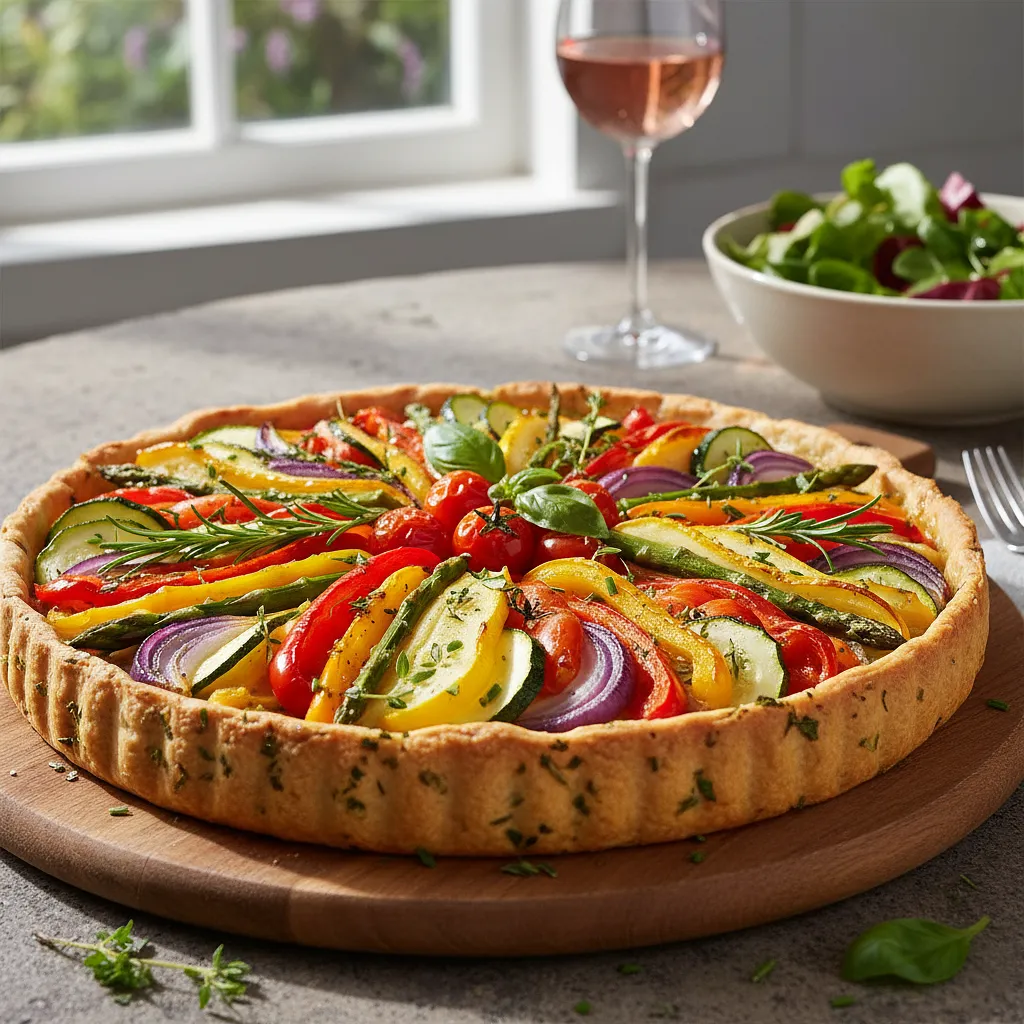
This tart is the essence of home cooking in the spirit of 'zero waste', inspired by Iza's cooking style, who can create wonders from what she has on hand. It is a dish that celebrates the abundance of a home garden and teaches respect for food by using vegetables in their entirety – from root to leaf. The crumbly, buttery crust with the addition of fresh herbs provides the perfect backdrop for the creamy, egg filling brimming with sautéed vegetable scraps – tough broccoli stems, carrot tops, or slightly wilted zucchini. The salty, tangy feta cheese perfectly balances the sweetness of the vegetables, and the whole dish, once baked, looks incredibly appetizing, with golden edges and a colorful interior. It’s an ideal idea for a light lunch, dinner, or as a hearty snack for a gathering with friends. Serve it warm or cold, accompanied by a simple salad with vinaigrette.
Start by preparing the dough. In a large bowl, sift the flour and add salt. Cut the cold butter into small cubes (about 1x1 cm) and add it to the flour. Now for the most important moment: using your fingertips, quickly rub the butter into the flour until it forms clumps resembling wet sand or crumble. The goal is to warm the butter as little as possible with your hands.
Ingredients:
Wheat flour type 500, Butter, Salt
You can use a pastry cutter or a food processor (pulse option, a few short bursts). The key is speed and keeping the ingredients at a low temperature. Do not blend the butter until smooth – small pieces of butter in the dough will make it flaky and crisp.

2
Chop the herbs (dill, parsley) very finely. Add them to the flour with butter. Make a well in the center, crack in the yolk, and pour in 2 tablespoons of ice-cold water. Quickly knead the dough into a uniform ball. Do not knead it too long, just until the ingredients are combined. Wrap the dough in plastic wrap and flatten it into a disk – this will make it easier to roll out later. Place it in the refrigerator for at least 30 minutes.
Ingredients:
Fresh herbs (dill, parsley), Egg yolk, Water
The most common mistake is kneading the dough for too long, which causes gluten to develop and makes the baked dough hard instead of crumbly. If the dough is too dry and crumbles, add another tablespoon of cold water.
Vegetable filling
3
While the dough is cooling, prepare the filling. Wash all the vegetables thoroughly. Chop the onion into small cubes. Press the garlic through a garlic press or chop it very finely. Cut the harder vegetables (e.g., broccoli stems, carrot) into thin slices or small cubes, and the softer ones (e.g., zucchini) into slightly thicker pieces.
Ingredients:
Vegetable scraps mix, Onion, Garlic
The goal is for all the vegetables to have a similar cooking time. If you are using very hard vegetables, like kohlrabi, you can blanch them for 2-3 minutes in boiling water before frying.
4
In a large skillet, heat 1 tablespoon of canola oil. Add the chopped onion and sauté over medium heat for about 4-5 minutes until it becomes translucent and soft. Add the harder vegetables (carrot, broccoli stems) and sauté for another 5-7 minutes, stirring occasionally. Then add the softer vegetables (zucchini) and garlic. Sauté everything together for another 3-4 minutes until the vegetables are slightly softened but still crisp (al dente). Season with salt and pepper. Remove from heat and set aside to cool slightly.
Use a large diameter pan (about 28 cm) so that the vegetables sauté rather than steam. Do not overcook the vegetables into a mush – they will continue to cook in the oven. They should be lightly sautéed to bring out their flavor.
Assembly and baking
5
Preheat the oven to 190°C (fan) or 200°C (top-bottom). Take the chilled dough out of the fridge. Lightly grease a tart pan (24-26 cm in diameter, preferably with a removable bottom) with butter. Dust the countertop with flour and roll out the dough into a round disc about 3-4 mm thick, slightly larger than the diameter of the pan. Carefully transfer the dough to the pan by loosely rolling it onto a rolling pin. Firmly press the dough into the bottom and sides of the pan with your fingers. Trim the excess dough with a knife, running it along the edge of the pan.
If the dough cracks while transferring, don't worry! You can easily 'patch' it in the mold by sticking a piece of dough and smoothing it with your fingers. It's important that there are no holes.
6
Prick the pie crust densely with a fork all over the surface. Cover the dough with a sheet of baking paper and weigh it down with special ceramic beads, dry beans, or peas. This is called 'blind baking', which prevents the crust from puffing up and ensures the base is perfectly crisp. Place the dish in the preheated oven and bake for 15 minutes.
Weighting is key to prevent the cake from 'slipping' down the sides of the pan and rising in the center. The parchment paper should be larger than the pan to easily remove it along with the weight later.
7
After 15 minutes, carefully remove the pan from the oven. Take off the paper with the weights (be careful, it's hot!). Put the cake back in the oven for another 5-7 minutes to lightly brown and dry the bottom. Meanwhile, in a bowl, whisk the eggs with a whisk. Add the cream, season with salt, freshly ground pepper, and grated nutmeg. Mix thoroughly until smooth.
Pre-baking the crust without weights is important to avoid a soggy bottom after pouring in the wet filling. The egg mixture should be well combined, but not whipped to a foam.
8
Remove the pre-baked crust from the oven. Lower the temperature to 180°C (fan oven). Evenly distribute the cooled, sautéed vegetables on the bottom of the tart. Crumble the feta cheese and sprinkle it over the vegetables. Pour the prepared egg mixture over everything. Additionally, if using, sprinkle the top with sunflower seeds for extra crunch.
Ingredients:
Feta cheese, Sunflower seeds
The vegetables should not be hot so that the eggs do not set prematurely. Pour the egg mixture slowly to evenly fill the spaces between the vegetables.
9
Put the tart back in the oven and bake for about 30-35 minutes. The tart is ready when the egg mixture is set (the center may still be slightly jiggly), and the top and edges of the crust are beautifully golden. Remove from the oven and let it sit for at least 10-15 minutes before slicing, so the filling can firm up.
To check if the tart is ready, gently shake the pan. If the center is still very liquid, bake for another 5 minutes. Baking time may vary depending on the oven.
Fun Fact
💡
The idea of 'nose-to-tail' in meat has its plant equivalent – 'root-to-leaf'. It promotes the use of edible parts of vegetables that often end up in the trash, such as radish leaves, carrot tops (for pesto!), or the tough stems of broccoli, which are delicious and full of nutrients after preparation.
Serve the tart warm or at room temperature. It tastes great on its own, but a simple salad of arugula or butter lettuce with a light vinaigrette made from olive oil, lemon juice, and a touch of honey will be the perfect complement. You can also serve it with a dollop of natural yogurt.
🥡Storage
Once completely cooled, the tart can be stored in the refrigerator, covered with plastic wrap or in an airtight container, for up to 3 days. It can be eaten cold straight from the fridge or reheated in an oven preheated to 160°C for about 10-15 minutes to restore the crispness of the crust. Reheating in the microwave is not recommended, as the bottom will become rubbery.
Vegetarian cuisine is a wealth of flavors without meat - healthy, colorful, and filling. Plant-based proteins: lentils, chickpeas, beans, peas, and soy take center stage. Cheeses and dairy: feta, halloumi, ricotta, and mascarpone in main dishes. Eggs in various forms: omelets, frittata, shakshuka...
Main courses are the heart of every meal - hearty, delicious, and full of nutrients. Meats: beef, pork, poultry, and lamb in various versions. Fish and seafood: baked, fried, grilled, and stewed. Vegetarian dishes: tofu, tempeh, legumes as the main protein. Casseroles: pasta, potato, vegetable wi...
Lunches are the main meal of the day - filling, balanced, and full of flavor. Traditional two-course lunches: soup and a main dish in Polish tradition. Pork chop with potatoes and cabbage - a classic of Polish lunches. Dumplings with meat, cheese, and fruit - hand-formed delicacies. Beef goulash,...
Dinner is the most important family meal - a time for spending time together and conversations at the table. Our collection of dinner recipes includes quick and simple dishes for everyday meals as well as more exquisite options for special occasions. You will find recipes for light diet dinners, ...
Comments (0)
Be the first to comment on this recipe!
Add a comment