Menu

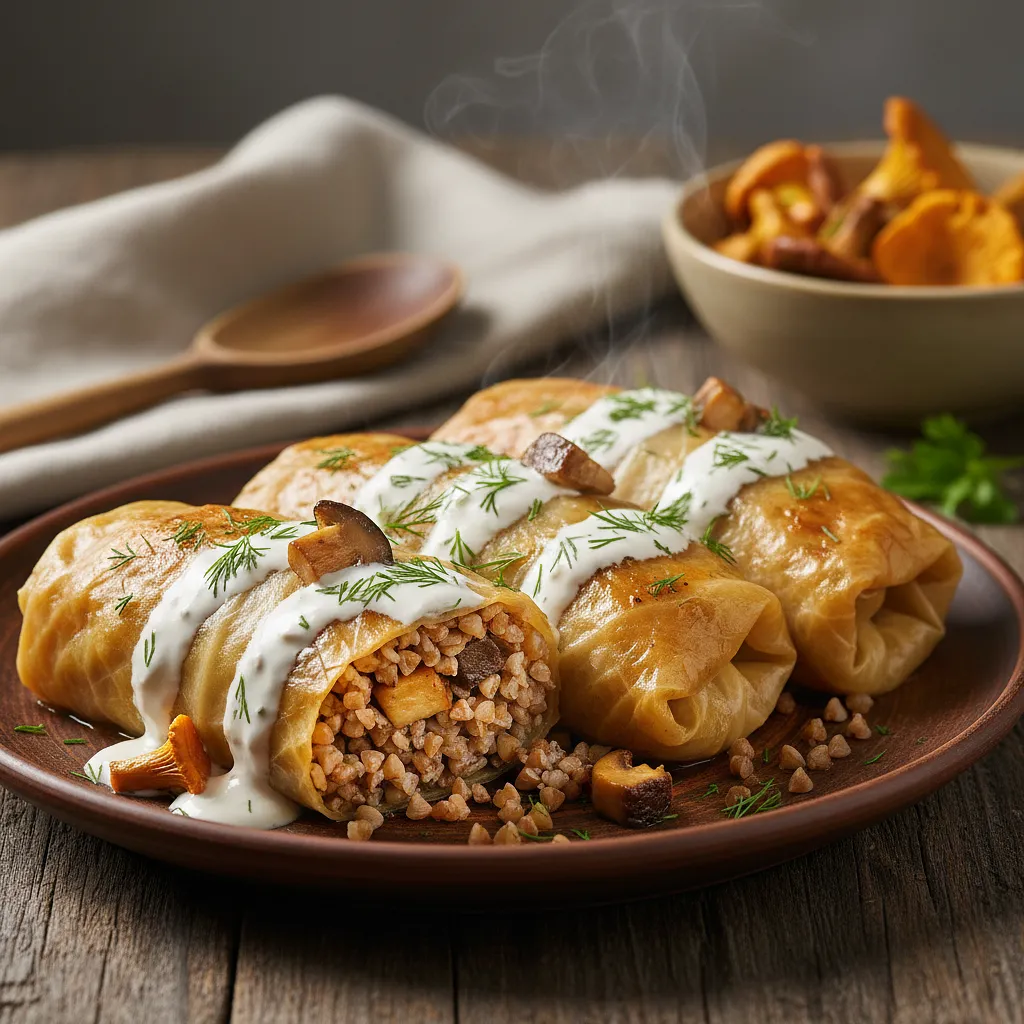
Christmas Cabbage Rolls with Buckwheat and Forest Mushrooms

Pikantne Regional Cuisine for Christmas Eve Christmas Dishes Vegan dishes 180 min Medium 11 wyświetleń ~25.42 PLN - (0)
Rate:
(0)

Description

Christmas cabbage rolls with buckwheat and mushrooms are a traditional dish of Polish regional cuisine, particularly popular in the eastern part of the country, including Podlasie and Lublin. They serve as a fasting, vegan alternative to classic meat-filled cabbage rolls, perfectly fitting the character of the Christmas Eve dinner. Their heart is an aromatic filling made of roasted buckwheat, which adds a nutty flavor, and dried forest mushrooms, bringing a deep, earthy aroma of the woods. The whole is wrapped in delicate, blanched leaves of white cabbage and slowly stewed in a light tomato-mushroom sauce. The dish is incredibly hearty and warming. Served hot, drizzled with the stewing sauce and sprinkled with fresh dill, they look very appetizing. It is a dish that evokes memories and creates a festive atmosphere, and its flavor deepens the next day.

Składniki (14)

Servings:
4
  • White cabbage 1500 g
  • Roasted buckwheat groats 200 g
  • Dried forest mushrooms 50 g
  • Onion 2 szt.
  • Garlic 3 ząbki
  • Rapeseed oil 45 g
  • Vegetable broth 500 ml
  • Tomato paste 50 g
  • 🌿 Przyprawy
  • Dried marjoram 2 łyżeczki
  • Salt 15 g
  • Pieprz czarny świeżo mielony 3 szczypty
  • ✨ Opcjonalne
  • Fresh dill 0.5 pęczek
  • Bay leaf 3.3 szt.
  • Allspice 1.5 g
💰 Szacowany koszt dania: ~25.42 PLN (6.35 PLN/porcję)

💡 Kliknij na składnik aby oznaczyć jako użyty

Preparation steps

Preparation of mushrooms and groats

1

Start by preparing the mushrooms. Place 50g of dried mushrooms in a medium-sized bowl. Pour about 500 ml of boiling water over them. Make sure all the mushrooms are submerged. Cover the bowl with a plate and let it sit for at least 30 minutes, preferably for an hour. During this time, the mushrooms will swell and soften, and the water will take on an intense, mushroom aroma.

Ingredients: Dried forest mushrooms
Do not pour out the water after soaking the mushrooms! It is the essence of flavor that will serve as a base for the sauce. Before pouring, it's a good idea to quickly rinse the mushrooms in a sieve under cold water to remove any potential impurities, such as sand.
2

After soaking, drain the mushrooms in a fine sieve, keeping all the water. Chop the mushrooms fairly finely with a knife on a cutting board. The finer you chop them, the better they will combine with the groats in the filling. Carefully pour the mushroom water (broth) into another container, leaving any sediment at the bottom.

Ingredients: Dried forest mushrooms
Use a sharp chef's knife. Chopping mushrooms can be time-consuming, but it's worth taking a moment for it. Don't use a blender, as it will turn the mushrooms into a mush – we want a noticeable texture.
3

Cook the buckwheat. Pour 200g of buckwheat into a small pot, add 400 ml of cold water (ratio 1:2), and add half a teaspoon of salt. Bring to a boil, then reduce the heat to the minimum, cover the pot, and cook for about 15 minutes, until the buckwheat absorbs all the water. Do not stir the buckwheat while cooking. After cooking, remove the pot from the heat and let it sit covered for another 10 minutes to finish cooking. It should be fluffy, not sticky.

Ingredients: Roasted buckwheat groats, Salt
Cooking the groats until fluffy is key for a good filling consistency. If there is still water at the bottom of the pot after 15 minutes, remove the lid and cook a little longer to let it evaporate. You can also 'bake' the groats by wrapping the pot in a blanket or placing it in a slightly warmed oven.

Preparing the cabbage

4

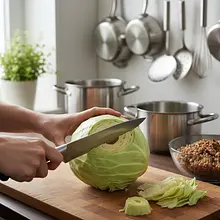
Prepare a head of cabbage. Using a sharp, long knife, cut out the core, which is the hard center at the base of the cabbage. Insert the knife at an angle around the core, creating a cone shape, then pry it out and remove it. This will make it easier for the leaves to separate during blanching.

Ingredients: White cabbage
Use a stable cutting board and be careful, as the cabbage is tough. It's best to use a narrow but strong knife. The deeper you cut the core, the easier it will be to separate the leaves.
5

In a large pot (large enough to fit the whole cabbage), bring water to a boil with one teaspoon of salt. When the water is boiling, carefully place the cabbage in upside down. Cook over medium heat for about 5-10 minutes. After this time, the leaves will start to soften and come off. Using two forks or tongs, gently remove each leaf one by one and place them on a large plate or colander to cool. Remove about 12-16 of the largest leaves.

Ingredients: White cabbage, Salt
Do not cook the cabbage too long, as the leaves will become too soft and tear. They should only be flexible. If the inner leaves are still hard, put the cabbage back into boiling water for a few minutes. The rest of the cabbage can be shredded and used for another dish, such as a salad.

Preparation of the filling

6

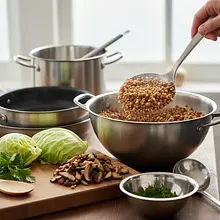
In a large skillet, heat 45 ml of rapeseed oil. Dice both onions finely and add them to the heated oil. Sauté over medium heat for about 8-10 minutes, stirring frequently, until the onion becomes soft, translucent, and slightly golden. Then add the garlic, pressed through a garlic press or finely chopped, and sauté for another minute until it releases its aroma. Finally, add the previously chopped mushrooms and sauté everything together for another 5 minutes.

Ingredients: Rapeseed oil, Onion, Garlic, Dried forest mushrooms
Use a heavy-bottomed pan that distributes heat evenly. Patient, slow frying of the onions is key to bringing out their natural sweetness, which will enhance the filling's flavor. Be careful not to burn the garlic, as it will become bitter.
7

Remove the pan from the heat. Transfer the cooked buckwheat to a large bowl, add the entire contents of the pan (onion with mushrooms). Season the filling with 4g (2 teaspoons) of crushed marjoram, salt (about 1.5 teaspoons), and freshly ground pepper (about half a teaspoon). Mix everything very thoroughly with a large spoon until the ingredients are evenly combined. Taste the filling and adjust with more salt or pepper if needed. It should be flavorful.

Ingredients: Roasted buckwheat groats, Onion, Dried forest mushrooms, Dried marjoram, Salt, Pieprz czarny świeżo mielony
The filling may seem a bit dry - that's normal. During the stewing of the cabbage rolls, it will absorb moisture from the cabbage and sauce. Mix thoroughly so that all ingredients are included in each cabbage roll. This is a good time to adjust the flavor of the filling to your preferences.

Shaping and cooking the cabbage rolls

8

Prepare the cabbage leaves for wrapping. Cut off or gently crush (e.g., with the handle of a knife) the tough, thick rib at the base of each cooled leaf. This will make the leaf more flexible and easier to roll.

Ingredients: White cabbage
This is a very important step! If you skip removing the tough nerve, the cabbage rolls will be difficult to roll, and the thickening will remain hard after cooking. You can cut it out with a knife, holding it flat parallel to the leaf.
9

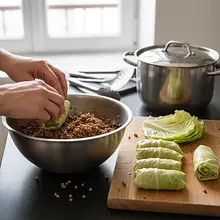
It's time to roll the cabbage rolls. In the center of each leaf, closer to the stem, place a portion of the filling (about 2-3 tablespoons). First, fold the stem end of the leaf over the filling (the part where you cut off the thickening). Then, fold in the left and right sides of the leaf. Finally, roll it all tightly towards the end of the leaf, creating a neat, closed package. Do the same with the remaining leaves and filling.

Ingredients: White cabbage
Do not add too much filling, as the cabbage roll may burst during cooking. Try to roll the cabbage rolls quite tightly so they do not fall apart. It's like rolling croquettes or spring rolls. The first few may not be perfect, but you'll quickly get the hang of it!
10

Choose a wide pot or a baking dish with a thick bottom. Line the bottom of the vessel with several leftover, even torn cabbage leaves. This will prevent the stuffed cabbage rolls from sticking and burning on the bottom. Arrange the rolled cabbage tightly in the pot, one next to the other, seam side down. You can stack them in layers.

Ingredients: White cabbage
A tight arrangement of the cabbage rolls is important as it prevents them from unraveling during cooking. If you have small or torn leaves that are not suitable for rolling, they work perfectly as a lining for the bottom of the pot.
11

Prepare the sauce. In a bowl, combine the reserved mushroom broth (about 400-500ml), 500 ml of vegetable broth, and 50g of tomato paste. Mix thoroughly. Pour the prepared sauce over the stuffed cabbage rolls so that they are almost completely covered. If using, add the bay leaf and allspice now. Bring to a boil over high heat, then reduce the heat to the minimum, cover the pot, and simmer slowly for about 60-90 minutes, until the cabbage is completely tender.

Ingredients: Vegetable broth, Tomato paste, Bay leaf, Allspice
Cabbage rolls can also be baked. For this purpose, place them in a baking dish, pour sauce over them, cover, and put in an oven preheated to 180°C for about 90 minutes. At the end of baking, you can remove the lid to let the sauce reduce slightly.
12

After the simmering time is up, gently take out one stuffed cabbage and check with a fork if the cabbage is tender. The sauce should have thickened. Remove the bay leaf and allspice. Serve the stuffed cabbages hot, generously drizzled with the sauce they were braised in. Optionally, for freshness and decoration, sprinkle them with a generous amount of freshly chopped dill.

Ingredients: Fresh dill
They taste best on the second or even third day, when the flavors have melded. You can reheat them in the same sauce over low heat or in the oven.

Fun Fact

💡

The name 'gołąbki' probably has nothing to do with birds. It is a Polish adaptation of the Ukrainian word 'hołubci', which may have referred to ancient, luxurious dishes made with stuffed pigeons, served at wealthy courts. Over time, the name was adopted for a 'poor man's' dish, namely cabbage stuffed with groats or potatoes.

Best for

Tips

🍽️ Serving

Serve the stuffed cabbage on deep plates, with 2-3 pieces per serving. Generously drizzle with the braising sauce and sprinkle with fresh dill. Traditionally, they are served as one of the main hot dishes on Christmas Eve. They pair perfectly with a simple mushroom sauce made from a broth of forest mushrooms.

🥡 Storage

Store the stuffed cabbage in the refrigerator, in a tightly sealed container or in the pot they were braised in, for up to 4 days. It is best to reheat them slowly in the sauce over low heat or in the oven covered. They can also be frozen - it is best to arrange them in a single layer in containers and cover with sauce.

📸 Ugotowane przez społeczność

Zaloguj się, aby dodać zdjęcie
Dodaj zdjęcie gotowej potrawy

Po zatwierdzeniu przez moderatora otrzymasz 10 punktów doświadczenia.

🍲

Nikt jeszcze nie dodał zdjęcia. Bądź pierwszy!

Comments (0)

Be the first to comment on this recipe!

Add a comment

You might also like

Recipe Categories

Regional cuisine for Christmas Eve features local traditions from various corners of Poland. Christmas Eve pierogi ruskie from Podkarpacie - with potatoes, cheese, and onions. Carp in Kashubian style - in horseradish sauce with raisins and almonds. Silesian żurek on sourdough - with mushrooms ins...

See all recipes in this category

Christmas Eve dishes are the heart of Polish holiday tradition - 12 meatless dishes on the table. Fried, baked, jellied, and Jewish-style carp - the main star of Christmas Eve. Dumplings with cabbage and mushrooms - handmade according to grandma's recipes. Small mushroom-filled pockets for borsch...

See all recipes in this category

Vegan cuisine features delicious dishes without animal products - healthy, ethical, and environmentally friendly. Plant-based protein: tofu, tempeh, soy, lentils, chickpeas, and beans take center stage. Vegan dairy substitutes: plant milks, cashew cheese, and vegan yogurts. Recipes for vegan burg...

See all recipes in this category
Main Dishes
Main Dishes in: Christmas Eve Dinner

Main courses are the heart of every meal - hearty, delicious, and full of nutrients. Meats: beef, pork, poultry, and lamb in various versions. Fish and seafood: baked, fried, grilled, and stewed. Vegetarian dishes: tofu, tempeh, legumes as the main protein. Casseroles: pasta, potato, vegetable wi...

See all recipes in this category
Reklama