Menu

Honey Roasted Pork Knuckle

Pikantne Main Dishes European cuisine 240 min Medium 15 wyświetleń ~53.14 PLN - (0)
Rate:
(0)

Description

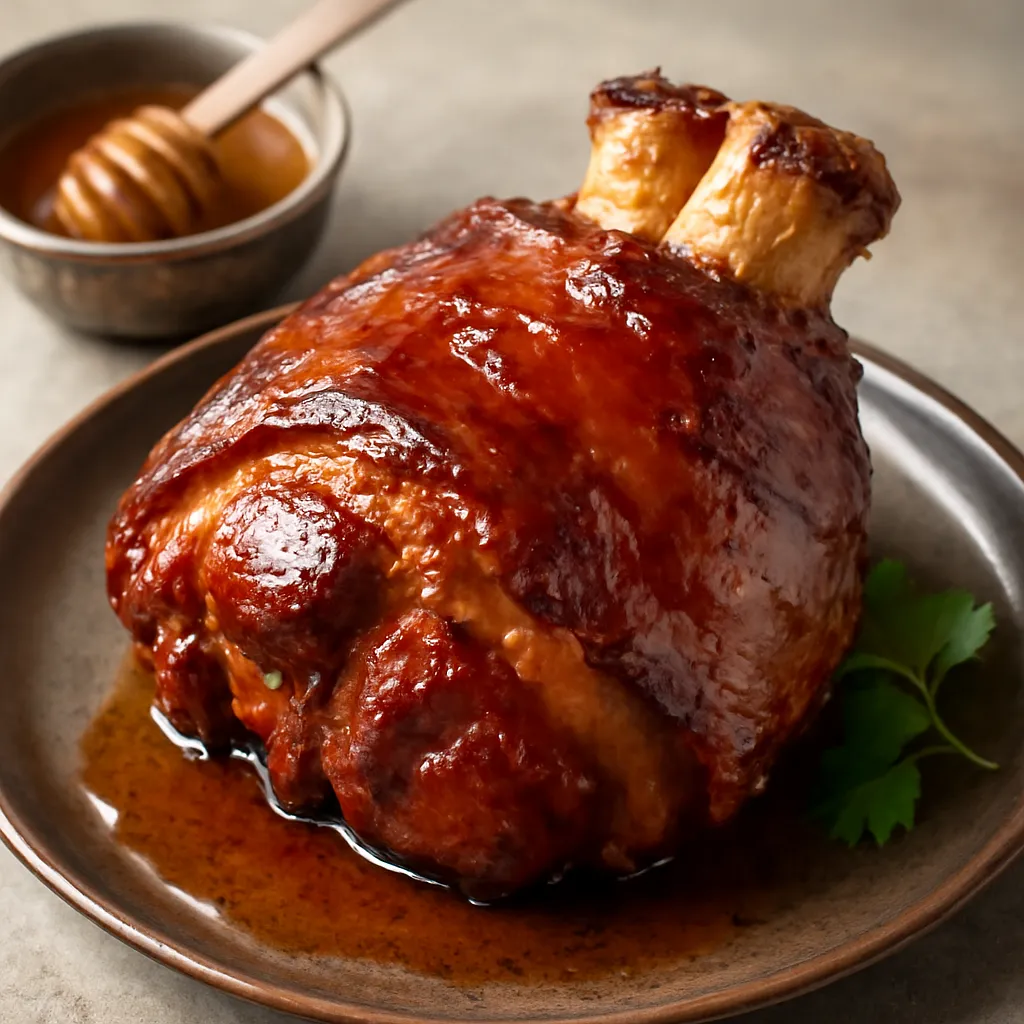
Honey-baked pork knuckle is a juicy, slightly sweet-glazed pork knuckle, with a crispy skin and tender, fork-falling-apart meat. This dish originates from Central European cuisine, where pork knuckle is valued for its intense flavor and rustic character. The combination of honey, mustard, and soy sauce gives the dish a complex umami taste with a delicate hint of sweetness and acidity, while the roasted skin adds an impressive appearance perfect for New Year's Eve 2025. Serve with roasted potatoes, sautéed cabbage, or bread and mustard. Qualities: contrast of textures (crispy skin vs. tender meat), aromatic glaze, and impressive presentation when sliced at the table.

Składniki (15)

Servings:
4
  • Raw pork knuckle 1600 g
  • Honey 100 ml
  • Dijon mustard 30 g
  • Soy sauce 30 ml
  • Apple cider vinegar 30 ml
  • Garlic 6 ząbków
  • Onion 1 szt.
  • Vegetable broth 500 ml
  • Olive oil 30 ml
  • Butter 30 g
  • 🌿 Przyprawy
  • Salt 12 g
  • Ground black pepper 4 szczypty
  • smoked paprika (sweet) 5 łyżeczek
  • ✨ Opcjonalne
  • Fresh thyme 30 g
  • Dried chili flakes 2 łyżeczki
💰 Szacowany koszt dania: ~53.14 PLN (13.29 PLN/porcję)

💡 Kliknij na składnik aby oznaczyć jako użyty

Preparation steps

Preparation

1

Unwrap the shanks and dry them thoroughly with a paper towel. If the skin is very wet, leave the meat on a rack in the refrigerator for 1 hour to allow the skin to dry slightly — this will make it easier to crisp later.

Ingredients: Raw pork knuckle
Use a large tray or drying rack and paper towels. Do not try to crisp wet skin — the result will be rubbery.
2

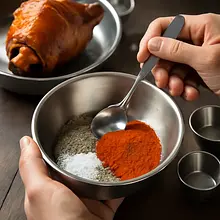
Prepare the rub: in a bowl, mix 12 g of salt, 4 g of black pepper, and 10 g of smoked paprika. Rub the shanks with the salt and spices on all sides, massaging the mixture into the skin and meat. Focus on even distribution.

Ingredients: Salt, Ground black pepper, smoked paprika (sweet), Raw pork knuckle
Use your hands (you can wear gloves) and rub the spices in well. Do not salt at the last minute - leaving it for at least 1-2 hours (or preferably overnight in the fridge) will improve the penetration of the salt.

Marinade

3

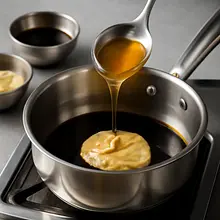
Prepare the glaze: in a small saucepan over low heat, combine 100 g of honey, 30 g of Dijon mustard, 30 g of soy sauce, 30 g of apple cider vinegar, and 30 g of oil. Add 30 g of chopped garlic and 150 g of finely chopped onion. Gently heat for 5-7 minutes, stirring, until the honey dissolves and the ingredients combine. Cool to room temperature.

Ingredients: Honey, Dijon mustard, Soy sauce, Apple cider vinegar, Olive oil, Garlic, Onion
Use a wooden spoon, a small saucepan with a capacity of 1 l. Be careful not to bring it to a boil — a light simmer for a few minutes is enough. Cooling is important to avoid 'cooking' the meat with the hot glaze.
4

If you have time, soak the pork knuckles in the prepared, cooled marinade and set aside in the fridge for 2-12 hours (preferably overnight). If you're in a rush, leave them for just 2 hours in the fridge covered with plastic wrap. The marinade should cover not only the meat but also the skin.

Ingredients: Honey, Dijon mustard, Soy sauce, Apple cider vinegar, Garlic, Onion, Olive oil
Use a large baking dish or bowl and plastic wrap. If the marinade does not completely cover the meat, turn the shanks every few hours.

Braising (pre-cooking)

5

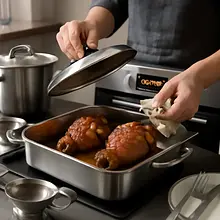
Preheat the oven to 160°C (top-bottom). Transfer the shanks to a large baking dish or roasting pan. Pour in 500 ml of vegetable broth so that it reaches about 1/3 of the height of the shanks. Add 1 bunch of fresh thyme (if using) and cover tightly with aluminum foil or a lid. Place in the oven and braise for 2 hours.

Ingredients: Raw pork knuckle, Vegetable broth, Fresh thyme
Use a baking dish measuring at least 30x20 cm. The dish should be tightly covered to prevent steam from escaping. Check the liquid level after 90 minutes — if it has evaporated significantly, replenish it with hot broth.

Stewing (continued)

6

After 2 hours, remove the dish (carefully, hot steam). Check the tenderness of the meat: insert a fork into the thickest part — it should go in easily, and the meat should start to separate, but not completely fall off the bone. If it's still tough, cover and braise for another 30 minutes.

Ingredients: Raw pork knuckle
Use a long fork or meat probe. Do not force it out; it's better to braise longer than to rush with a higher temperature.

Baking and glazing

7

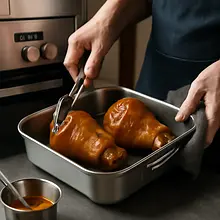
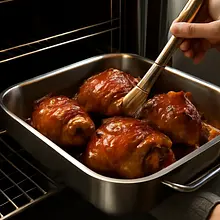
Increase the oven temperature to 220°C (grill/convection if available). Remove the shanks, uncover them. Strain the liquid remaining in the roasting pan into a saucepan and reduce over medium heat for 5-8 minutes to achieve a concentrated sauce. In the meantime, brush the shanks with 1/3 of the prepared glaze (set aside) evenly using a brush or spoon.

Ingredients: Honey, Dijon mustard, Soy sauce, Apple cider vinegar, Raw pork knuckle
Use a silicone brush to evenly spread the glaze. Reduce the liquid in a small saucepan, stirring occasionally to avoid burning the sugars from the honey.
8

Place the hocks in the oven and bake for 20-30 minutes: every 8-10 minutes, take out the tray (briefly wait on the handle) and brush with glaze again. Slightly turn the hocks to ensure the skin browns nicely on all sides. The goal is to achieve a deep golden, slightly caramelized skin — the surface should be shiny, and the honey slightly darker in places (not burnt).

Ingredients: Honey, Butter, Dried chili flakes
Use the convection/grill setting if you have it, but keep an eye on it — honey burns quickly. If you see black spots, immediately reduce the temperature by 10-20°C.

Finishing

9

Remove the shanks from the oven. Place 30 g of butter on the hot meat and let it melt, spreading it with a brush over the surface. Set the shanks on a cutting board and wait 15 minutes — resting will allow the juices to distribute evenly.

Ingredients: Butter
Use a cutting board with a rim to catch the juices. Do not cut the pork knuckle immediately after taking it out, as the juices will run out and the meat will be dry.

Serving

10

Cut the pork knuckle into slices along the bone or divide it into whole portions. Serve with reduced sauce (strained) on the side, baked potatoes or mashed potatoes, and with cabbage or sauerkraut. For decoration, use fresh sprigs of thyme and lightly sprinkle with chili flakes if you like it spicy.

Ingredients: Raw pork knuckle, Fresh thyme, Dried chili flakes
Use a sharp knife to cut near the bone. On the plates, add the sauce in a small jug so guests can request more.

Cleaning and leftovers

11

Save the remaining sauce and any meat scraps — they can be strained and reduced to make a sauce for snacks or for spreading on bread. The leftover meat can be used the next day for stew or sandwiches.

Ingredients: Vegetable broth, Soy sauce
Store leftovers in the refrigerator in a sealed container for up to 2 days or freeze for up to 3 months.

Fun Fact

💡

Pork knuckle was a traditional, hearty dish in Central European countries; thanks to the long braising, the meat becomes tender, and the crispy skin provides a satisfying crunch, which contrasts wonderfully with the softness of the interior.

Best for

Tips

🍽️ Serving

Serve the pork knuckle with a thick reduced sauce in a separate jug. It pairs well with heavier sides: roasted potatoes, celery-potato puree, braised red or white cabbage, and mustard. For drinking: strong lager beer or dark caramel beer; alternatively, red wine with moderate tannins.

🥡 Storage

Store the pork knuckle in the refrigerator in an airtight container for up to 2 days. To reheat: place in a baking dish, add 2-3 tablespoons of broth, and cover with aluminum foil, heat in the oven at 160°C for 20-30 minutes, and before serving, briefly roast at a high temperature to refresh the skin.

📸 Ugotowane przez społeczność

Zaloguj się, aby dodać zdjęcie
Dodaj zdjęcie gotowej potrawy

Po zatwierdzeniu przez moderatora otrzymasz 10 punktów doświadczenia.

🍲

Nikt jeszcze nie dodał zdjęcia. Bądź pierwszy!

Comments (0)

Be the first to comment on this recipe!

Add a comment

You might also like

Recipe Categories

Main Dishes
Main Dishes in: Christmas Eve Dinner

Main courses are the heart of every meal - hearty, delicious, and full of nutrients. Meats: beef, pork, poultry, and lamb in various versions. Fish and seafood: baked, fried, grilled, and stewed. Vegetarian dishes: tofu, tempeh, legumes as the main protein. Casseroles: pasta, potato, vegetable wi...

See all recipes in this category

European cuisine is a mosaic of culinary traditions from the Old Continent - from Spain to Scandinavia. Valencian paella and tapas from Spain - sunshine on a plate. Boeuf bourguignon and ratatouille from France - elegance and finesse. Wiener schnitzel and strudel from Austria - Central European c...

See all recipes in this category
Reklama