Pour the wheat flour into a large, clean bowl. Make a small well in the flour. In a separate jug, measure out cool water and dissolve 1 g of salt (from the total amount) in it. Gradually pour the water into the well and mix with your hand or a wooden spoon, gathering the flour from the sides until a loose dough forms.
Description
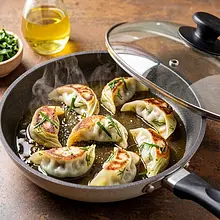
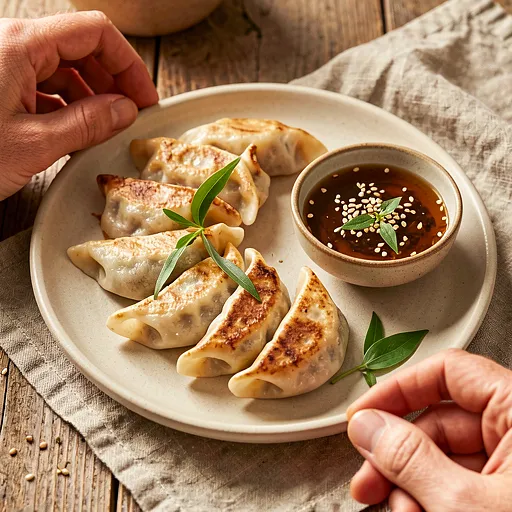
Delicate gyoza dumplings with a Polish spring filling: young cabbage with the aroma of wild garlic, sautéed with onion and bound with egg. Served with a creamy, sweet-sour soy-dill sauce with a touch of apple cider vinegar, which adds freshness and highlights the herbal character of the dill. The dish combines Asian technique (pan-frying with steaming) with the flavors of Polish spring — light, green, perfect as an appetizer or main course for 4 people. They look appetizing: golden bottoms, moist interiors, green accents of garlic and dill. Serve with a dipping sauce and optional toasted sesame seeds for a contrast in texture.
Ingredients Used
Ingredients (16)
- Wheat flour 400 g
- Water 200 ml
- Young cabbage 0.4 szt. (~500 g)
- Wild garlic 30 g
- Onion 1 szt. (~150 g)
- Chicken egg 1 szt. (~60 g)
- Rapeseed oil 30 g
- Soy sauce 80 ml
- Apple cider vinegar 20 ml
- Sugar 10 g
- Cornstarch 10 g
- 🌿 Przyprawy
- Salt 8 g
- Dill 1 pęczek (~20 g)
- Black pepper 4 szczypty (~2 g)
- ✨ Opcjonalne
- Sesame 10 g
- Chili flake 2 g
💡 Kliknij na składnik aby oznaczyć jako użyty
Preparation steps
Cake
Place the dough on a lightly floured countertop and knead by hand for 8–10 minutes until it is smooth, elastic, and less sticky. If the dough is too dry, add a teaspoon of water; if too wet — sprinkle in a little flour. Shape into a ball.
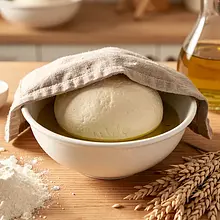
Transfer the ball of dough to a bowl greased with a teaspoon of rapeseed oil, cover with a damp cloth, and let it rest for 30 minutes at room temperature so the gluten can relax — the dough will become more elastic and easier to roll out.
Filling
Wash and drain the young cabbage. Remove the tough parts and chop it very finely with a knife. Chop the onion very finely. Heat 1 tablespoon of rapeseed oil in a medium skillet.
In a heated pan, sauté the onion for 3–4 minutes until it becomes soft and translucent. Add the chopped young cabbage, 1 g of salt, and 1 g of black pepper. Fry, stirring for 6–8 minutes, until the cabbage softens but retains a slight crunch. Set aside to cool.
Finely chop the wild garlic leaves. In a large bowl, mix the cooled cabbage with the chopped wild garlic, beaten egg, and 1 g of salt. Taste the filling and adjust with salt and pepper — the filling should be flavorful but not overly salty, as the soy sauce is salty.
Shaping
Divide the rested dough into 3 parts. Roll each part thinly (about 2 mm) on a floured surface. Use a glass with a diameter of 7–8 cm or a special cutter to cut out circles. Knead and roll out the remaining dough again until you use it all. The circles should be about 7–8 cm in diameter.
Place a teaspoon of filling in the center of each circle (about 8–12 g of filling). Moisten the edges of the circle with water using your finger, fold it in half, and seal the edges tightly, creating small pleats along the closure — this is typical for gyoza and ensures a tight seal during steaming.
Frying and steaming
Heat a non-stick skillet (best 26–28 cm) with 1 tablespoon of canola oil over medium-high heat. Place the gyoza bottom side down in the skillet, do not overcrowd (about 8–10 pieces at a time). Fry for 2–3 minutes until the bottoms are golden and slightly crispy.
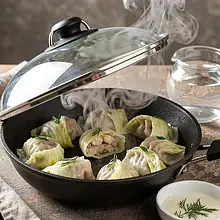
When the bottoms are golden, pour 80 ml of water into the pan (be careful, the steam will be intense) and immediately cover with a tight-fitting lid. Reduce the heat to medium and cook covered for 4–6 minutes, until the water evaporates and the gyoza are soft inside.
Sauce
In a small saucepan, combine soy sauce, apple cider vinegar, sugar, and finely chopped dill. Heat over low heat until the sugar dissolves. In a bowl, mix cornstarch with 20 ml of cold water and pour it into the sauce, stirring vigorously until the sauce thickens slightly (1–2 minutes). Finally, season with a pinch of black pepper and, if you want some heat, add a chili flake.
Assembly and serving
Transfer the finished gyoza to a plate, the bottom should be golden, the top soft. Serve with a bowl of dill soy sauce. Optionally sprinkle with toasted sesame seeds and fresh wild garlic leaves for decoration.
Cleaning and leftovers
If there are unbaked dumplings left, you can freeze them arranged on a tray, and then transfer them to a bag. Fry the frozen gyoza directly from frozen, adding 1–2 minutes longer during steaming.
Fun Fact
Gyoza is the Japanese version of Chinese jiaozi; in Poland, the popular filling has long been local cabbage and herbs — here, wild garlic is used for a local touch.
Best for
Tips
Serve immediately after preparation. For a contrast of textures, add toasted sesame seeds and slices of fresh pickled cucumber. You can also serve additional bowls with rice vinegar and chili paste.
Store cooked gyoza in the refrigerator for up to 24 hours in an airtight container. Reheat in a pan with a little water covered, until hot. Frozen raw gyoza can be stored for up to 1 month; fry without thawing.
📸 Ugotowane przez społeczność
Zaloguj się, aby dodać zdjęcieDodaj zdjęcie gotowej potrawy
Po zatwierdzeniu przez moderatora otrzymasz 10 punktów doświadczenia.
Nikt jeszcze nie dodał zdjęcia. Bądź pierwszy!
Comments (0)
Be the first to comment on this recipe!
Add a comment