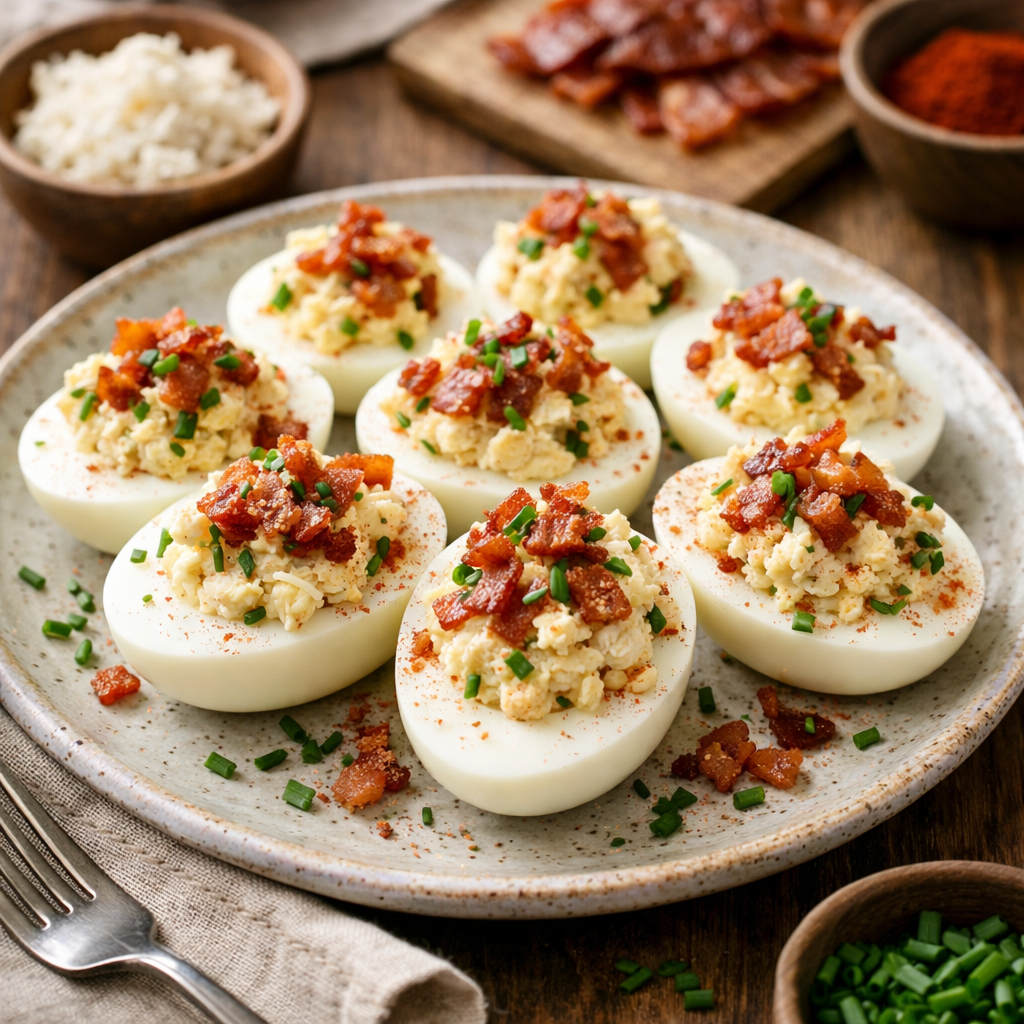
Stuffed eggs Polish style with cottage cheese, horseradish, and crispy bacon

Appetizers Dishes for Special Occasions 50 min Medium 84 wyświetleń ~19.56 PLN - (0)
Rate:
(0)
Start Cooking

Description

A classic appetizer in a modern Polish version: a combination of creamy twaróg and egg yolks with sharp horseradish and tangy pickled cucumber, finished with caramelized onions and crispy bacon. A dish inspired by traditional Polish flavors, but with a twist of textures — smooth, delicate filling versus salty, crunchy bacon. Great for parties, Easter, Sunday breakfast, or as a snack with beer. Visually: white egg halves with a light cream-colored filling, green accents of chives and dill, and golden-brown cracklings on top. Flavor-wise, it combines the mildness of twaróg and mayonnaise, the spiciness of horseradish, and the freshness of pickled cucumber.

Ingredients Used

Ingredients (12)

Servings:
4
  • Chicken egg 8 szt. (~480 g)
  • Semi-fat cottage cheese 200 g
  • Mayonnaise 80 g
  • Pickled cucumber 1 szt. (~100 g)
  • Smoked bacon 100 g
  • Onion 0.5 szt. (~75 g)
  • Grated horseradish 30 g
  • 🌿 Przyprawy
  • Salt 2 g
  • Black pepper 2 szczypty (~1 g)
  • Chives 0.3 pęczków (~30 g)
  • ✨ Opcjonalne
  • Dill 1.5 pęczki (~30 g)
  • Smoked paprika powder 0.4 łyżeczek (~2 g)
💰 Szacowany koszt dania: ~19.56 PLN (4.89 PLN/porcję)

💡 Kliknij na składnik aby oznaczyć jako użyty

Preparation steps

Cooking eggs

1

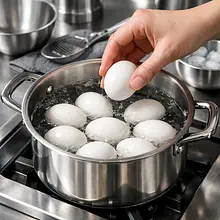
Prepare a pot with a diameter suitable for 8 eggs (preferably 18–20 cm). Arrange the eggs in a single layer at the bottom of the pot. Cover with cold water so that the water reaches about 2 cm above the eggs. Add 1 pinch of salt (1 g) to the water — this will make peeling the shells easier. Place the pot over high heat and bring to a boil, cover with a lid, and once boiling, reduce the heat to medium and cook for 9 minutes to achieve hard-boiled eggs with a creamy yolk. After 9 minutes, immediately transfer the eggs to cold water and place them in a bowl of ice-cold water (optionally add a few ice cubes) for at least 5 minutes — this will stop the cooking process and make peeling easier.

Use a pot with a steaming tray or a regular saucepan. A time of 9 minutes from boiling gives firm, unovercooked yolks; if you prefer completely dry yolks, extend to 11 minutes. A cold bath is crucial — without it, the yolks may continue to cook.

Peeling and preparing the yolks

2

Remove the cooled eggs from the icy water. Gently tap each egg against a hard surface and roll it under your hand to crack the shell. Peel each egg under running cold water — the water will seep under the shell and make it easier to remove the membrane. Cut each egg in half lengthwise with a sharp knife, inserting the blade once and pulling to make a smooth cut. Scoop out the yolks with a teaspoon and set them aside in a large bowl; place the whites on a plate to fill later.

Use a sharp, thin knife and a teaspoon to remove the yolks. If the yolks stick to the whites, gently cut the point of contact with the knife to make it easier to remove. Peel under water to avoid small pieces of shell.

Fried bacon and caramelized onions

3

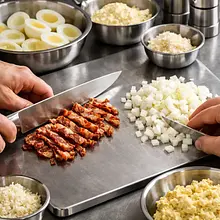
Cut the bacon into strips about 1 cm wide, and peel and finely dice the onion (if using half an onion — 75 g — slice it into thin half-moons). Heat a 24 cm skillet over medium heat (preferably non-stick). Add the bacon without any additional fat and fry for 5–7 minutes, until the fat renders and the bacon becomes golden and crispy. Remove the bacon to a paper towel to drain excess fat. In the same skillet, reduce the heat to medium-low, add the chopped onion, and sauté for 6–8 minutes, stirring frequently with a wooden spoon, until the onion becomes translucent and then lightly caramelizes (it should be soft and light golden). After frying the onion, combine it with the bacon.

Use a wide skillet so the bacon has room to cook and brown evenly. Don't burn the bacon — too high a temperature will scorch the flavor. Sauté the onion over medium-low heat to bring out its sweetness without burning it.

Filling

4

To the bowl with the separated yolks, add the cottage cheese (200 g). Mash the yolks and cottage cheese with a fork or potato masher until you achieve a uniform, smooth consistency (it should be creamy with a slight graininess from the cottage cheese). Add the mayonnaise (80 g) and horseradish (30 g). Mix thoroughly until the mixture is smooth and slightly loose. Finely chop the pickled cucumber (100 g) and add it to the filling. Season lightly with salt (use a maximum of 1 g of salt — remember the saltiness of the bacon and cucumbers) and add freshly ground pepper (1 g). Add about 2/3 of the chopped chives (from a bunch of 30 g) and mix in. Consistency: the filling should be thick but soft enough to easily scoop with a teaspoon or pipe from a pastry bag. If the mixture is too dry, add 1–2 teaspoons of mayonnaise (15–30 g).

Use a fork to mash or an immersion blender on low speed if you prefer a very smooth filling. Don't overdo it with the horseradish — it's better to add less and then adjust the seasoning than to go overboard with the spiciness. Check the taste before filling.

Filling and decoration

5

Prepare a serving plate. Fill the egg whites with the filling using a teaspoon or transfer the filling to a piping bag with a large tip and pipe shaped mounds onto each half. On top of each half, place a teaspoon (or a bit) of caramelized onion and a few pieces of crispy bacon. Sprinkle the rest of the finely chopped chives over the top. Optionally, lightly dust with smoked paprika (2 g) for color and a smoky aroma, and garnish with fresh dill (30 g) if using.

If you want an aesthetic look, use a piping bag. Arrange the halves evenly on a plate in two rows. You can also add thin slices of radish for a fresh crunch.

Serving

6

Serve the eggs immediately after filling, while the bacon is still slightly warm and crispy. On the plate, you can arrange a few leaves of young lettuce or parsley as a base and serve with additional pickles on the side. If you prepare them in advance, store in the refrigerator, and keep the bacon and onion in a separate container in the fridge, adding them just before serving to maintain their crispness.

It is best served at a slightly chilled temperature (about 10–12°C) — this way the flavors are well pronounced. If serving as part of a cold platter, set it out just before the guests arrive.

Final tips

7

If you want a meatless variant, skip the bacon and add more crunchy carrots or toasted walnuts (optional). For a milder flavor, reduce the horseradish to 15 g. Prepare the filling up to 24 hours in advance and store it in a closed container, but fry the bacon and onion fresh before serving.

Instead of mayonnaise, you can use thick natural yogurt (Greek) — this will give a lighter flavor, but the filling will be less stable. Remember that eggs are a perishable product — do not leave them out of the fridge for too long.

Fun Fact

💡

Stuffed eggs are popular in many cultures; in Poland, they often appear on holiday tables. In the past, the fillings were more extravagant — for example, sardines, anchovies, or pickles with spices were added to diversify the flavors.

Best for

Tips

🍽️ Serving

Serve as a cold appetizer on a flat plate with fresh herbs and slices of pickled cucumber. If serving with alcohol, they pair well with craft beer and dry white wine. For aesthetics, use a piping bag to squeeze out the filling.

🥡 Storage

Store filled eggs in a closed container in the refrigerator for up to 24 hours. Keep the bacon and caramelized onions separately and add them before serving to maintain crispness. Do not freeze filled eggs (they will change texture).

📸 Ugotowane przez społeczność

Zaloguj się, aby dodać zdjęcie
Dodaj zdjęcie gotowej potrawy

Po zatwierdzeniu przez moderatora otrzymasz 10 punktów doświadczenia.

🍲

Nikt jeszcze nie dodał zdjęcia. Bądź pierwszy!

Comments (0)

Be the first to comment on this recipe!

Add a comment

You might also like

Recipe Categories

Appetizers
Appetizers in: New Year's Eve

Appetizers are a key element of the New Year's Eve menu, which should be colorful and impressive, encouraging people to try them.

See all recipes in this category

Dishes for special occasions are culinary masterpieces for birthdays, anniversaries, and holidays. Grilled beef steak with herb butter - restaurant quality at home. Beef Wellington - beef in puff pastry with duxelles. Roast duck with apples - a holiday tradition in a new edition. Pink salmon with...

See all recipes in this category
Reklama