Carpathian Cake with Custard Cream

Desserts Cakes and Bakes Regional Cuisine of Poland 90 min Hard 2 wyświetleń ~33.00 PLN * - (0)
Rate:
(0)
Start Cooking

Description

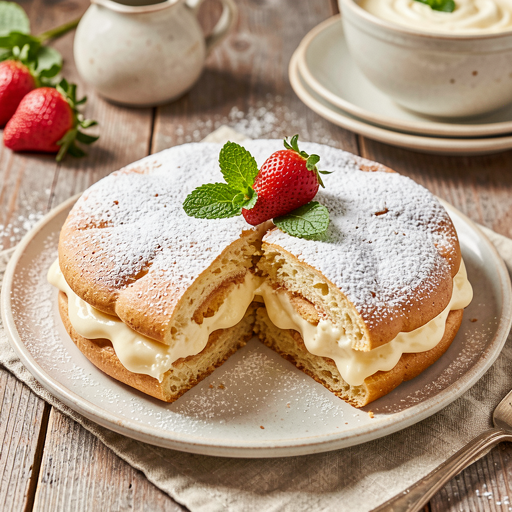
Traditional Polish Karpatka is a light dessert made from choux pastry consisting of two crispy layers resembling mountain peaks and fluffy custard cream. The origin of the dessert is linked to home cooking in Poland; the name refers to the "Carpathian" peaks formed by the irregular structure of the pastry. The dish works great as an afternoon snack or dessert for a party — it combines crunchy, golden layers with smooth, vanilla cream. Serve chilled, dusted with powdered sugar; it pairs well with seasonal strawberries or slightly tart rhubarb mousse for a contrasting flavor and color.

Ingredients Used

Ingredients (10)

Servings:
10
  • Wheat flour 250 g
  • Butter 400 g
  • Milk 1250 ml
  • Water 250 ml
  • Chicken egg 6 szt. (~360 g)
  • Sugar 180 g
  • Vanilla pudding 80 g
  • 🌿 Przyprawy
  • Salt 0.2 szczypt (~5 g)
  • ✨ Opcjonalne
  • Vanilla sugar 16 g
  • Powdered sugar 30 g
💰 Szacowany koszt dania: ~33.00 PLN (3.30 PLN/porcję)
* Brak cen dla niektórych składników

💡 Kliknij na składnik aby oznaczyć jako użyty

Preparation steps

Choux pastry

1

Prepare the tools and ingredients: two baking trays (preferably each 24×30 cm), baking paper, a saucepan, a wooden spoon, a large bowl, a measuring cup. Preheat the oven to 200°C (top-bottom). Weigh and prepare all the ingredients according to the list.

Use a baking sheet with dimensions close to those given; if you only have one, bake the layers one after the other. Preheat the oven for at least 20 minutes to ensure a stable temperature.
2

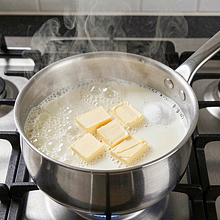
In a medium saucepan, pour in 250 ml of water and 250 ml of milk, add 200 g of butter, 30 g of sugar, and 5 g of salt. Place over medium heat and heat until boiling — the butter should completely melt. When it starts to boil and steam forms, immediately remove the saucepan from the heat.

Ingredients: Water, Milk, Butter, Sugar, Salt
Use a saucepan with a diameter of 18-20 cm with a solid bottom; make sure the mixture does not boil over. Heat over medium heat to allow the butter to melt evenly.
3

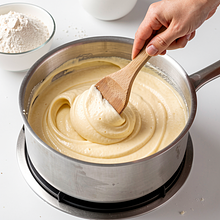
Add 250 g of wheat flour to the hot mixture all at once. Stir vigorously with a wooden spoon until the flour absorbs the liquid and forms a uniform, smooth dough that pulls away from the sides of the saucepan. Place the saucepan back on very low heat and warm for another 1–2 minutes, stirring constantly — this will evaporate the excess moisture.

Ingredients: Wheat flour
Mix vigorously to avoid lumps; the dough should form a ball and lightly 'film' the bottom of the pot. If there are pieces of flour remaining, sauté for a short while longer.
4

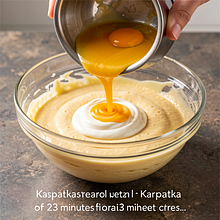
Pour the hot batter into a large bowl and let it sit for 2–3 minutes to cool slightly (it should be warm, but not hot). Then add the eggs one by one (6 pieces, a total of 360 g): crack one egg in, vigorously mix or stir with a wooden spoon until it is absorbed and the mixture becomes smooth, repeat with the remaining eggs. The batter is ready when it has a thick, shiny consistency and flows from the spoon in a thick ribbon — it should not be too runny or completely stiff.

Use a mixer with a dough hook or a hand whisk; if you don't have a mixer, beat by hand thoroughly for 5–7 minutes. Add the eggs gradually — adding them too quickly will cause the dough to separate.
5

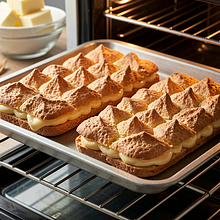
Divide the dough into two equal parts. Prepare two baking trays lined with parchment paper. On each, shape with your hands or a spatula an irregular, thick layer of dough (so that after baking the surface is rough and resembles mountain peaks). The thickness of the layer should be about 1–1.5 cm at the highest points.

Ingredients: Sugar
Use a wet spoon or spatula to spread the batter — it will prevent sticking. Do not smooth the surface too much; unevenness is desirable for the appearance of the karpatka.
6

Place the trays in the preheated oven and bake for 25–30 minutes at 200°C (top-bottom). Do not open the oven for the first 20 minutes — the cake should rise evenly. Once baked, the layers will be deep golden and crisp on the outside. Remove and let cool completely on a rack — do not stack the layers on top of each other to prevent steam from softening the bottom.

Ingredients: Wheat flour, Butter
The best is a cooling rack for cakes. If you are baking one tray after another, set the thermostat to 180–190°C for the second bake if the oven tends to burn.

Custard Cream

7

Prepare the cream: measure 1000 ml of milk, 150 g of sugar, and optionally 2 sachets of vanilla sugar (16 g). Pour 150 ml of this milk into a bowl and mix in 80 g of vanilla pudding until smooth and lump-free.

Ingredients: Milk, Sugar, vanilla pudding, Vanilla sugar
Use a wide metal pot and a whisk to distribute the pudding powder to avoid lumps. When measuring the ingredients, remember to be precise — the pudding can curdle with too much sugar or too rapid heating.
8

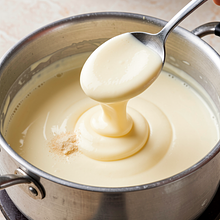
Heat the remaining milk (850 ml) in a pot with sugar and vanilla sugar. When the milk starts to boil, reduce the heat to medium and pour in the mixed pudding, whisking vigorously. Cook for 1–2 minutes after boiling until the pudding thickens — the mixture should be smooth, without lumps, and have the consistency of thick pudding.

Ingredients: Milk, Sugar, vanilla pudding
Stir vigorously while adding the pudding to avoid lumps. The finished pudding is very thick — if it is too runny, cook it for a shorter time; if it is too thick, you can add 1–2 tablespoons of milk.
9

Cover the cream with plastic wrap 'touching' (place the wrap directly on the surface of the cream) to prevent a skin from forming. Set aside to cool completely (you can place the pot in a cold water bath and stir every few minutes to speed up the cooling).

The overlapping foil is a key trick — it prevents a crust from forming. The cream must be cool (about 20–25°C) before you add the butter, otherwise the butter will melt.
10

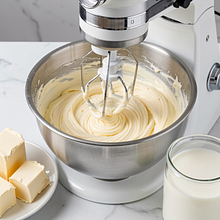
Beat 200 g of butter in a mixing bowl until fluffy and light (about 3–5 minutes on medium speed). Add 1–2 tablespoons of cooled pudding to the butter, mixing on low speed until all ingredients are combined and a smooth cream forms. Continue until all the pudding is added. The cream should be light, silky, and easy to spread.

Ingredients: Butter, vanilla pudding, Milk
The butter must be soft, at room temperature; if it is too cold, beat it longer or leave it out 30 minutes beforehand. Add the cool (not hot) pudding to avoid separation.

Assembly and decoration

11

When both layers of the cake are completely cool, place one layer on the countertop with the top side facing up. Spread the prepared custard cream evenly — the thickness of the cream should be about 1–1.5 cm. Cover with the second layer of cake. Gently press down to ensure the cream spreads evenly on the sides.

Ingredients: Powdered sugar
Use a wide spatula to spread the cream. Gently pressing down after placing the top layer will remove small air bubbles and level the layers.
12

Before serving, generously sprinkle the top with powdered sugar (about 30 g) through a sieve to achieve a 'snowy' effect. Chill the karpatka in the refrigerator for at least 2 hours (preferably 4 hours) — the cream will set, and the flavors will meld. Cut with a sharp knife just before serving.

Ingredients: Powdered sugar
Slicing is best done with a sharp, long knife (a bread knife works well); it's a good idea to wipe the knife before each cut to prevent it from dragging the cream.

Fun Fact

💡

The name 'karpatka' comes from the shape of the choux pastry, which resembles the jagged peaks of the Carpathians. The version with custard cream became popular in Polish homes in the 20th century as an easy yet impressive dessert.

Best for

Tips

🍽️ Serving

Serve chilled, cut into rectangular pieces. For a flavor contrast, add fresh strawberries or rhubarb compote. If you want an elegant presentation, serve on light-colored plates and add mint leaves.

🥡 Storage

Store in the refrigerator covered with plastic wrap or in a container for up to 48 hours. The cream and cake may soften over time — best consumed within 24 hours. To refresh the crispness of the base, you can briefly bake a portion at 160°C for 3-4 minutes, but be careful not to melt the cream.

📸 Ugotowane przez społeczność

Zaloguj się, aby dodać zdjęcie
Dodaj zdjęcie gotowej potrawy

Po zatwierdzeniu przez moderatora otrzymasz 10 punktów doświadczenia.

🍲

Nikt jeszcze nie dodał zdjęcia. Bądź pierwszy!

Comments (0)

Be the first to comment on this recipe!

Add a comment

You might also like

Recipe Categories

Desserts
Desserts in: New Year's Eve

A sweet ending to the New Year's Eve dinner is a must-have that will put everyone in a joyful mood for the new year.

See all recipes in this category

Homemade cakes and pastries are the heart of Polish culinary tradition - sweet memories from childhood. In our collection, you will find recipes for classic yeast cakes, shortcrust, sponge, and cheesecake. Apple pie, poppy seed cake, gingerbread, Easter babka, chocolate cake, and New York cheesec...

See all recipes in this category

Traditional recipes from various regions of Poland that showcase the richness of local flavors and ingredients.

See all recipes in this category
Reklama