Prepare your workspace so that frying and breading go smoothly. Take out 3 deep plates or bowls: pour flour into the first, crack eggs into the second, and place breadcrumbs in the third. Next to it, lay down a cutting board, a meat mallet (or a heavy pot), and paper towels for draining. Also, have a large frying pan (preferably 26–28 cm) and a lid within reach.
Description
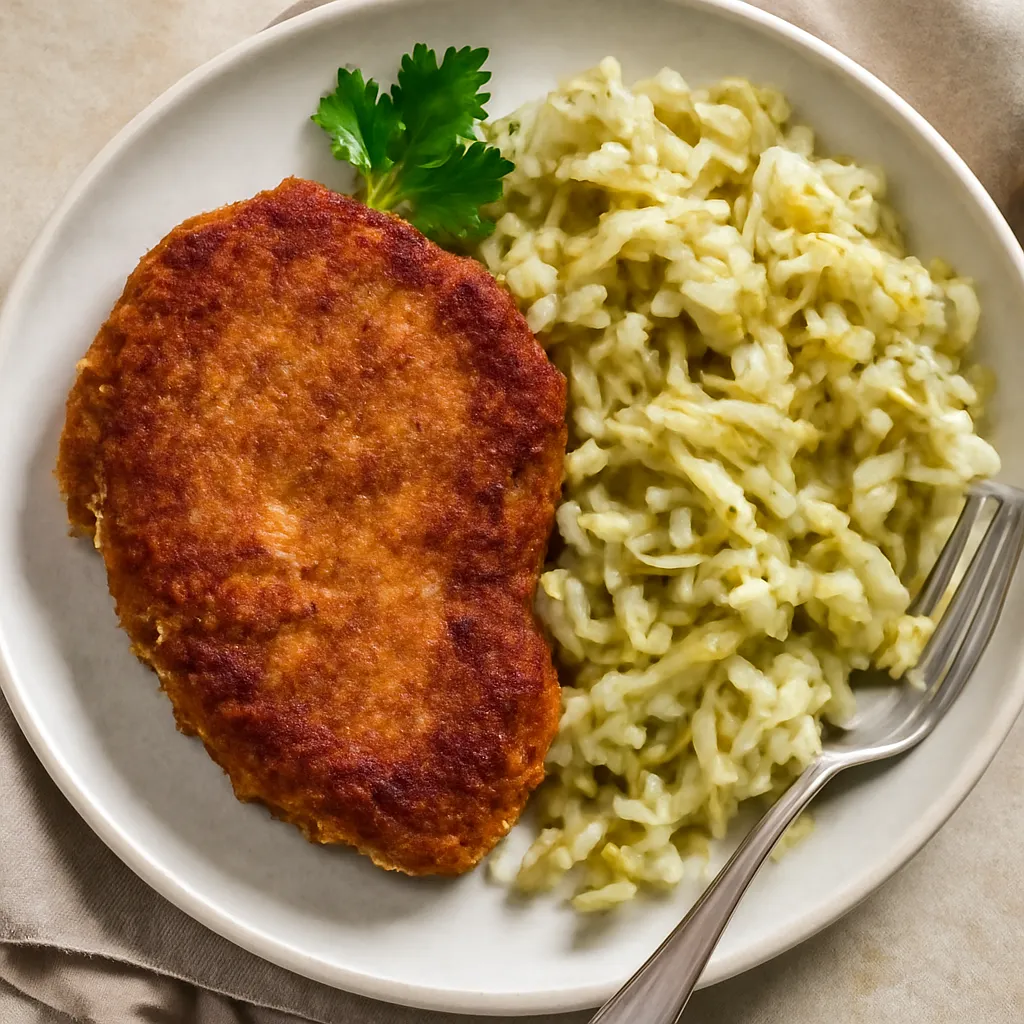
Pork schnitzel is a classic of Polish cuisine: thinly pounded pork loin, seasoned, breaded in flour, egg, and breadcrumbs, then fried to a golden brown. The best ones are crispy on the outside and juicy on the inside, with a distinctly "air-filled" coating. Sautéed cabbage (most often made from sauerkraut) provides a great contrast: it is sweet and sour, soft, aromatic from bay leaves and allspice, and thanks to the sauté, slightly thick and silky. This is the perfect set for a home-cooked dinner – serve with potatoes, mashed potatoes, or fresh bread. Visually, the dish is very appetizing: golden schnitzels and light brown cabbage with visible onions create "comfort food" at its best.
Składniki (17)
- Boneless pork loin 600 g
- Wheat flour type 450–550 60 g
- Egg 2 szt.
- Breadcrumbs 120 g
- Rapeseed oil 60 g
- Sauerkraut 800 g
- Onion 1 szt.
- Water 250 ml
- Butter 30 g
- Wheat flour (for roux) 25 g
- 🌿 Przyprawy
- Salt 6 g
- Ground black pepper 2 szczypty
- Bay leaf 3.3 szt.
- Allspice 2 g
- ✨ Opcjonalne
- sugar 5 g
- Cumin 2 g
- Lemon 0.8 szt.
💡 Kliknij na składnik aby oznaczyć jako użyty
Preparation steps
Preparation of the workstation
Pork chops
Divide the pork loin into 4 portions. If you have one piece, cut it across the grain into 4 slices of about 150 g each. Place each slice on a board, cover with plastic wrap (to prevent splattering), and pound with a meat mallet: start from the center and work your way to the edges. Pound gently, without aggressive "smashing," until the meat is about 6–8 mm thick and has a relatively even surface.
Season the meat. Sprinkle each cutlet on both sides with salt and pepper. Rub the spices into the meat with your hands for 10–15 seconds on each side – this will help the spices "stick" better and be more even. Set the cutlets aside for 5 minutes to allow the salt to work (the meat will taste better).
Prepare the egg for breading: in a bowl with the egg, add a small pinch of salt and pepper, then whisk with a fork for 30–40 seconds until the white and yolk are completely combined. The mixture should be uniform and slightly frothy.
Bread the cutlets step by step. Take 1 cutlet and: (1) coat it in flour on both sides, shaking off the excess (it should be a thin layer), (2) transfer it to the egg and thoroughly cover the entire surface with egg, including the edges, (3) transfer it to the breadcrumbs and press the breadcrumbs with your hand to ensure they adhere well to the meat. Set aside on a plate and repeat with the remaining cutlets.
Heat the pan and fat: place a large skillet over medium heat, pour in the oil, and spread it across the bottom. Wait 2–3 minutes until the oil is clearly hot. Check the temperature: drop in a tiny crumb of breadcrumbs – if it starts to sizzle intensely and lightly browns immediately, you can start frying.
Fry the cutlets: place 1–2 cutlets in the pan (do not crowd them – they need space). Fry for 3–4 minutes on the first side, until the coating is golden and crispy. Then flip with a spatula and fry for another 3–4 minutes. If the cutlet is very large or thicker, you can cook it for an additional 30–60 seconds on each side. After frying, transfer to a plate lined with paper towels and let it rest for 2 minutes. Repeat frying with the remaining cutlets (add a little oil if necessary).
Sautéed Cabbage
Prepare the cabbage: transfer the sauerkraut to a sieve and let it drain for a moment. Taste 1–2 strands: if it is very sour or very salty, rinse it briefly under cold water (literally 3–5 seconds under the tap) and squeeze it again. Then chop the cabbage into shorter pieces (about 2–3 cm) for easier eating.
Cook the cabbage: transfer the chopped cabbage to a pot (about 2–3 liters in capacity). Pour in water, add a bay leaf and allspice. Bring to a boil over high heat, and when it starts bubbling, reduce the heat to low and cook with the lid slightly ajar for 25–35 minutes. Stir every 10 minutes to prevent the cabbage at the bottom from burning. The cabbage is ready when it is noticeably soft and most of the liquid has been absorbed or evaporated.
Chop the onion: peel the onion, cut it in half and dice it finely. Try to make the pieces of similar size – this way the onion will sauté evenly and there won't be any raw or burnt parts.
Make the onion base for the cabbage: in a small pan or pot, melt 10 g of butter (set aside the rest of the butter for the roux). Add the onion and sauté over medium-low heat for 6–8 minutes, stirring frequently, until it becomes translucent and soft, with slightly golden edges. Then transfer the sautéed onion to the pot with the boiling cabbage and mix.
Prepare the roux: in the same pan (do not wash it – there will be flavor from the onion), melt the remaining butter (20 g) over low heat. When the butter foams, add the flour to the roux and mix vigorously with a whisk or wooden spoon for 1–2 minutes. The roux should have a slightly "nutty" aroma and lose the smell of raw flour, but it must not darken to brown.
Combine the roux with the cabbage without lumps: scoop 2–3 tablespoons of hot liquid from the pot (if there is little liquid in the pot, scoop 2–3 tablespoons of just the hot cabbage) and add it to the roux in the pan. Stir quickly until a smooth, thick sauce forms. Only then transfer everything from the pan to the pot with the cabbage and immediately mix thoroughly. Cook for another 5 minutes on low heat to thicken the cabbage and blend the flavors.
Season the cabbage at the end: taste and decide what it needs. If it's too sour – optionally add sugar (start with half, about 2–3 g), mix and taste again. If you want a more classic flavor – optionally add caraway seeds. If needed, season with a pinch of salt and pepper. Remove the bay leaf and allspice berries before serving.
Serving
Serve the dish: place a portion of hot sautéed cabbage on the plate, and next to it, arrange the pork chop. If you are using lemon (optional), cut it into wedges or slices and drizzle the chop with 2–3 drops just before eating – the flavor will be fresher. Serve immediately while the coating is crispy.
Fun Fact
The classic pork cutlet is a Polish interpretation of the Austrian Wiener Schnitzel – the difference lies in the meat (we usually use pork loin), but the technique of thinly pounding and breading is very similar.
Best for
Tips
To ensure the coating is as crispy as possible, do not cover the fried cutlets with a lid (they will steam). If frying in batches, keep the finished cutlets in an oven preheated to 90°C on a rack (not on a baking sheet) – the rack allows steam to escape. Serve the cabbage hot; be sure to remove the bay leaf and allspice before serving.
Cutlets: store in the fridge for up to 2 days in an airtight container, preferably separated by a paper towel (it will absorb moisture). Reheat in a dry pan for 2–3 minutes on each side or in the oven at 180°C for 8–10 minutes – the microwave will soften the coating. Cabbage: store for up to 3 days; reheat in a pot over low heat with 1–2 tablespoons of water, stirring occasionally.
📸 Ugotowane przez społeczność
Zaloguj się, aby dodać zdjęcieDodaj zdjęcie gotowej potrawy
Po zatwierdzeniu przez moderatora otrzymasz 10 punktów doświadczenia.
Nikt jeszcze nie dodał zdjęcia. Bądź pierwszy!
Comments (0)
Be the first to comment on this recipe!
Add a comment