Menu

Royal Nut Strudel on Buttery Puff Pastry

Cakes and Bakes Desserts Dishes for Special Occasions 270 min Medium 4 wyświetleń ~46.63 PLN - (0)
Rate:
(0)

Description

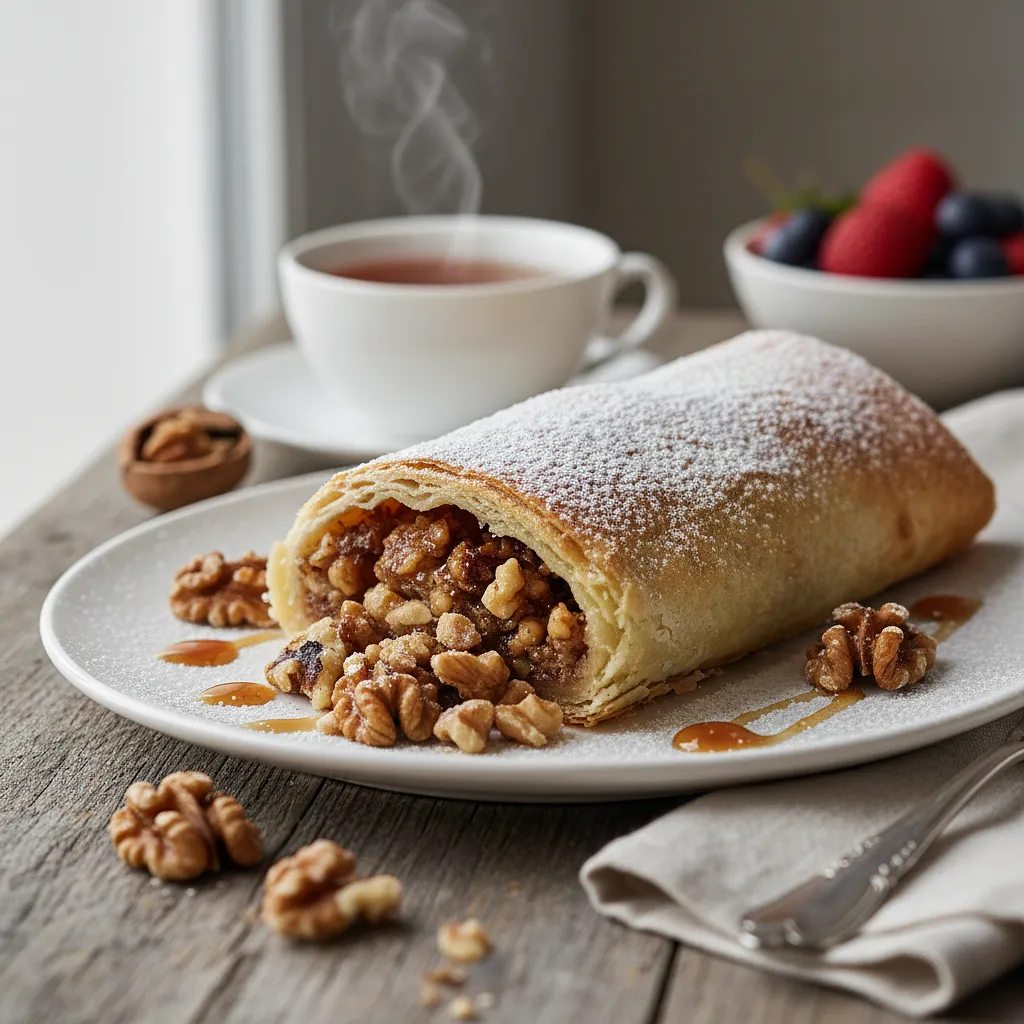
Here is a masterpiece of homemade confectionery – Royal Walnut Strudel, which combines the finesse of French pastry with the richness of Polish tradition. The puff pastry, prepared using the lamination method with butter, separates into hundreds of crispy, buttery layers after baking, creating an extraordinary contrast to the moist, aromatic filling. The heart of the strudel consists of a mixture of coarsely ground walnuts, sweetened with natural honey and brown sugar, with a subtle hint of cinnamon and cardamom. The addition of chopped dark chocolate and orange zest enriches the flavor, giving it depth and a festive character. Served warm or at room temperature, drizzled with a delicate lemon glaze, it embodies elegance and homely warmth. Perfect for special occasions, the holiday table, or as a luxurious addition to afternoon coffee.

Składniki (18)

Servings:
12
  • Mąka pszenna tortowa typ 450 500 g
  • Butter 250 g
  • Milk 3.2% 200 ml
  • Fresh yeast 25 g
  • Cukier drobny 60 g
  • Żółtko jaja kurzego 2 szt.
  • Shelled walnuts 300 g
  • wildflower honey 80 g
  • Breadcrumbs 50 g
  • Egg white 1 szt.
  • Egg for brushing 1 szt.
  • Powdered sugar 150 g
  • Lemon juice 30 ml
  • 🌿 Przyprawy
  • Salt 0.2 szczypt
  • Ground cinnamon 4 g
  • Ground cardamom 2 g
  • ✨ Opcjonalne
  • Bitter chocolate 50 g
  • Candied orange peel 40 g
💰 Szacowany koszt dania: ~46.63 PLN (3.89 PLN/porcję)

💡 Kliknij na składnik aby oznaczyć jako użyty

Preparation steps

Puff pastry - Step 1: Yeast dough

1

Start by preparing the starter. In a small saucepan, heat the milk to a temperature of about 37°C (it should feel pleasantly warm to the touch, like bath water for a baby). In a large bowl, crumble the fresh yeast, add 1 tablespoon of sugar (from the measured portion of 60g), and pour in half of the warm milk. Gently mix with a fork until the yeast is dissolved. Cover the bowl with a clean cloth and set it in a warm, draft-free place for 10-15 minutes. The starter is ready when a thick, fluffy foam appears on its surface.

Ingredients: Fresh yeast, Milk 3.2%, Cukier drobny
The most common mistake is using milk that is too hot, which kills the yeast. Check the temperature by dropping it on the inside of your wrist. If no foam appears after 15 minutes, the yeast is inactive and you need to start over.
2

In a bowl with the active starter, add the sifted flour, remaining sugar, egg yolks, salt, and the rest of the warm milk. Start kneading the dough. You can do this by hand on a countertop or use a mixer with a dough hook. Knead for about 10 minutes (with a mixer) or 15 minutes (by hand), until the dough becomes smooth, elastic, and pulls away from your hands and the sides of the bowl. Shape the dough into a ball, place it in a bowl dusted with flour, cover with a cloth, and set aside to rise in a warm place for about 60-90 minutes, until it doubles in size.

Ingredients: Mąka pszenna tortowa typ 450, Cukier drobny, Żółtko jaja kurzego, Salt, Milk 3.2%
Use a stand mixer with a 'hook' attachment on medium speed. If kneading by hand, sprinkle your hands and the work surface with a minimal amount of flour to prevent the dough from becoming too tough. Well-kneaded dough should slowly return to its shape when pressed with a finger.

Puff pastry - Step 2: Butter lamination

3

While the dough is rising, prepare the butter block. Place 250g of very cold butter between two sheets of baking paper. Using a rolling pin, pound and roll out the butter, shaping it into a square about 15x15 cm and 1 cm thick. Try to work quickly to keep the butter cold and firm. Once ready, place the butter block in the paper in the refrigerator for at least 30 minutes.

Ingredients: Butter
The key to success is keeping the butter at a low temperature. If the butter starts to soften, immediately put it back in the fridge. An even thickness of the butter block will ensure uniform layering of the dough.
4

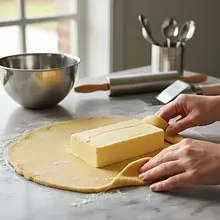
Remove the risen dough onto a lightly floured work surface and knead briefly to degas it. Roll it out into a rectangle measuring about 30x20 cm. In the center of the rectangle (on one half), place the chilled block of butter. Cover the butter with the other half of the dough, creating an 'envelope'. Seal the edges of the dough thoroughly on all sides to ensure the butter is tightly enclosed inside. It is very important that the butter does not escape during rolling.

Imagine that you are closing a book. The butter is one page, and the dough is the cover that surrounds it. Make sure the edges are well 'pinched' to create an airtight seal.
5

Carefully roll out the butter dough into a long rectangle about 1 cm thick, always rolling in one direction, away from you. Fold the dough 'in thirds' (like a business letter): first, fold 1/3 of the dough into the center, then cover it with the remaining 1/3. You will get a smaller, thicker rectangle. Wrap it in plastic wrap and place it in the refrigerator for 30 minutes to rest and chill.

Roll out gently but firmly. If the butter starts to break through the dough, it means it is too warm. Dust that area with flour and cool the dough in the fridge as quickly as possible. Chilling between folds is crucial for achieving layers.
6

Take the chilled dough out of the fridge. Place it on the work surface so that the shorter side is facing you. Roll it out again into a long rectangle and fold it 'in thirds', just like in the previous step. Wrap it in plastic wrap and chill it in the fridge for another 30 minutes. Repeat the entire process (rolling, folding, chilling) one last time. After the third fold, the dough should chill in the fridge for at least 1 hour (preferably 2-3 hours).

Each time, rotate the dough 90 degrees before rolling it out. This will ensure an even distribution of the butter layers. After three folds, your dough will have dozens of alternating layers of dough and butter that will create a flakiness effect.

Nut filling

7

While the dough is cooling, prepare the filling. Grind the walnuts in a meat grinder or chop them in a food processor. Do not grind them to a powder – it’s best if small pieces remain detectable. In a small pot, heat 100 ml of milk with honey until the honey dissolves (do not boil). Pour the hot mixture over the ground walnuts and breadcrumbs in a bowl. Mix thoroughly and set aside for 10 minutes to allow the nuts to absorb the liquid and swell.

Ingredients: Shelled walnuts, wildflower honey, Breadcrumbs, Milk 3.2%
Use the pulse mode in the food processor to control the grinding level of the nuts. Overly finely ground nuts can release too much oil and make the filling greasy.
8

Add cinnamon and cardamom to the nut mixture. In a separate, clean, and dry bowl, whip the egg white (leftover from the dough) with a pinch of salt until stiff peaks form. Gently fold the whipped egg white into the nut mixture using a spatula, making upward motions so that the egg white does not deflate. Finally, if using, fold in the chopped dark chocolate and candied orange peel. The filling should be thick but fluffy. Set aside to cool completely.

Ingredients: Egg white, Ground cinnamon, Ground cardamom, Bitter chocolate, Candied orange peel, Salt
The egg white foam will give the filling lightness. Mix it with the nut mixture only until the ingredients are combined. Overmixing will cause the foam to lose its volume. The filling must be cold before spreading on the dough; otherwise, it will melt the butter.

Shaping and Baking

9

Preheat the oven to 180°C (fan) or 190°C (top-bottom). Line a large baking tray with parchment paper. Take the chilled dough out onto a lightly floured work surface and roll it out into a large rectangle measuring about 40x50 cm and 3-4 mm thick.

Work quickly to keep the dough cold. If the dough becomes too soft and sticky, place it in the refrigerator for 10 minutes. An even thickness of the dough is important for even baking.
10

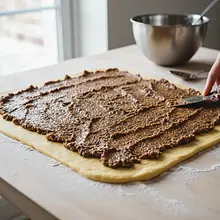
On the rolled-out dough, evenly spread the cooled nut filling, leaving about 2-3 cm of free margin along all edges. Roll the dough along the longer side into a tight log, similar to a roulade. Tuck the ends of the log underneath, and seal the edge where the rolling ends, pressing with your fingers to ensure the strudel doesn't open during baking.

To make rolling easier, you can roll out the dough on a sheet of baking paper, and then lift the paper to help shape an even roll. Brushing the free edge with a little water will help seal the dough better.
11

Carefully transfer the strudel to the prepared baking sheet, placing it seam side down. You can lay it straight or shape it into a crescent. Cover loosely with a cloth and let it rest at room temperature for the last 20-30 minutes to rise. In a small bowl, beat the whole egg with a tablespoon of milk. Brush the top and sides of the strudel with the prepared mixture. With a sharp knife or scissors, make a few diagonal slits on the top to allow steam to escape during baking.

Ingredients: Egg for brushing
To transfer the strudel, use a wide spatula or roll it onto a rolling pin and unroll it onto the baking sheet. The slits not only prevent the dough from cracking but also create a beautiful pattern after baking.
12

Place the baking tray in the preheated oven. Bake for about 35-45 minutes, until the strudel is deeply golden brown and beautifully risen. If the top browns too quickly, loosely cover it with aluminum foil. To check if it's done, you can insert a wooden stick into the thickest part – it should come out dry. Remove the baked strudel from the oven and transfer it to a rack to cool completely.

Every oven bakes differently, so keep an eye on the strudel towards the end of baking. A properly baked strudel will make a dull sound when tapped on the bottom. Cooling on a rack prevents the bottom from steaming.

Icing and finishing

13

When the strudel is completely cool, prepare the icing. In a bowl, sift the powdered sugar. Gradually, one tablespoon at a time, add the lemon juice, vigorously mixing with a whisk or fork until you achieve a smooth, thick, but still liquid icing. Adjust the thickness with the amount of juice – if the icing is too thick, add more juice; if too thin, add more powdered sugar.

Ingredients: Powdered sugar, Lemon juice
Sifting the powdered sugar is key to avoiding lumps. Add the liquid slowly – it's easier to thin out the icing than to thicken it. The ideal consistency is one that flows from the spoon in a thick stream.
14

Drizzle the strudel with the prepared icing, allowing it to flow freely down the sides, creating appetizing streaks. Before the icing sets, you can sprinkle the top with chopped walnuts or pistachios for decoration. Leave it for about 30 minutes for the icing to fully set. Cut into thick slices and serve.

Ingredients: Shelled walnuts
Place parchment paper under the rack to catch any excess icing, making cleanup easier. It's best to cut the strudel with a serrated knife to avoid crushing the delicate layers of pastry.

Fun Fact

💡

Strucla, like strudel, has its roots in the confectionery of Austro-Hungary. The Polish version, often made with yeast dough or puff pastry, has become an integral part of holiday tables, especially during Christmas and Easter. Each region of Poland has its variations on the filling – from poppy seed, to cheese, to walnut.

Best for

Tips

🍽️ Serving

The strudel tastes delicious both warm and at room temperature. Serve it sliced into pieces about 2-3 cm thick. It pairs perfectly with a cup of strong coffee, aromatic tea, or a glass of milk. For a dessert version, it can be served with a scoop of vanilla ice cream or a dollop of whipped cream.

🥡 Storage

Store the strudel in an airtight container or wrapped in plastic wrap at room temperature for up to 3 days. The pastry will lose its crispness each day. You can refresh it by heating slices for a few minutes in an oven preheated to 150°C. The strudel can also be frozen (without icing) – after baking and completely cooling. Thaw at room temperature.

📸 Ugotowane przez społeczność

Zaloguj się, aby dodać zdjęcie
Dodaj zdjęcie gotowej potrawy

Po zatwierdzeniu przez moderatora otrzymasz 10 punktów doświadczenia.

🍲

Nikt jeszcze nie dodał zdjęcia. Bądź pierwszy!

Comments (0)

Be the first to comment on this recipe!

Add a comment

You might also like

Recipe Categories

Homemade cakes and pastries are the heart of Polish culinary tradition - sweet memories from childhood. In our collection, you will find recipes for classic yeast cakes, shortcrust, sponge, and cheesecake. Apple pie, poppy seed cake, gingerbread, Easter babka, chocolate cake, and New York cheesec...

See all recipes in this category
Desserts
Desserts in: New Year's Eve

A sweet ending to the New Year's Eve dinner is a must-have that will put everyone in a joyful mood for the new year.

See all recipes in this category

Dishes for special occasions are culinary masterpieces for birthdays, anniversaries, and holidays. Grilled beef steak with herb butter - restaurant quality at home. Beef Wellington - beef in puff pastry with duxelles. Roast duck with apples - a holiday tradition in a new edition. Pink salmon with...

See all recipes in this category

Christmas Eve is the most important evening of the year - a time for tradition, family, and special dishes. Our collection of Christmas Eve recipes includes all 12 traditional dishes: from red borscht with dumplings to poppy seed cake and kutia. Recipes for carp in various versions: fried, baked,...

See all recipes in this category
Reklama