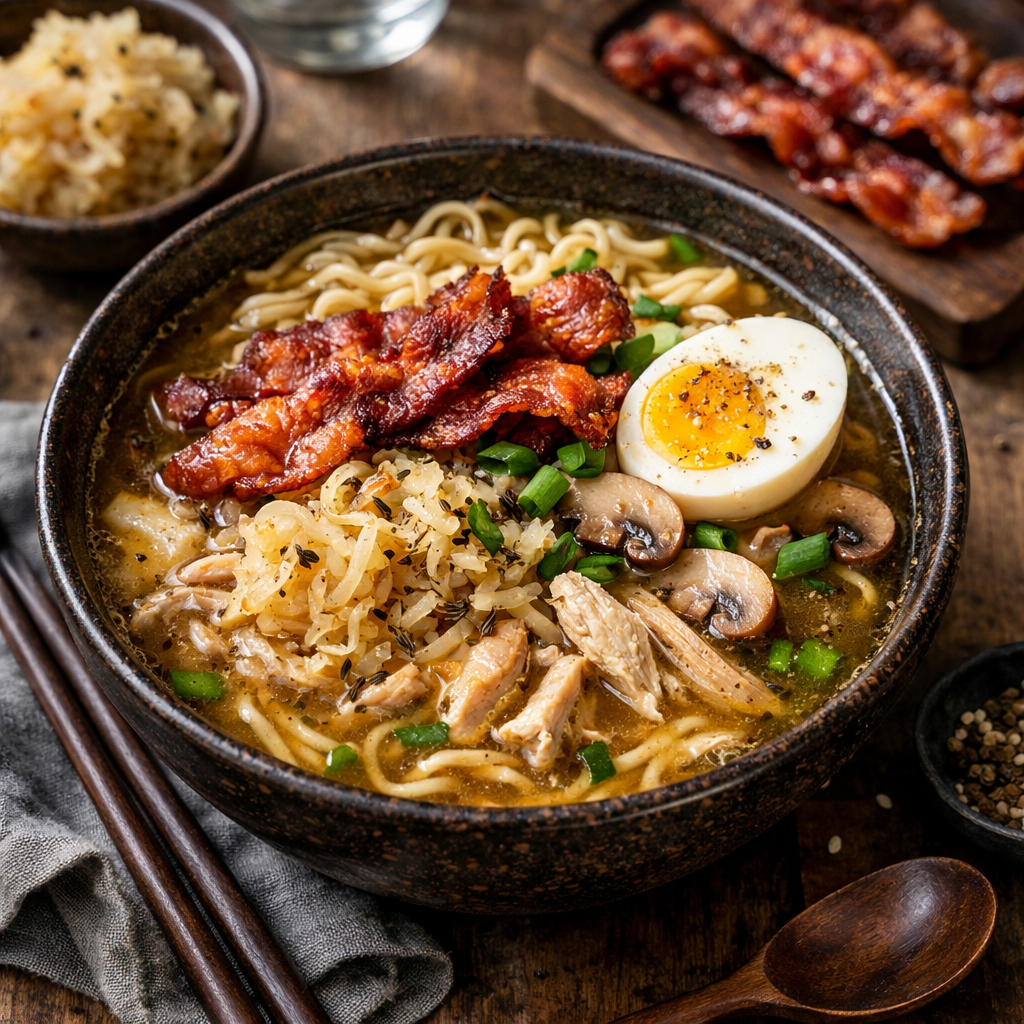
Winter ramen with a Polish twist: chicken-pork broth, sauerkraut, and crispy bacon

Pikantne Soups Asian Fusion Cuisine 90 min Medium 26 wyświetleń ~34.66 PLN * - (0)
Rate:
(0)
Start Cooking

Description

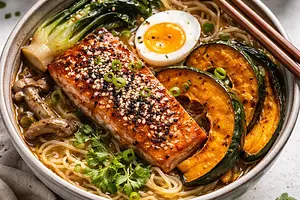
Thick, aromatic ramen inspired by Japanese tradition, but with a strong Polish twist – sauerkraut and smoked bacon. The broth is made by combining chicken thighs and pork bones, enriched with dried porcini mushrooms and ginger for deep umami. Tare (flavor concentrate) combines miso paste and light soy sauce with a touch of butter, creating a creamy, full flavor profile. In the bowls, we place fresh ramen noodles, a soft-boiled egg with a runny yolk, thinly fried bacon, and warm sauerkraut – a contrast of flavors: salty, sour, fatty, and mushroomy-forest umami. Perfect for winter evenings as a one-pot dish, impressive for a home gathering; it looks beautiful thanks to the contrast of colors and textures: intensely golden broth, green scallions, yellow yolk, and red-brown bacon.

Ingredients Used

Ingredients (23)

Servings:
4
  • White miso paste 80 g
  • Chicken thighs 800 g
  • Pork bones 500 g
  • Dried porcini mushrooms 20 g
  • Onion 1 szt. (~150 g)
  • Carrot 2.5 szt. (~200 g)
  • Leek (white part) 1 szt. (~120 g)
  • Garlic 3 ząbki (~15 g)
  • Fresh ginger 30 g
  • Water 3000 ml
  • Pepper 4 szczypty (~2 g)
  • Light soy sauce 120 ml
  • Butter 30 g
  • Fresh ramen noodles 400 g
  • Smoked bacon (thin slices) 200 g
  • Sauerkraut 150 g
  • Scallions (chives) 3.3 szt. (~50 g)
  • Apple cider vinegar 15 ml
  • Chicken egg 4 szt. (~240 g)
  • 🌿 Przyprawy
  • Salt 8 g
  • Bay leaf 13.3 szt. (~4 g)
  • ✨ Opcjonalne
  • Toasted sesame seeds 20 g
  • Nori sheets 8 g
💰 Szacowany koszt dania: ~34.66 PLN (8.67 PLN/porcję)
* Brak cen dla niektórych składników

💡 Kliknij na składnik aby oznaczyć jako użyty

Preparation steps

Broth

1

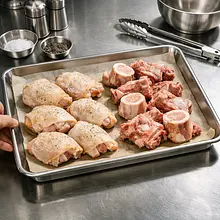
Preheat the oven to 220°C. Place the chicken thighs and pork bones on a baking tray lined with parchment paper. Cut the onion in half (do not peel the outer skin, leave it for color), the carrot into halves, and the leek into 3-4 pieces. Arrange the vegetables next to the meat. Place in the oven and roast for 30 minutes, until the meat and bones are well browned – this is important for the color and flavor of the broth. Check: the surface should have caramel-brown scorch marks, but not burnt black.

Use a large baking tray lined with parchment paper. Do not wash away the browned bits — we will add them to the pot later for extra flavor. A common mistake: browning for too short a time (the broth will be light and less intense).
2

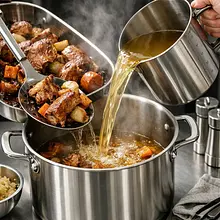
Transfer the browned meat, bones, and vegetables to a large pot with a capacity of at least 5 liters. Pour in 3 liters of cold water so that everything is covered. Add dried porcini mushrooms, crushed garlic cloves, slices of ginger, bay leaves, and whole peppercorns. Place the pot over high heat and bring to a boil.

Use a large, heavy pot (e.g., stainless steel). Cold water helps to extract flavors from the bones better. A common mistake: cooking too high - the broth should only gently 'wink' (light simmer) to remain clear.
3

When it starts to boil, reduce the heat to the minimum so that the broth just gently 'flickers'. Skim off the foam and fat from the surface with a slotted spoon every 5-10 minutes for the first 20 minutes. Cook on very low heat for 60 minutes from the moment you reduce the flame — longer cooking will deepen the flavor, but in a 90-minute plan, we will achieve a good result.

Use a slotted spoon or a sieve. Do not stir the broth vigorously (this leads to cloudiness). It should gently move on the surface, not boil violently.

Tare (flavor concentrate)

4

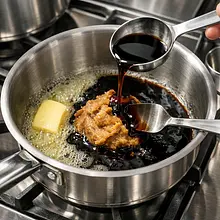
In a small skillet over medium heat, melt the butter (30 g). Add the miso paste (80 g) and light soy sauce (120 ml). Gently heat, stirring with a wooden spoon, until the miso paste dissolves into the butter and a smooth sauce forms. Taste - the tare should be intense and salty, but remember it will be diluted with broth; do not season heavily with salt at this stage.

Use a small non-stick pan. Stir with a wooden spatula. Do not let it boil – just gently heat it to combine the butter and miso.

Ajitsuke eggs

5

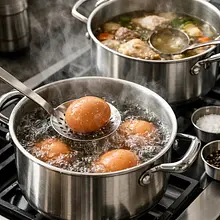
While the broth is cooking, prepare the eggs: bring a medium pot of water to a boil. When the water starts to boil, gently add the eggs (240 g = 4 pieces) and cook for 6 minutes from the moment it starts boiling again – this will give you a runny yolk. After 6 minutes, quickly transfer the eggs to a bowl of very cold water (ice or cold water) for 5–10 minutes to stop the cooking. Peel the eggs carefully.

Use a slotted spoon to place and remove the eggs. If you want to marinate the eggs in tare for longer, cut them in half only after 20-30 minutes of marinating. A common mistake: cooking too long – the yolk becomes hard.

Marinating eggs (optional)

6

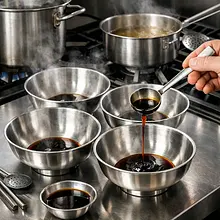
If you want extra aromatic eggs: mix 60 ml of tare with 40 ml of water (use a small bowl), add the peeled eggs and refrigerate for at least 20-30 minutes (you can also leave them overnight for a stronger flavor). After marinating, cut in half when serving.

Use an airtight container so the eggs absorb the flavor well. You can skip the marinade, but pickled eggs will be more flavorful.

Bacon and sauerkraut

7

In a medium skillet, heat 1 tablespoon of canola oil (about 15 g). Place thin slices of bacon (200 g) and fry for 3-5 minutes on each side until crispy and golden. Remove the bacon to a paper towel. In the same skillet, if there is a lot of fat, remove the excess, leaving about 1 teaspoon of fat, and add sauerkraut (150 g). Fry for 5-7 minutes over medium heat until the cabbage loses some moisture and softens slightly; if it is too sour, add 5-10 ml of apple cider vinegar and a little sugar (optional) to balance it out.

Use a pan with a diameter of 24–28 cm. Paper towels with fat will help maintain the crispiness of the bacon. A common mistake: stirring the cabbage too vigorously – it's better to fry without frequent stirring to allow the water to evaporate.

Pasta and final cooking

8

When the broth is almost ready, bring a separate large pot of water to a boil and add the ramen noodles (400 g) in batches — fresh noodles cook quickly: 2–3 minutes (check the instructions on the package). Cook until the noodles are firm (al dente). Drain the noodles thoroughly and quickly rinse briefly with cold water only if using dried noodles; if fresh, transfer them directly to bowls before pouring hot broth over them.

Use a large pot with plenty of water so the pasta has room to move. Do not cook the pasta too long; it should be al dente. If you are using fresh pasta, do not leave it in the strainer for too long as it will stick together.

Seasoning the broth

9

Turn off the heat under the broth. Strain the broth through a fine sieve into a clean pot to make it clear. Taste and season with salt (adding 1 g/1 pinch at a time) if needed; remember that tare is already salty. Keep the broth hot, but not boiling.

Use a large sieve or cheesecloth. Season gradually – it's better to add than to subtract. A common mistake: adding too much salt before adding tare.

Assembly and serving

10

Preheat 4 bowls. Pour 30 g tare (about 30 ml) into the bottom of each – evenly distribute the prepared mixture of butter, miso, and soy sauce. Place a portion of cooked noodles (100 g dry/fresh portion) into the bowl. Using a ladle, pour hot broth into the bowls (about 500–600 ml per bowl) – pour in such a way that the tare dissolves and spreads evenly. On top, place half of ajitsuke egg, 2–3 slices of crispy bacon, a portion of warm sauerkraut (about 35–40 g), chopped green onions (about 12 g per bowl), and optionally, sprinkle with sesame (5 g) and add a piece of nori.

Use a ladle for even pouring of the broth. Arrange the ingredients aesthetically: the egg cut side up, bacon on the side, cabbage next to it. A common mistake: pouring cold broth – use hot broth so the pasta and egg don't cool down.

Final tips

11

Before serving, taste one last time and add a few drops of apple cider vinegar to the bowl if you want to enhance the acidity. Serve hot, with an extra small bowl of tare on the side for those who enjoy a more intense flavor.

Serve immediately after assembling — ramen is best enjoyed right away. If you prepare the eggs in advance, keep them in the marinade in the fridge for up to 24 hours.

Fun Fact

💡

Ramen, although associated with Japan, is a dish with a global heritage; every culture adapts it with local ingredients. In Poland, versions with sauerkraut or smoked meat are becoming more common – it's a natural combination, as pickles help balance the richness of the broth.

Best for

Tips

🍽️ Serving

Serve the ramen in deep bowls. For visual effect, place a halved egg in the center, bacon on the side, and lightly shape the cabbage into a mound. Additionally, serve a small bowl of chili sauce or sesame oil for those who want some spiciness.

🥡 Storage

Store the broth and tare separately in airtight containers in the refrigerator for up to 3 days (broth) and up to 7 days (tare). It is best to prepare the noodles fresh before serving; cooked noodles can be kept in the refrigerator for up to 24 hours, but they will lose their elasticity. Keep ajitsuke eggs in the marinade for up to 48 hours.

📸 Ugotowane przez społeczność

Zaloguj się, aby dodać zdjęcie
Dodaj zdjęcie gotowej potrawy

Po zatwierdzeniu przez moderatora otrzymasz 10 punktów doświadczenia.

🍲

Nikt jeszcze nie dodał zdjęcia. Bądź pierwszy!

Comments (0)

Be the first to comment on this recipe!

Add a comment

You might also like

Recipe Categories

Soups are the essence of home cooking - they warm, satisfy, and comfort in any weather. In this category, we present recipes for Polish soups - chicken broth, sour rye soup, borscht, tomato soup, cucumber soup, and pea soup. Our dishes also include cream soups, cold soups, and broths. You will fi...

See all recipes in this category

Modern recipes that combine traditional flavors of Asia with other culinary cultures, offering unusual combinations and innovative dishes.

See all recipes in this category
Reklama