Easter Sand Cake Babka

Cakes and Bakes Easter 60 min Medium 26 wyświetleń ~23.37 PLN - (0)
Rate:
(0)
Start Cooking

Description

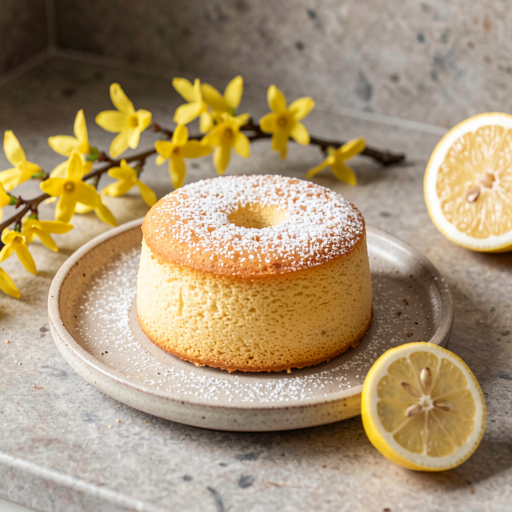
Traditional Polish sand cake with a delicate, almost sandy texture, perfect for Easter. The cake combines velvety butter with whipped egg whites, resulting in a light, melt-in-your-mouth crumb and a golden crust. The origin of this type of cake is typically Polish, popular in homes in Greater Poland and Silesia, where it was baked for festive tables. It tastes great on its own with coffee or tea, can be served with a lemon glaze or dusted with powdered sugar; it also pairs wonderfully with tart additions like rhubarb jam. Visually, it presents elegantly as a tall cake in a mold, with a uniformly browned crust and a fine, silky texture inside.

Ingredients Used

Ingredients (10)

Servings:
10
  • Chicken egg 5 szt. (~300 g)
  • Sugar 250 g
  • Butter 200 g
  • Wheat flour 200 g
  • Potato flour 100 g
  • Baking powder 15 g
  • Vanilla sugar 16 g
  • 🌿 Przyprawy
  • Salt 1 g
  • ✨ Opcjonalne
  • Lemon 1.3 szt. (~100 g)
  • Powdered sugar 30 g
💰 Szacowany koszt dania: ~23.37 PLN (2.34 PLN/porcję)

💡 Kliknij na składnik aby oznaczyć jako użyty

Preparation steps

Preparation

1

Take the butter and eggs out of the fridge at least 30 minutes before starting — they should be at room temperature (the butter should be soft, and the eggs not cold). Preheat the oven to 170°C (fan 150°C). Prepare a bundt pan with a diameter of 22–24 cm: thoroughly grease the inside with butter and dust with flour or breadcrumbs, removing any excess.

Ingredients: Butter
Use a bundt pan with a central hole, preferably a metal one with a capacity of 1.5–2 l. If you don't have a bundt pan, use a loaf pan and reduce the baking time by 10–15 minutes.
Cake

2

Separate the yolks from the whites: crack each egg over a small bowl, transfer the whites between the halves of the shell, and place the yolks in a separate bowl. Place the whites in a large, dry, and grease-free bowl intended for whipping.

Use a glass or metal bowl to whip the egg whites (plastic bowls may have greasy residues). Make sure not to let even a drop of yolk get into the whites — this will prevent the foam from whipping properly.
3

Beat the egg whites with 50 g of sugar and a pinch of salt until stiff, glossy peaks form: start on low speed, and when the foam begins to form, increase to medium-high speed. The foam is ready when stiff peaks form that do not fall and have a shiny appearance when the whisk is lifted.

Ingredients: Sugar, Salt
Use a hand mixer or a stand mixer with a whisk attachment. If you don't have a mixer, you can whip the egg whites by hand with a whisk, but it will take 8–12 minutes.
4

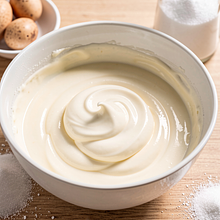
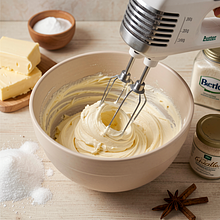
In a separate large bowl, beat the softened butter with the remaining sugar (200 g) and vanilla sugar until light and fluffy — mix for 4–6 minutes on medium speed. The mixture is ready when it turns a light cream color and becomes airy and creamy.

Ingredients: Butter, Sugar, Vanilla sugar
Use a mixer with a whisk attachment or a large wooden spoon. If the butter is too hard, heat it in the microwave for 5–10 seconds (be careful not to melt it).
5

Add the egg yolks to the butter one at a time, mixing briefly after each addition just until combined. After adding all the yolks, the mixture should be smooth and uniform. If you are adding lemon zest (optional), grate a thin layer of the yellow part of the zest using a fine grater and add it now.

Ingredients: Butter, Lemon
Use a grater with a sieve for the lemon zest to avoid grating the bitter white part. Mix briefly — overmixing after adding the yolks can cause separation.
6

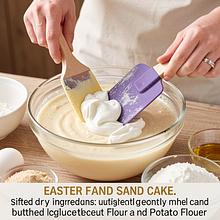
Sift the wheat flour, potato flour, and baking powder directly into a large bowl or through a sieve over the bowl with the butter mixture. Gently mix the dry ingredients with a spoon to combine them evenly.

Ingredients: Wheat flour, Potato flour, Baking powder
Sifting aerates the flour and removes lumps; if you don't have a sieve, use a potato masher to break up the lumps in the flour.
7

To the butter mixture, add the sifted dry ingredients and gently mix with a spatula until combined. Then add 1/3 of the whipped egg whites and mix vigorously to loosen the batter. Next, add the remaining egg whites in two batches, but from this point on, mix very gently using an up-and-down motion to avoid deflating the meringue. The mixture should be thick but homogeneous.

Ingredients: Wheat flour, Potato flour
Use a silicone spatula or a large spoon. It is important to gently fold in the egg whites — mixing too vigorously will cause them to deflate and result in a heavy cake texture.

Baking

8

Pour the prepared batter into the prepared mold, smoothing the top with a spatula. Gently tap the mold on the countertop a few times to remove larger air bubbles. Bake in the preheated oven for 50–60 minutes at 170°C (fan oven 150°C). After about 45 minutes, check with a toothpick — insert it into the center of the cake; if it comes out dry or with a few crumbs, the cake is ready.

Ingredients: Wheat flour, Potato flour, Baking powder, Butter
Use the middle rack of the oven. If the top browns too much, loosely cover the pan with aluminum foil for the last 10–15 minutes of baking.

Cooling

9

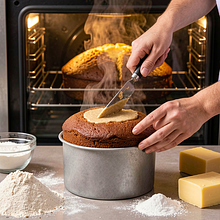
After baking, remove the pan from the oven and let it cool on a rack for 10–12 minutes. After this time, run a thin knife along the edges of the pan, then invert the pan onto the rack and carefully remove the cake. Allow it to cool completely before adding the glaze.

Do not remove the cake hot directly after 5 minutes — it may break. A rack allows air to circulate and prevents moisture from accumulating underneath.

Glaze and decoration

10

Optionally prepare a lemon glaze: sift 150 g of powdered sugar into a small bowl and mix with the juice of half a lemon (about 15–25 ml) and 1–2 tablespoons of hot water until you achieve a smooth, pourable icing. Drizzle it over the cooled cake and let it set. Alternatively, dust the cake evenly with 30 g of powdered sugar through a sieve.

Ingredients: Powdered sugar, Lemon
Adjust the amount of lemon juice so that the glaze is not too runny — it should flow slowly over the cake. If you are using a whole lemon, first try a smaller amount of juice.

Serving

11

Before serving, you can lightly dust the cake with powdered sugar and decorate it with grated lemon zest. Cut into even slices and serve at room temperature with coffee or tea.

Ingredients: Powdered sugar, Lemon
Use a serrated knife to slice the cake for nice pieces. If you are storing some of the cake, wrap the slices in plastic wrap or place them in an airtight container.

Fun Fact

💡

Sandy babka got its name due to its texture resembling fine sand — this is achieved by adding potato flour or starch and gently folding whipped egg whites into the butter mixture. In many regions of Poland, babka has been the central Easter cake since the 19th century.

Best for

Tips

🍽️ Serving

Serve sliced thinly, preferably with a cup of strong coffee or tea with lemon. If you want a festive variant, serve alongside rhubarb jam or sour cream with a bit of vanilla sugar.

🥡 Storage

Store the cake at room temperature in an airtight container for up to 3 days. If it is covered with fresh lemon juice glaze, it is better to store it in the refrigerator for up to 4 days. To refresh a slightly stale cake, heat it for 5–7 minutes in an oven preheated to 150°C.

📸 Ugotowane przez społeczność

Zaloguj się, aby dodać zdjęcie
Dodaj zdjęcie gotowej potrawy

Po zatwierdzeniu przez moderatora otrzymasz 10 punktów doświadczenia.

🍲

Nikt jeszcze nie dodał zdjęcia. Bądź pierwszy!

Comments (0)

Be the first to comment on this recipe!

Add a comment

You might also like

Recipe Categories

Homemade cakes and pastries are the heart of Polish culinary tradition - sweet memories from childhood. In our collection, you will find recipes for classic yeast cakes, shortcrust, sponge, and cheesecake. Apple pie, poppy seed cake, gingerbread, Easter babka, chocolate cake, and New York cheesec...

See all recipes in this category

Easter is one of the most important holidays in the Christian calendar, celebrated in spring, commemorating the resurrection of Jesus. It is a time of joy, hope, and communal celebration with family around a bountiful table. The culinary traditions associated with Easter are incredibly rich and d...

See all recipes in this category
Reklama