Menu

Chocolate-Honey Spartak Cake with Mascarpone Cream

Cakes and Bakes Desserts Dishes for Special Occasions 150 min Medium 12 wyświetleń ~64.98 PLN - (0)
Rate:
(0)

Description

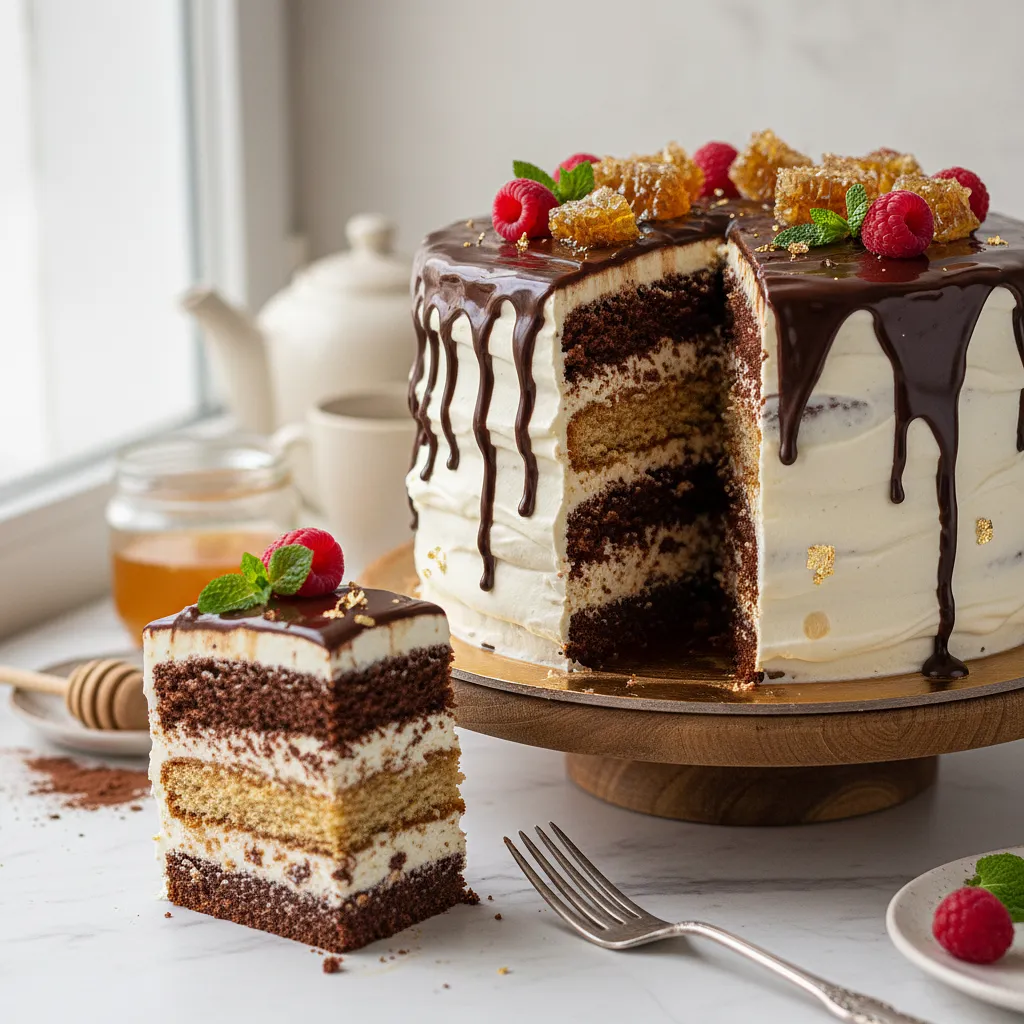
The Spartak cake is a masterpiece of confectionery from Eastern Europe, often associated with Ukrainian and Russian cuisine. It is a layered cake made up of many paper-thin, chocolate-honey layers, filled with a delicate cream. In my version, the classic, slightly sour cream based on sour cream is replaced with a velvety, rich cream made from mascarpone cheese and whipped cream, with a subtle hint of lemon that perfectly balances the sweetness. The addition of instant coffee in the layers deepens the cocoa flavor, making it more intense and savory. Visually, the cake delights with the contrast of dark layers and white cream, creating a striking 'zebra' effect when cut. Served chilled, it is the perfect dessert for special occasions, combining a wealth of flavors with a surprising lightness that comes from the layers being moistened by the cream during long cooling.

Składniki (15)

Servings:
12
  • Mąka pszenna tortowa (typ 450) 500 g
  • Masło 82% 100 g
  • Cukier drobny 150 g
  • Eggs 2 szt.
  • Natural honey 100 g
  • Instant coffee 10 g
  • Baking soda 10 g
  • Serek mascarpone 500 g
  • Śmietanka 36% 500 ml
  • Powdered sugar 120 g
  • Lemon zest 5 g
  • Dark chocolate 70% 100 g
  • 🌿 Przyprawy
  • Kakao ciemne 40 g
  • Salt 0.1 szczypt
  • ✨ Opcjonalne
  • Walnuts 50 g
💰 Szacowany koszt dania: ~64.98 PLN (5.41 PLN/porcję)

💡 Kliknij na składnik aby oznaczyć jako użyty

Preparation steps

Preparing the dough

1

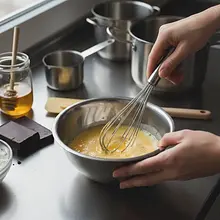
Prepare a water bath. Pour water into a larger pot to a height of about 3-4 cm and bring it to a boil. Reduce the heat so that the water is just gently 'bubbling'. Place a smaller pot or metal bowl on top of the larger pot, ensuring that the bottom of the bowl does not touch the surface of the water. In the bowl, add butter, sugar, and honey. Heat, stirring occasionally with a spatula, until all the ingredients dissolve and combine into a smooth, liquid mixture. This should take about 5-7 minutes.

Ingredients: Masło 82%, Cukier drobny, Natural honey
A bain-marie is a gentle heating technique that prevents sugar and honey from burning. Make sure the bowl is stable on the pot. Use a silicone spatula to thoroughly scrape the ingredients from the sides.
2

In a small bowl, beat the eggs with a fork until the yolks and whites are combined. Remove the bowl with the honey mixture from the pot. While continuously stirring the mixture with a whisk, pour in the beaten eggs in a very thin stream. Vigorous mixing is key to prevent the eggs from curdling due to the heat and turning into scrambled eggs. The mixture should become smooth and slightly thicken.

Ingredients: Eggs
This is a critical moment. If you pour in the eggs too quickly or without mixing, they will curdle. If you're unsure, you can let the mixture cool slightly for 1-2 minutes before adding the eggs.
3

Place the bowl back over the pot of hot water. Add the baking soda and mix vigorously for about a minute. The mixture will start to foam, increase in volume, and take on a lighter, caramel color. This is a sign that the baking soda has activated. Remove the bowl from the water bath and set it aside.

Ingredients: Baking soda
The reaction of baking soda with warm, acidic honey is what will leaven the dough. Don't skip this step. The mixture can even double in volume, so make sure the bowl is large enough.
4

In a large bowl, mix the sifted flour, cocoa, instant coffee, and salt. Make a well in the center. Pour the still warm, liquid honey mixture into it. Using a wooden spoon or spatula, start mixing, incorporating the dry ingredients from the sides until a sticky, thick dough forms.

Ingredients: Mąka pszenna tortowa (typ 450), Kakao ciemne, Instant coffee, Salt
Sifting the dry ingredients is important to avoid lumps and aerate the dough. At this stage, the dough will be very sticky - this is normal. Do not add more flour than stated in the recipe.
5

Transfer the dough to a lightly floured countertop or board. Knead it briefly by hand, just until it is smooth and uniform, about 2-3 minutes. Shape the dough into a ball, flatten it slightly, wrap it tightly in plastic wrap, and place it in the refrigerator for at least 30-40 minutes. The chilled dough will be less sticky and easier to roll out.

Do not knead the dough too long, or it will become tough. Chilling is essential. You can prepare the dough a day in advance and leave it in the fridge overnight.

Baking the layers

6

Preheat the oven to 180°C (fan or conventional). Prepare several sheets of baking paper. Take the dough out of the fridge and divide it into 8 equal parts. It's best to use a kitchen scale to ensure each portion is identical. Shape each part into a ball. Keep the parts you are not currently using covered to prevent them from drying out.

Equal portions of dough are the key to even layers. Preparing several sheets of paper will allow you to work faster - while one layer is baking, you can prepare another.
7

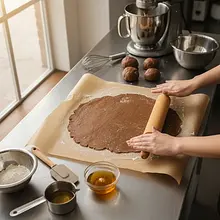
Take one ball of dough and place it on a sheet of baking paper. Roll it out very thinly, to a thickness of about 1-2 mm, into a circle slightly larger than 24 cm in diameter. The dough is flexible, but if it sticks, you can lightly dust the rolling pin or the dough with flour. From the bottom of a 24 cm springform pan or from a large plate, trace a circle, and then cut it out with a pizza cutter or a regular knife. Do not remove the scraps - they will bake along with the base.

Roll out the dough directly on the baking paper - transferring such a thin crust is almost impossible. The scraps after baking will be used to decorate the cake, so they are very important!
8

Prick the cut circle with a fork in several places to prevent air bubbles from forming during baking. Transfer the paper with the dough to a baking tray. Place in the preheated oven and bake for 5-7 minutes. The finished crust should be matte and slightly browned at the edges. Be careful not to burn it, as thin dough bakes very quickly.

The layers will be soft when taken out of the oven, but they will harden as they cool. This is normal. Later, after being filled with cream, they will soften again.
9

Remove the baking sheet from the oven and carefully slide the paper with the baked layers onto a cooling rack. Repeat the rolling and baking process for the remaining 7 portions of dough. Set all the baked layers and scraps aside to cool completely. When the scraps are cold and hard, place them in a food processor or a sturdy zip-top bag and crush into fine crumbs using a rolling pin.

Cooling on a rack will prevent the layers from steaming from the bottom. Work efficiently by preparing the next layer while the previous one is baking. Store the crumbs from the trimmings in an airtight container.

Preparation of the cream

10

Prepare the cream. Make sure that the mascarpone cheese and cream are very well chilled. Also chill the bowl (preferably metal) and the mixer attachments by placing them in the freezer for 15 minutes. Pour the 36% cream into the chilled bowl and start whipping on medium speed. When the cream begins to thicken, gradually add the sifted powdered sugar. Increase the speed and whip until a thick, stiff cream forms (there should be clear traces left by the mixer).

Ingredients: Śmietanka 36%, Powdered sugar
Chilling everything is key to perfectly whipped cream. Be careful not to 'overwhip' the cream, as it will turn into butter. Stop the mixer as soon as the cream is stiff.
11

Add the chilled mascarpone cheese (in 2-3 batches) and freshly grated lemon zest to the whipped cream. Reduce the mixer speed to the lowest setting and mix very briefly, just until the ingredients are combined into a smooth, uniform cream. You can also gently fold in the mascarpone using a spatula, making motions from bottom to top, so the cream doesn't lose its fluffiness.

Ingredients: Serek mascarpone, Lemon zest
Overmixing mascarpone with cream can cause the cream to curdle. Short mixing on low speed or hand mixing is a safer option.

Assembling the cake

12

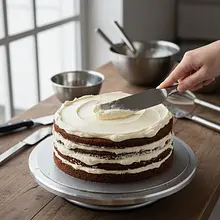
On a platter or large plate where you will serve the cake, spread a little cream in the center - this will prevent the first layer from sliding. Place the first chocolate layer. Spread an even layer of cream on it (about 3-4 tablespoons). Cover with the second layer, press down gently, and spread cream again. Repeat this process until all layers are used. Do not spread cream on the last, top layer for now.

Divide the cream so that there is enough to fill all the layers and to spread on the top and sides of the cake. Use a curved spatula to evenly spread the cream.
13

Spread the remaining cream on the top and sides of the cake, trying to smooth the surface. It doesn't have to be perfectly smooth, as the sides will be covered with crumbs. Place the assembled cake in the refrigerator for at least 8 hours, preferably overnight. This is an absolutely crucial step during which the firm layers will absorb moisture from the cream, become soft and 'cakey', and the flavors will meld together.

Do not skip the cooling step! The cake right after assembling will be hard and dry. Patience will be rewarded with an incredibly moist and delicious cake.

Decoration

14

After cooling the cake, prepare the glaze. In a small saucepan, heat the 36% cream almost to boiling. Remove from heat. Add the broken dark chocolate and butter to the hot cream. Let it sit for 2-3 minutes without stirring, so the chocolate melts from the heat. After that time, mix everything with a spatula until smooth and shiny ganache forms.

Ingredients: Dark chocolate 70%, Śmietanka 36%, Masło 82%
Do not boil the cream, just heat it up well. The butter will give the glaze a beautiful shine. Stir gently to avoid incorporating too much air into the glaze.
15

Remove the cake from the refrigerator. Pour the slightly cooled but still liquid glaze in the center of the top of the cake. Use a spatula or spoon to spread it evenly, allowing it to flow freely down the sides, creating appetizing 'drips'. Generously sprinkle the sides of the cake with the prepared cake crumbs. On top, you can additionally sprinkle the cake with chopped, toasted walnuts. Place the cake in the refrigerator for another 30 minutes to let the glaze set.

Ingredients: Walnuts
To easily coat the sides, take a handful of crumbs and gently 'press' them into the cream on the sides of the cake while rotating the cake stand. Do this over a larger tray to avoid making a mess.

Fun Fact

💡

The name 'Spartak' probably refers to Spartacus, the Roman gladiator, symbolizing the strength and popularity of this cake during the USSR era. It is a close relative of another famous honey cake known as 'Medovik', but it is distinguished by the addition of cocoa, which gives it a chocolate character.

Best for

Tips

🍽️ Serving

The Spartak cake tastes best when well chilled, cut with a sharp, long knife dipped briefly in hot water and dried before each cut. This will ensure perfectly even pieces with visible layers. Serve in small portions, as it is quite filling. It pairs perfectly with a cup of black, unsweetened coffee or tea, which will balance its sweetness.

🥡 Storage

The cake should be stored in the refrigerator, in an airtight cake container, to prevent it from absorbing odors. It retains its freshness and excellent taste for 3-4 days. Moreover, many believe that on the second and third day it tastes even better, as the flavors fully meld together.

📸 Ugotowane przez społeczność

Zaloguj się, aby dodać zdjęcie
Dodaj zdjęcie gotowej potrawy

Po zatwierdzeniu przez moderatora otrzymasz 10 punktów doświadczenia.

🍲

Nikt jeszcze nie dodał zdjęcia. Bądź pierwszy!

Comments (0)

Be the first to comment on this recipe!

Add a comment

You might also like

Recipe Categories

Homemade cakes and pastries are the heart of Polish culinary tradition - sweet memories from childhood. In our collection, you will find recipes for classic yeast cakes, shortcrust, sponge, and cheesecake. Apple pie, poppy seed cake, gingerbread, Easter babka, chocolate cake, and New York cheesec...

See all recipes in this category
Desserts
Desserts in: Christmas Eve Dinner

Desserts are a sweet ending to a meal that brings joy to both children and adults. In this category, we present recipes for a variety of sweets - from simple creams and mousses, to elegant panna cottas, and exquisite fruit tarts. Our desserts include both classics of Polish cuisine - fruit jelly,...

See all recipes in this category

Dishes for special occasions are culinary masterpieces for birthdays, anniversaries, and holidays. Grilled beef steak with herb butter - restaurant quality at home. Beef Wellington - beef in puff pastry with duxelles. Roast duck with apples - a holiday tradition in a new edition. Pink salmon with...

See all recipes in this category
Reklama