Menu

Christmas Kulebiak with Cabbage and Mushrooms

Rate:
(0)

Description

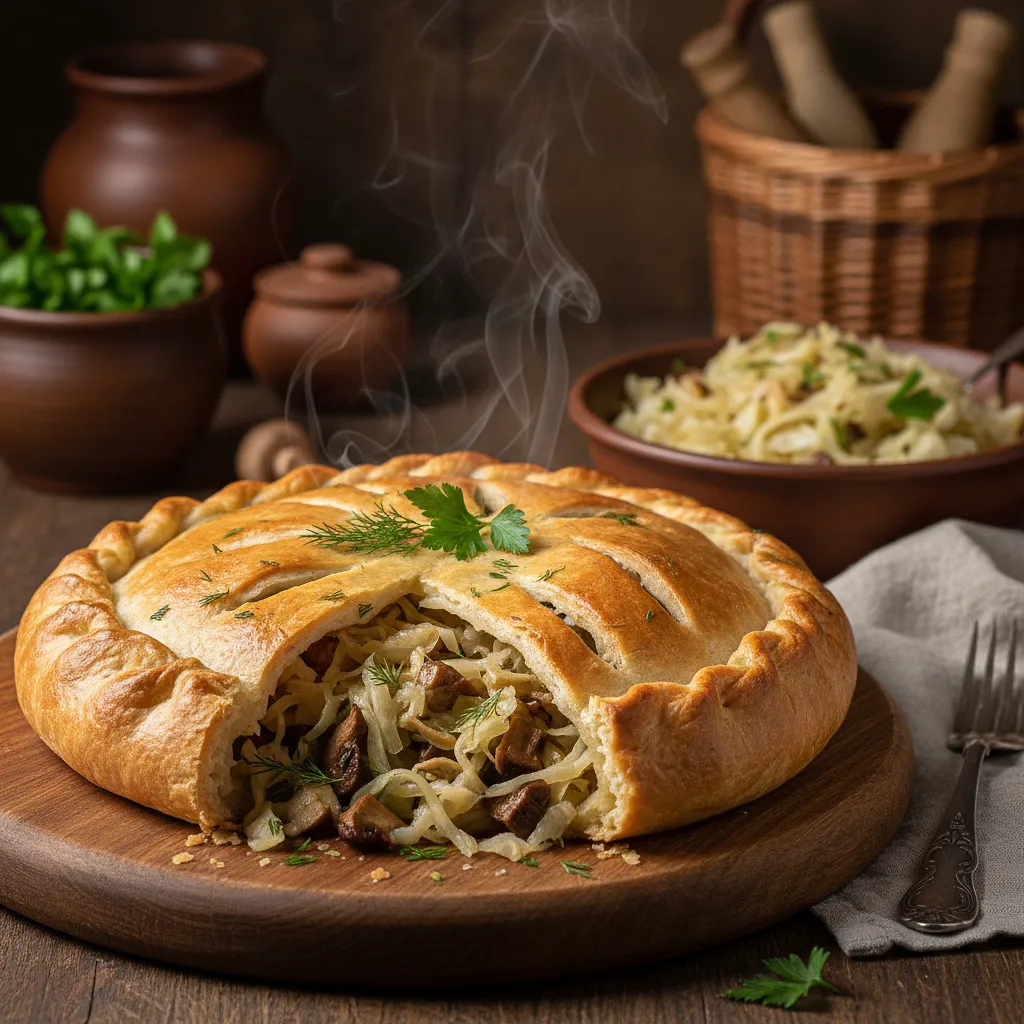
Kulebiak is a traditional dish from the borderlands cuisine that has firmly established itself on Polish tables, especially during Christmas Eve. It is a large, baked pie made from yeast dough, filled to the brim with an aromatic filling of sauerkraut and dried forest mushrooms. Its crust is golden and crispy, while the interior is moist, full of deep, earthy flavors, balanced by the sour note of cabbage and the sweetness of sautéed onions. Visually, it is incredibly impressive – an elongated, beautifully risen loaf, often decorated on top with patterns made from dough, sprinkled with poppy seeds or caraway seeds. It is served warm, cut into thick slices, most often as an accompaniment to clear, rich red borscht. It is an excellent alternative to dumplings or pastries, being a hearty and elegant element of the Christmas Eve dinner.

Składniki (17)

Servings:
8
  • Mąka pszenna typ 500 lub 550 500 g
  • Fresh yeast 25 g
  • Milk 3.2% 250 ml
  • Masło 82% 75 g
  • sugar 15 g
  • Egg 2 szt.
  • Sauerkraut 800 g
  • Dried forest mushrooms 50 g
  • Onion 2 szt.
  • Rapeseed oil 45 g
  • 🌿 Przyprawy
  • Salt 7 g
  • Bay leaf 6.7 szt.
  • Allspice 4 g
  • Ground black pepper 3 szczypty
  • Dried marjoram 2 łyżeczki
  • ✨ Opcjonalne
  • Blue poppy seeds 0.7 łyżka
  • Whole caraway seeds 1 łyżeczka
💰 Szacowany koszt dania: ~29.14 PLN (3.64 PLN/porcję)

💡 Kliknij na składnik aby oznaczyć jako użyty

Preparation steps

Preparing the filling

1

Start by preparing the mushrooms. Place the dried mushrooms in a small bowl and cover them with about 300 ml of boiling water, ensuring they are completely submerged. Let them sit for at least 30 minutes, preferably for an hour, to soften well and release their aroma. The water they soaked in will be very fragrant – do not discard it!

Ingredients: Dried forest mushrooms
Use a glass or ceramic bowl. Make sure all the mushrooms are submerged; you can press them down with a small plate. The longer they soak, the more intense their flavor will be.
2

Transfer the soaked mushrooms along with the water they soaked in to a small pot. Cook over low heat, covered, for about 20-25 minutes, until completely soft. After cooking, drain the mushrooms in a sieve, reserving the broth. You can later add the broth to mushroom soup or Christmas borscht. Set the mushrooms aside to cool.

Ingredients: Dried forest mushrooms
Cooking on low heat will bring out the maximum flavor from the mushrooms. Keeping the broth is key to 'zero waste' in the kitchen and adding flavor to other dishes.
3

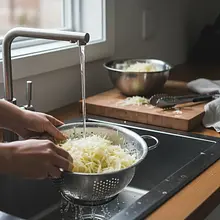
Prepare the sauerkraut. If it is very sour, rinse it once or twice in cold water in a sieve and squeeze it well in your hands to remove excess water. Then chop it on a board into smaller pieces to make the filling more compact. Transfer the cabbage to a larger pot, add bay leaves and allspice. Cover with water just to the surface and cook over medium heat for about 30-40 minutes, until it is soft. Finally, drain it very thoroughly in a sieve.

Ingredients: Sauerkraut, Bay leaf, Allspice
The acidity of the cabbage is a matter of taste – try it before rinsing. Too much water in the cabbage will make the filling runny and soak the dough. Use a large pot, as the cabbage initially has a large volume.
4

While the cabbage is cooking, peel the onions and chop them into small cubes (about 0.5 cm x 0.5 cm). In a large skillet, heat the rapeseed oil over medium heat. Add the chopped onion and sauté, stirring occasionally, for about 8-10 minutes. The onion should become translucent, soft, and slightly golden, but not brown. The sautéed onion will add sweetness to the filling.

Ingredients: Onion, Rapeseed oil
Use a large skillet, preferably with a thick bottom, so the onion cooks evenly. Patience is key – do not increase the heat to speed up the process, as the onion will burn and become bitter.
5

Chop the cooled mushrooms very finely with a knife or grind them in a meat grinder with a coarse setting. To the pan with the sautéed onion, add the drained, cooked cabbage and the chopped mushrooms. Mix everything thoroughly. Season with salt, freshly ground pepper, and marjoram crushed in your hands. Fry everything together for about 5 minutes, stirring constantly to combine the flavors. Remove the pan from the heat and set the filling aside to cool completely. The filling must be cold before placing it on the dough.

Ingredients: Salt, Ground black pepper, Dried marjoram
The filling must be cold, as a warm filling would melt the butter in the yeast dough and make it sticky and difficult to shape. You can prepare the filling a day in advance and store it in the refrigerator.

Preparation of yeast dough

6

Prepare the yeast starter. In a small saucepan, heat the milk to a temperature of about 37°C (it should feel slightly warm to the touch, like body temperature). In a large bowl or cup, crumble the fresh yeast, add a tablespoon of sugar, a tablespoon of flour (from the measured portion of 500g), and pour in half of the warm milk. Mix thoroughly with a fork until all the ingredients are combined and there are no lumps. Cover with a cloth and set aside in a warm place for 10-15 minutes. The starter is ready when it doubles in volume and a thick foam appears on the surface.

Ingredients: Fresh yeast, Milk 3.2%, sugar, Mąka pszenna typ 500 lub 550
This is a key step to check the activity of the yeast. If the starter does not rise, it means the yeast is inactive and you need to start over. Be careful that the milk is not too hot, as it will kill the yeast.
7

In the meantime, melt the butter in a small saucepan over low heat and set aside to cool slightly. Sift the remaining flour into a large bowl, add salt, and mix. Crack one egg, add the risen yeast mixture, and the rest of the warm milk. Start kneading the dough.

Ingredients: Masło 82%, Mąka pszenna typ 500 lub 550, Salt, Egg
Sifting the flour aerates it, making the dough lighter and fluffier. Use a large bowl to have enough space for kneading.
8

Knead the dough by hand or using a mixer with a dough hook. Initially, it will be sticky. After about 5 minutes of kneading, when the ingredients are combined, start gradually adding the melted and cooled butter while continuing to knead. Continue kneading for another 5-7 minutes. The finished dough should be smooth, elastic, and pull away from the sides of the bowl and your hands.

Ingredients: Masło 82%
Do not add all the butter at once, as the dough will be difficult to knead. Add it in batches. If the dough is too sticky, you can sprinkle a little flour, but not too much, so it doesn't become tough. Kneading by hand on the countertop will take about 10-15 minutes.
9

Form the dough into a ball, place it back in the bowl, cover with a clean kitchen towel or plastic wrap, and set it in a warm, draft-free place for about 60-90 minutes. The dough should double in size during this time.

A good warm place is near a radiator or an oven with the 'light' function on (temperature about 30°C). You can lightly grease the bowl with oil to help the dough come off more easily after rising.

Shaping and baking the kulebiak

10

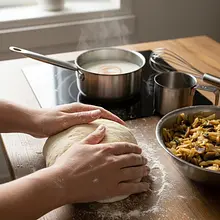
Remove the risen dough onto a lightly floured surface or pastry board. Knead it briefly to eliminate air bubbles. Then roll it out with a rolling pin into a large rectangle measuring about 30x40 cm and about 0.5 cm thick.

Ingredients: Mąka pszenna typ 500 lub 550
Try to roll out the dough evenly so that the kulebiak has a uniform wall thickness. Do not use too much flour for dusting, as it may make the dough tough.
11

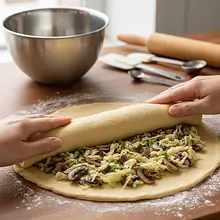
On the rolled-out dough, evenly spread the completely cooled filling of cabbage and mushrooms. Leave about 2-3 cm of free margin on each side of the rectangle. This is important for sealing the edges properly.

The filling must be really cold. Make sure the layer of filling is even across the entire surface, which will ensure even baking and flavor in every piece.
12

Roll the dough with the filling into a tight log, starting from the longer side. Try to roll it as tightly as possible to avoid any empty spaces inside. Seal the ends of the log and the edge along the seam very carefully, pressing with your fingers to ensure that the filling doesn't leak out during baking.

You can brush the free edges of the dough with a little water or beaten egg white, which will help with sealing. This is the most important step in shaping – it determines the shape of the kulebiak.
13

Transfer the shaped kulebiak to a large baking sheet lined with parchment paper, placing it seam side down. Cover it with a cloth and set it in a warm place for another 20-30 minutes to rise again (the so-called proofing). In the meantime, preheat the oven to 180°C (top and bottom heat).

To make it easier to transfer the kulebiak, you can roll it directly on parchment paper and then move it to the baking sheet along with the paper. The second rising will make the kulebiak fluffier after baking.
14

In a small bowl, beat the remaining egg with a fork. Brush the risen kulebiak thoroughly on the top and sides with the beaten egg using a kitchen brush. Additionally, if using, sprinkle the top with poppy seeds or caraway seeds. Make a few slashes on the top with a sharp knife to allow steam to escape during baking.

Ingredients: Egg, Blue poppy seeds, Whole caraway seeds
Brushing with egg will ensure a beautiful, shiny, and golden crust. The slashes are important, they will prevent the dough from cracking uncontrollably.
15

Place the tray with the kulebiak in the preheated oven. Bake for about 35-45 minutes on the middle rack, until the kulebiak has a deep golden-brown color. To check if it is baked, you can tap the bottom – it should make a hollow sound.

If the top browns too quickly, loosely cover it with aluminum foil and continue baking. Baking time depends on the oven, so check the kulebiak after 30 minutes.
16

Remove the baked kulebiak from the oven and carefully transfer it to a metal cooling rack. Leave it to cool slightly for at least 15-20 minutes before slicing. Cutting a hot kulebiak may cause the dough to collapse.

Cooling on a rack is important because it allows air circulation and prevents the bottom from steaming. It tastes best served warm.

Fun Fact

💡

The name 'kulebiak' comes from the Russian word 'кулебяка'. This dish gained international fame in the 19th century thanks to the French master chef, Auguste Escoffier, who included it in the canon of haute cuisine, serving it in luxurious Parisian restaurants.

Best for

Tips

🍽️ Serving

Serve warm, sliced into thick pieces (about 2-3 cm thick). Traditionally, it is served as a side dish to clear red borscht, which is poured into cups for sipping. It can also be a standalone dish with mushroom or horseradish sauce.

🥡 Storage

Once completely cooled, the kulebiak can be stored at room temperature, wrapped in aluminum foil or a linen cloth, for up to 2 days. To regain its crispness, it can be reheated in an oven preheated to 150°C for 10-15 minutes. It is great for freezing, both whole and in slices.

📸 Ugotowane przez społeczność

Zaloguj się, aby dodać zdjęcie
Dodaj zdjęcie gotowej potrawy

Po zatwierdzeniu przez moderatora otrzymasz 10 punktów doświadczenia.

🍲

Nikt jeszcze nie dodał zdjęcia. Bądź pierwszy!

Comments (0)

Be the first to comment on this recipe!

Add a comment

You might also like

Recipe Categories

Regional cuisine for Christmas Eve features local traditions from various corners of Poland. Christmas Eve pierogi ruskie from Podkarpacie - with potatoes, cheese, and onions. Carp in Kashubian style - in horseradish sauce with raisins and almonds. Silesian żurek on sourdough - with mushrooms ins...

See all recipes in this category

Christmas Eve dishes are the heart of Polish holiday tradition - 12 meatless dishes on the table. Fried, baked, jellied, and Jewish-style carp - the main star of Christmas Eve. Dumplings with cabbage and mushrooms - handmade according to grandma's recipes. Small mushroom-filled pockets for borsch...

See all recipes in this category

Vegetarian cuisine is a wealth of flavors without meat - healthy, colorful, and filling. Plant-based proteins: lentils, chickpeas, beans, peas, and soy take center stage. Cheeses and dairy: feta, halloumi, ricotta, and mascarpone in main dishes. Eggs in various forms: omelets, frittata, shakshuka...

See all recipes in this category

Homemade cakes and pastries are the heart of Polish culinary tradition - sweet memories from childhood. In our collection, you will find recipes for classic yeast cakes, shortcrust, sponge, and cheesecake. Apple pie, poppy seed cake, gingerbread, Easter babka, chocolate cake, and New York cheesec...

See all recipes in this category
Reklama