Start by preparing the mushrooms. Place the dried mushrooms in a bowl and cover them with about 400 ml of boiling water, ensuring they are completely submerged. Cover the bowl with a plate and set aside for at least 30 minutes, preferably for an hour. During this time, the mushrooms will swell, become soft, and release their aroma into the water.
Description
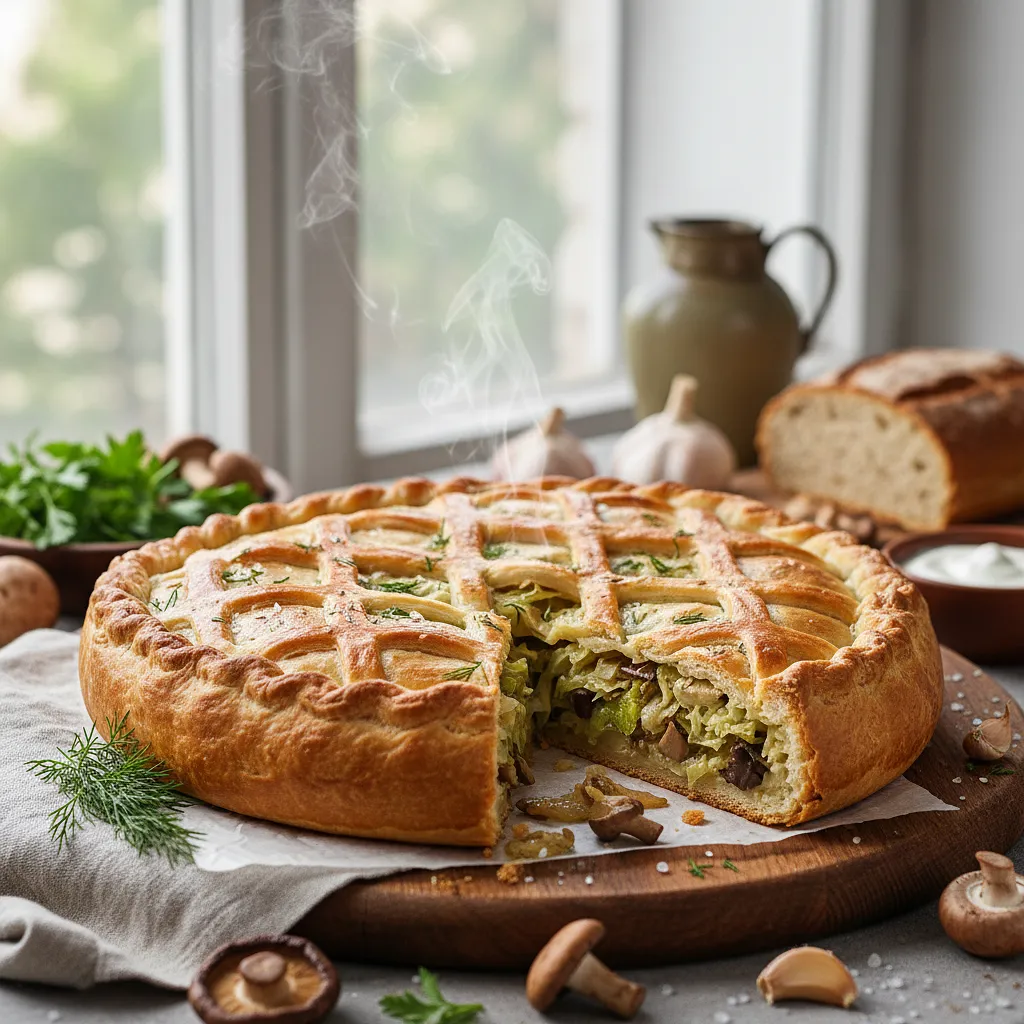
Kulebiak is a traditional dish of Eastern European cuisine that has gained immense popularity on Polish tables, especially in the Eastern Borderlands. It is a large, baked pie in the form of a roll, made from delicate, buttery yeast dough that envelops a rich and aromatic filling. In the Christmas Eve version, the filling consists of sauerkraut, dried forest mushrooms, and golden onions, seasoned with marjoram, bay leaves, and allspice. Its flavor is deep, slightly tangy from the cabbage, with an intense, earthy note from the mushrooms. Visually, kulebiak looks incredibly appetizing – its shiny, golden-brown crust, often sprinkled with poppy seeds or caraway, hides a moist, fragrant interior. Served warm, sliced into thick pieces, it makes an ideal accompaniment to clear, hearty red borscht, creating one of the most classic duos of the Christmas Eve dinner.
Składniki (17)
- Wheat flour type 500 500 g
- Fresh yeast 25 g
- Milk 3.2% 250 ml
- Butter 100 g
- Egg 2 szt.
- sugar 5 g
- Sauerkraut 800 g
- Dried forest mushrooms 50 g
- Onion 2 szt.
- Rapeseed oil 45 g
- 🌿 Przyprawy
- Salt 6 g
- Ground black pepper 2 szczypty
- Bay leaf 3.3 szt.
- Allspice 2 g
- Dried marjoram 2.5 łyżeczki
- ✨ Opcjonalne
- Blue poppy seeds 1 łyżka
- Whole caraway seeds 0.6 łyżeczka
💡 Kliknij na składnik aby oznaczyć jako użyty
Preparation steps
Preparing the filling
Drain the soaked mushrooms, but BE SURE to keep the water they soaked in – it’s an essential mushroom broth. Carefully pour it into another container, leaving any sediment at the bottom. Chop the mushrooms fairly finely with a knife on a cutting board.
Prepare the sauerkraut. If it is very sour, squeeze out the excess juice, then rinse it once or twice with cold water. Squeeze it well in your hands. Chop the cabbage on a board so that the strands are not too long. Transfer the cabbage to a large pot, add the chopped mushrooms, the reserved mushroom broth, bay leaves, and allspice. Pour enough water over everything to just cover the ingredients. Cook over medium heat, covered, for about 45-60 minutes, until the cabbage is tender. Stir occasionally.
Meanwhile, while the cabbage is cooking, peel the onions and chop them into small cubes. In a large skillet, heat the rapeseed oil over medium heat. Add the chopped onion and sauté, stirring occasionally, for about 8-10 minutes, until it becomes translucent, soft, and slightly golden. Do not let it brown.
When the cabbage is soft, drain it very well in a colander, pressing down with a spoon to remove as much liquid as possible. Remove the bay leaves and allspice. Transfer the cabbage with mushrooms back to the pot, add the sautéed onion along with all the fat from the pan. Season with salt, freshly ground pepper, and marjoram crushed in your hands. Mix thoroughly. Taste and adjust seasoning if necessary. Set the filling aside to cool COMPLETELY. This is very important, as a hot filling would dissolve the yeast dough.
Preparing the yeast dough
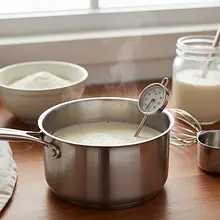
Prepare the yeast mixture. In a small saucepan, heat the milk to a temperature of about 35-37°C (it should feel pleasantly warm to the touch, like bath water for a baby, but not hot). Crumble fresh yeast into a bowl, add a teaspoon of sugar, a tablespoon of flour, and pour in half of the warm milk. Mix with a fork until smooth. Cover with a cloth and set aside in a warm place for 10-15 minutes. The yeast mixture is ready when a thick foam appears on its surface, indicating that the yeast is active.
While the starter is rising, melt the butter in a small pot and set aside to cool slightly. In a large bowl, sift the flour and add a pinch of salt. Make a well in the center. Pour the risen starter into it, the rest of the warm milk, one egg (lightly beaten with a fork), and the cooled, melted butter.
Start kneading the dough. You can do this by hand, gathering the ingredients from the inside to the outside, and then kneading on a countertop for about 10-15 minutes. Alternatively, use a stand mixer with a dough hook and knead on medium speed for 7-10 minutes. The dough is ready when it is smooth, elastic, shiny, and pulls away from your hands and the sides of the bowl.
Form a ball from the kneaded dough, place it in a bowl lightly dusted with flour, cover it with a clean kitchen towel or plastic wrap, and set it in a warm, draft-free place for about 60-90 minutes. The dough should double in volume during this time.
Shaping and Baking
Remove the risen dough onto a lightly floured work surface. Knead it briefly to release the gas, then roll it out into a large rectangle measuring about 35x45 cm and about 0.5 cm thick.
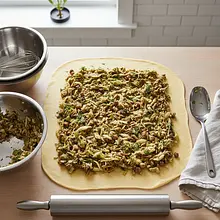
On the rolled-out dough, evenly spread the completely cooled filling, leaving about 2-3 cm of free margin on each side. Roll the dough along the longer side into a tight log, similar to a sponge cake roll. Seal the end of the dough and the sides tightly, tucking them underneath to prevent the filling from leaking during baking.
Carefully transfer the kulebiak to a large baking sheet lined with parchment paper, placing it seam side down. Cover with a cloth and let it rest for another 20-30 minutes to rise. In the meantime, preheat the oven to 180°C (fan or conventional). In a small bowl, beat the remaining egg with a fork. Brush the risen kulebiak with the egg using a pastry brush. If desired, sprinkle the top with poppy seeds or caraway seeds.
Place the tray with the kulebiak in the preheated oven. Bake for about 40-45 minutes, until the crust is a deep golden brown. To check if it is baked, you can tap the bottom – it should make a hollow sound.
Remove the baked kulebiak from the oven and carefully transfer it to a metal cooling rack. Leave it for at least 15-20 minutes before slicing. Cutting a hot kulebiak may cause the dough to collapse and the filling to spill out.
Fun Fact
The name 'kulebiak' comes from the Russian word 'кулебя́ка'. One theory suggests that it derives from the verb 'kulebiaczyć', meaning 'to shape by hand'. Another, more fanciful theory links the name to the German 'Kohlgebäck' (cabbage pastry). Traditionally, Russian kulebiaks had many layers of different fillings, separated by thin pancakes, making them a true work of culinary art.
Best for
Tips
Kulebiak is traditionally served warm, sliced into thick pieces about 2-3 cm wide. It is an essential accompaniment to clear, rich red borscht served in cups. It can also be served as a standalone snack with mushroom sauce or horseradish sauce based on sour cream.
Once cooled, the kulebiak can be stored in the refrigerator, wrapped in aluminum foil or in an airtight container, for 3-4 days. It is best to reheat it in an oven preheated to 160°C for 10-15 minutes, which will help the pastry regain its crispness. Kulebiak is great for freezing – it is best to slice it, wrap each slice in plastic wrap, and freeze.
📸 Ugotowane przez społeczność
Zaloguj się, aby dodać zdjęcieDodaj zdjęcie gotowej potrawy
Po zatwierdzeniu przez moderatora otrzymasz 10 punktów doświadczenia.
Nikt jeszcze nie dodał zdjęcia. Bądź pierwszy!
Comments (0)
Be the first to comment on this recipe!
Add a comment