Start by preparing the mushrooms. Place the dried mushrooms in a medium bowl and pour about 500 ml of boiling water over them. Make sure all the mushrooms are submerged. Cover the bowl with a plate and set aside for at least 30 minutes, preferably for an hour, to soften well and release their aroma. After soaking, the mushrooms should be soft and pliable.
Description
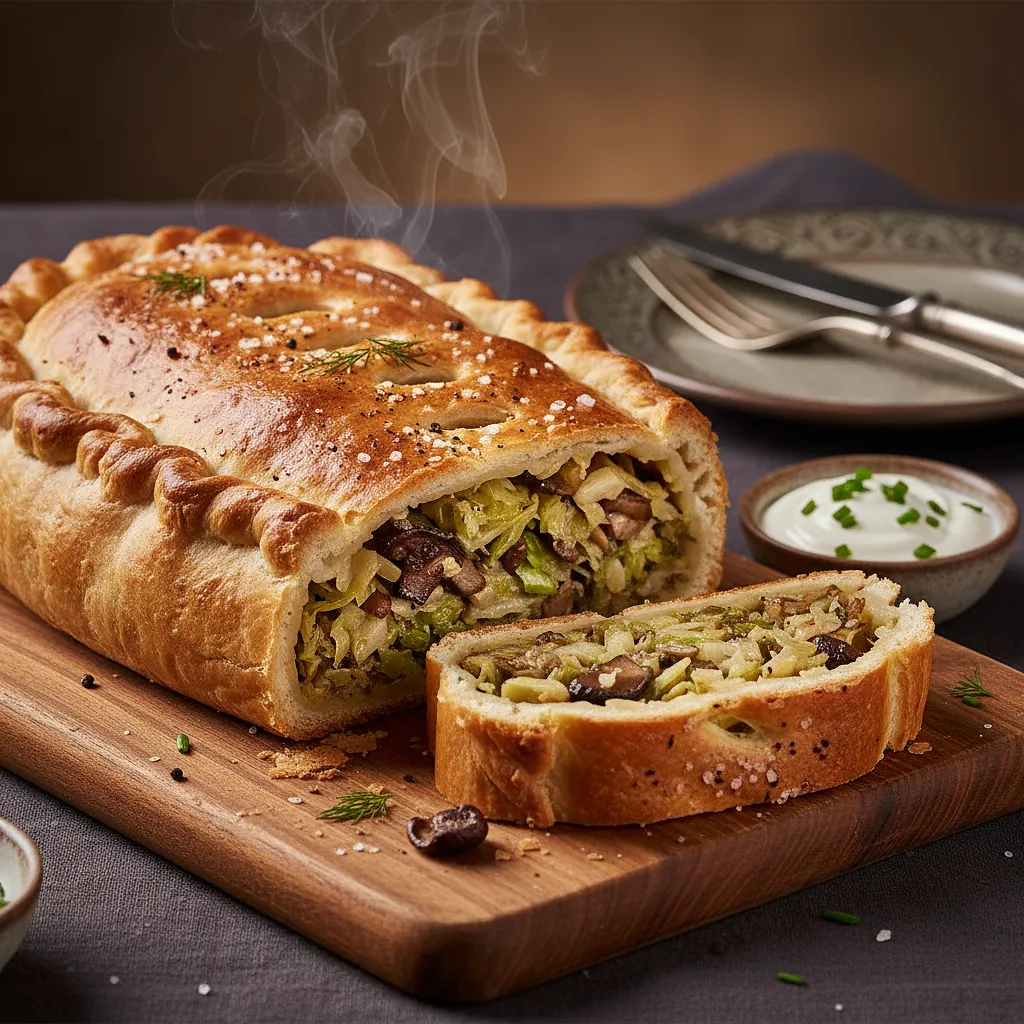
Kulebiak is a traditional dish of Eastern European cuisine that has firmly established itself on Polish tables, especially in the eastern regions like Podlasie. It is a large, baked pie made from yeast dough, filled with a hearty filling. In the Christmas version, the heart of the kulebiak consists of aromatic stuffing made from sauerkraut and dried forest mushrooms, which gives it a deep, earthy, and slightly sour taste. The golden, fluffy crust of the yeast dough perfectly contrasts with the moist and flavorful interior. Served warm or cold, sliced into thick pieces, it is not only a filling dish but also a true decoration of the Christmas table. Its aroma while baking fills the home with a festive atmosphere. It pairs perfectly with clear red borscht, creating a classic and unforgettable combination of flavors.
Składniki (17)
- Wheat flour type 550 500 g
- Fresh yeast 25 g
- Plant-based milk (e.g. oat milk) 250 ml
- Butter (or vegan margarine) 50 g
- sugar 15 g
- Egg 1 szt.
- Sauerkraut 800 g
- Dried mushrooms (boletus, bay boletes) 50 g
- Onion 2 szt.
- Rapeseed oil 45 g
- 🌿 Przyprawy
- Salt 8 g
- Bay leaf 6.7 szt.
- Allspice 4 g
- Dried marjoram 2 łyżeczki
- Pieprz czarny świeżo mielony 2 szczypty
- ✨ Opcjonalne
- Egg for brushing 1 szt.
- Blue poppy seeds 1 łyżka
💡 Kliknij na składnik aby oznaczyć jako użyty
Preparation steps
Preparation of the filling
Drain the mushrooms, reserving all the soaking water. Transfer the mushrooms to a small pot, pour in the reserved soaking water, add bay leaves and allspice. Cook on low heat covered for about 20-25 minutes, until completely soft. After cooking, remove the mushrooms with a slotted spoon, and keep the broth. Finely chop the cooled mushrooms on a cutting board.
Prepare the sauerkraut. Taste it - if it is very sour, rinse it lightly in a sieve under cold water. Then squeeze it well in your hands to remove excess juice. Chop the sauerkraut on a board so that the strands are not too long. Peel the onion and chop it into small cubes.
In a large, wide pot or deep skillet, heat the rapeseed oil over medium heat. Add the chopped onion and sauté, stirring occasionally, for about 5-7 minutes until it becomes translucent and soft but not browned. Add the chopped cabbage and sauté together for another 5 minutes to combine the flavors.
Add the chopped mushrooms to the pot with the cabbage and onion. Mix everything thoroughly. Pour in about 150-200 ml of the reserved mushroom broth. Season with salt, freshly ground pepper, and marjoram (crush it in your hands before adding). Reduce the heat, cover the pot, and simmer the filling for about 30-40 minutes, until the cabbage is soft and the flavors meld together. In the end, the filling should be thick and moist, but not watery. Remove from heat and set aside to cool completely.
Preparing the yeast dough
Prepare the starter. In a small saucepan, heat the plant-based milk until it is lukewarm (about 37°C – when you put your finger in, it should feel pleasantly warm, not hot). In a large bowl, crumble the fresh yeast, add the sugar, and pour in half of the warm milk. Mix with a fork until the yeast and sugar dissolve. Sprinkle a tablespoon of flour on top, cover with a cloth, and set aside in a warm place for 10-15 minutes. The starter is ready when a thick foam appears on the surface.
In a large bowl, sift the remaining flour and add salt. Make a well in the center. Pour in the risen yeast mixture, the rest of the milk, the egg, and the melted and cooled butter. Start mixing the ingredients from the center with a wooden spoon, gradually incorporating the flour from the edges until a firm, sticky ball of dough forms.
Transfer the dough to a lightly floured surface and knead vigorously for about 10 minutes. Knead the dough by pushing it away from you with your wrist, folding it in half, and turning it 90 degrees. Repeat this motion. The dough is ready when it becomes smooth, elastic, and no longer sticks to your hands. Form it into a ball, place it in a bowl dusted with flour, cover it with a cloth, and set it in a warm place for about 60-90 minutes, until it doubles in size.
Shaping and baking the kulebiak
Take the risen dough out onto the countertop, punch it down to release the gas, and knead briefly. Roll it out into a large rectangle measuring about 30x40 cm and about 0.5 cm thick. In the center of the dough, along the longer side, evenly spread the cooled filling, leaving about 3-4 cm of free margin on each side.
Brush the edges of the dough with water or beaten egg, which will help seal it. Roll the dough into a log, starting from the longer side. First, fold one side over the filling, then cover it with the other, creating a long, closed roll. Seal the edges of the dough thoroughly along the entire length and at the ends, tucking them underneath to prevent the filling from leaking during baking.
Prepare a large baking tray and line it with parchment paper. Carefully transfer the kulebiak to the tray, placing it seam side down. Cover it with a cloth and set it in a warm place for another 20-30 minutes to rise again. In the meantime, preheat the oven to 180°C (fan) or 190°C (conventional).
When the kulebiak has risen, brush the top with beaten egg (optional ingredient) using a kitchen brush. If you like, sprinkle it with poppy seeds. Make a few slits on top with a sharp knife so that steam can escape during baking. Place the tray in the preheated oven and bake for about 40-45 minutes, until the kulebiak has a deep golden-brown color.
Remove the baked kulebiak from the oven. To check if it is ready, tap the bottom – it should make a hollow sound. Carefully transfer it to a metal rack and leave it to cool partially for at least 20-30 minutes before slicing. This will allow the filling to set, and the dough will not crumble.
Fun Fact
The name 'kulebiak' comes from the Russian word 'kulebyaka' (кулебя́ка), which may in turn derive from the German 'Kohlgebäck', meaning 'cabbage pastry'. This dish, popular throughout Eastern Europe, was popularized in the 19th century by French chefs working at the imperial court, who adapted it to the refined tastes of the aristocracy.
Best for
Tips
Serve the kulebiak sliced into thick pieces about 2-3 cm wide. It is delicious both warm, right after baking, and cold. Traditionally, it is served as an accompaniment to clear red borscht during Christmas, served in drinking cups. It can also be served with mushroom sauce, horseradish sauce, or a simple dill sauce based on yogurt.
Once completely cooled, the kulebiak can be stored in the refrigerator, tightly wrapped in plastic wrap or in a closed container, for 3-4 days. To reheat and restore the crispness of the crust, place slices in an oven preheated to 150°C for 10-15 minutes or heat in a dry pan over low heat.
📸 Ugotowane przez społeczność
Zaloguj się, aby dodać zdjęcieDodaj zdjęcie gotowej potrawy
Po zatwierdzeniu przez moderatora otrzymasz 10 punktów doświadczenia.
Nikt jeszcze nie dodał zdjęcia. Bądź pierwszy!
Comments (0)
Be the first to comment on this recipe!
Add a comment