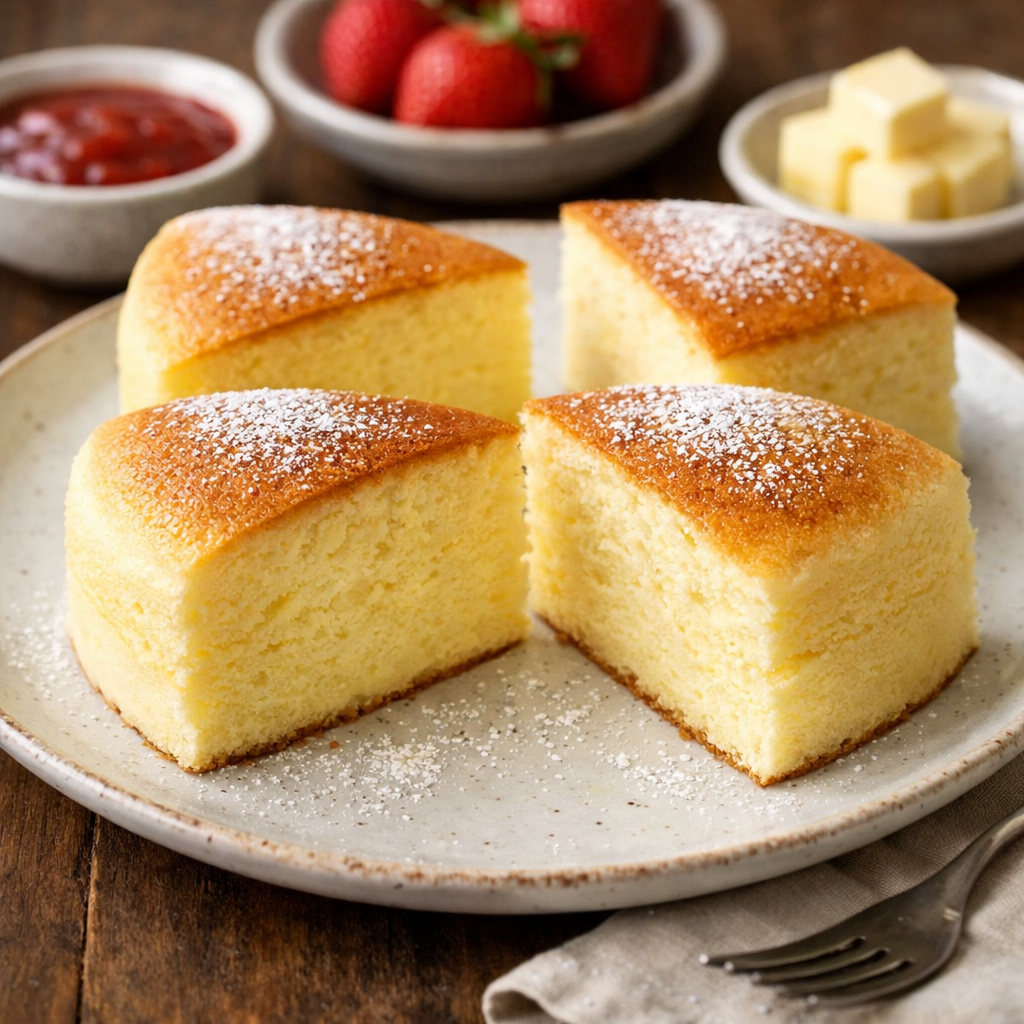
Fluffy Asian-style cheesecake (soufflé) — 4 servings

Desserts Asian Fusion Cuisine Cakes and Bakes 120 min Medium 33 wyświetleń ~14.54 PLN * - (0)
Rate:
(0)
Start Cooking

Description

A delicate, fluffy cheesecake inspired by Japanese soufflé cheesecake — light as a cloud, with a creamy interior and a subtle tartness of lemon. This version uses Polish semi-fat twaróg and cream, but the technique of whipping egg whites and baking in a water bath, typical of Asian cheesecakes, gives it a soft, almost mousse-like texture. Serve chilled, cut into small portions: it pairs wonderfully with matcha green tea (you can add matcha to part of the batter for a green accent), fruit preserves (e.g., currant), or toasted sesame. The aesthetic, light golden top, moist interior, and slightly springy texture make it a dessert suitable for both family gatherings and more sophisticated occasions.

Ingredients Used

Ingredients (13)

Servings:
4
  • Chicken egg 3 szt. (~180 g)
  • Semi-fat cottage cheese 300 g
  • Sugar 100 g
  • 18% cream 80 ml
  • Butter 30 g
  • Milk 50 ml
  • Wheat flour 30 g
  • Potato starch 20 g
  • Lemon juice 15 ml
  • Vanilla extract 5 g
  • 🌿 Przyprawy
  • Salt 1 g
  • ✨ Opcjonalne
  • Matcha (optional) 4 g
  • Black sesame (optional) 10 g
💰 Szacowany koszt dania: ~14.54 PLN (3.64 PLN/porcję)
* Brak cen dla niektórych składników

💡 Kliknij na składnik aby oznaczyć jako użyty

Preparation steps

Preparing the pan

1

Preheat the oven to 160°C (fan 150°C). Prepare an 18 cm round cake pan (or a small loaf pan, but preferably an 18 cm pan). Grease the sides and bottom with butter, and line the bottom with parchment paper. Wrap the outside of the pan with two layers of aluminum foil to prevent water from getting in during the water bath.

Use an 18 cm springform pan. If you only have a larger pan, increase the proportions of the batter. The foil will protect against water seeping in. Tools: pastry brush, baking paper.
Separating the eggs

2

Prepare two clean bowls (one for the yolks, one for the whites). Gently crack the egg against the edge of the bowl, hold the shell over the bowl, and transfer the yolk from one half of the shell to the other so that the white flows out. Place the yolks in the bowl with the yolks, and the whites in the other bowl. Make sure that no drop of yolk gets into the whites — the fat will prevent them from whipping properly.

If you are not experienced, use an egg separator or pour the egg into a small bowl and then into the mixing bowl. The bowl for the egg whites must be completely dry and grease-free (preferably metal or glass).

Cheese mixture

3

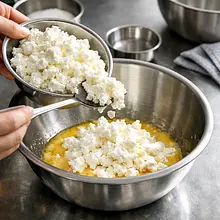
In a large bowl, place semi-fat curd (300 g). If the curd is lumpy, pass it through a sieve using a spoon or briefly blend it with a hand blender (do not blend too long to avoid making a paste). Add the yolks from the separated eggs (whole yolks), 50 g of sugar (from the total of 100 g), 18% cream (80 g), soft butter (30 g), and milk (50 ml). Pour in lemon juice (15 g) and vanilla extract (5 g). Mix in wheat flour (30 g), potato starch (20 g), and salt (1 g). Stir with a wooden spoon or mix on the lowest speed until the ingredients are combined — the mixture should be smooth, free of larger lumps, and moderately runny (not completely liquid).

Use a mixer with a blending attachment on the lowest speed or an immersion blender on short pulses. If the mixture is too thick, add a tablespoon of milk. Avoid aerating the mixture at this stage — the goal is smoothness, not fluffiness (fluffiness will be achieved with the egg whites).

Egg whites (meringue)

4

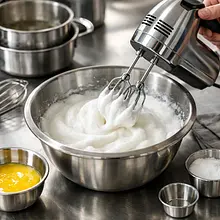
Skip the bowl with egg whites to a stand mixer or hand mixer. Whip the egg whites on low speed until small bubbles form (about 1–2 minutes). Gradually increase the speed to medium-high and add the remaining 50 g of sugar, one tablespoon at a time, whipping evenly. Continue whipping for about 3–5 minutes, until the meringue is glossy and forms stable, stiff peaks (the peak should hold when the whisk is lifted).

The bowl and whisk must be absolutely dry and grease-free. If the foam does not become stiff, it may have gotten egg yolk or the bowl was greasy. Tools: hand mixer or stand mixer, silicone spatula.

Combining the mixture

5

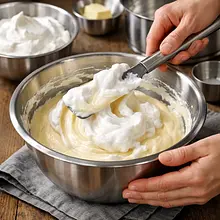
Remove 1/3 of the whipped egg whites and gently fold it into the cheese mixture with energetic movements to loosen the cream (use a silicone spatula, with a cutting and surrounding motion). Then add the remaining egg whites in two batches — gently fold each in from the bottom to the top, rotating the bowl, until the mixture is uniform and aerated. Keep as many air bubbles as possible — they will provide fluffiness.

Do not mix too vigorously in circular motions, as you will lose fluffiness. The correct mixture after combining is light, slightly fluffy, and without visible streaks of foam.

Optional twist

6

If you want to add matcha: pour about 60–80 g of the cheese mixture into a small bowl and add matcha (4 g). Mix thoroughly until the color is even. Pour this green mixture back into the main mixture and gently make a few swirling motions to create a marbled effect (do not mix until completely lightened).

Matcha colors intensely — use gloves when working with white dishes. Additionally, you can add matcha only to part of the mixture and pour it into the mold in layers.

Baking in a water bath

7

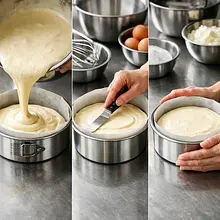
Pour the mixture into the prepared pan (18 cm). Smooth the top with a spatula, gently tap the pan on the countertop to release larger air bubbles. Place the pan in a larger baking tray or roasting pan and pour hot (not boiling) water into it so that it reaches halfway up the sides of the pan with the mixture. Loosely cover the top of the springform pan with a sheet of aluminum foil (do not let it touch the mixture). Bake in the preheated oven for 50–60 minutes at 160°C. After 50 minutes, check: the edges should be set, the center should jiggle slightly when shaken — it should be firm but not liquid.

Different ovens heat differently; if the top browns too much, lower the temperature to 150°C and extend the time. The water bath prevents cracking and gives a delicate texture. Tools: large baking dish, oven mitts.

Cooling and chilling

8

After baking, turn off the oven, crack the door open about 5 cm, and leave the cheesecake inside for 15 minutes — this prevents sudden shrinking. Then remove the cheesecake from the water bath and take off the foil. Let it cool on a rack to room temperature (about 30–60 minutes). Once cooled, place it in the refrigerator for at least 4 hours, preferably overnight, to allow the filling to set and the flavors to meld.

Do not place a hot cheesecake on a cold surface — this may cause cracks. It is best to cut it after it has completely cooled; dipping the knife in hot water makes it easier to achieve clean slices.

Decoration and serving

9

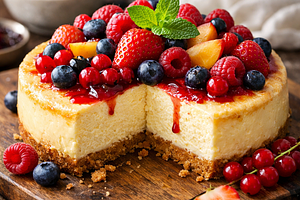
Before serving, you can sift a thin layer of powdered sugar through a sieve or sprinkle the top with a bit of matcha (if using) for a color effect. Sprinkle a piece with toasted black sesame (10 g) for a contrast of flavor and texture. Serve chilled, cutting into 4 equal portions.

Additionally, you can serve a teaspoon of red fruit jam or a few fresh fruits for acidity. Tools: powdered sugar sifter, small spoon for spreading jam.

Fun Fact

💡

Japanese soufflé cheesecake was created as a hybrid of Western cheesecake and delicate soufflé desserts; it is known for its very light, almost airy texture, often achieved by separately whipping the egg whites and baking in a water bath.

Best for

Tips

🍽️ Serving

Serve chilled, thinly sliced (small pieces are more impressive). Green tea (e.g. sencha) or slightly sweet sparkling wine pairs well with cheesecake. Cutting with a knife warmed under hot water will give perfectly even slices.

🥡 Storage

Store in the refrigerator covered with plastic wrap or in an airtight container for 3-4 days. Do not freeze — the texture may lose its fluffiness after thawing. Before serving, take it out 10-15 minutes in advance to reach the ideal serving temperature.

📸 Ugotowane przez społeczność

Zaloguj się, aby dodać zdjęcie
Dodaj zdjęcie gotowej potrawy

Po zatwierdzeniu przez moderatora otrzymasz 10 punktów doświadczenia.

🍲

Nikt jeszcze nie dodał zdjęcia. Bądź pierwszy!

Comments (0)

Be the first to comment on this recipe!

Add a comment

You might also like

Recipe Categories

Desserts
Desserts in: New Year's Eve

A sweet ending to the New Year's Eve dinner is a must-have that will put everyone in a joyful mood for the new year.

See all recipes in this category

Modern recipes that combine traditional flavors of Asia with other culinary cultures, offering unusual combinations and innovative dishes.

See all recipes in this category

Homemade cakes and pastries are the heart of Polish culinary tradition - sweet memories from childhood. In our collection, you will find recipes for classic yeast cakes, shortcrust, sponge, and cheesecake. Apple pie, poppy seed cake, gingerbread, Easter babka, chocolate cake, and New York cheesec...

See all recipes in this category
Reklama