Mushroom, spelt, and sauerkraut casserole

Pikantne Main dishes Vegetarian Dishes Regional Cuisine of Poland 90 min Medium 36 wyświetleń ~54.11 PLN 5.0 (1)
Rate:
5.0 (1)
Start Cooking

Description

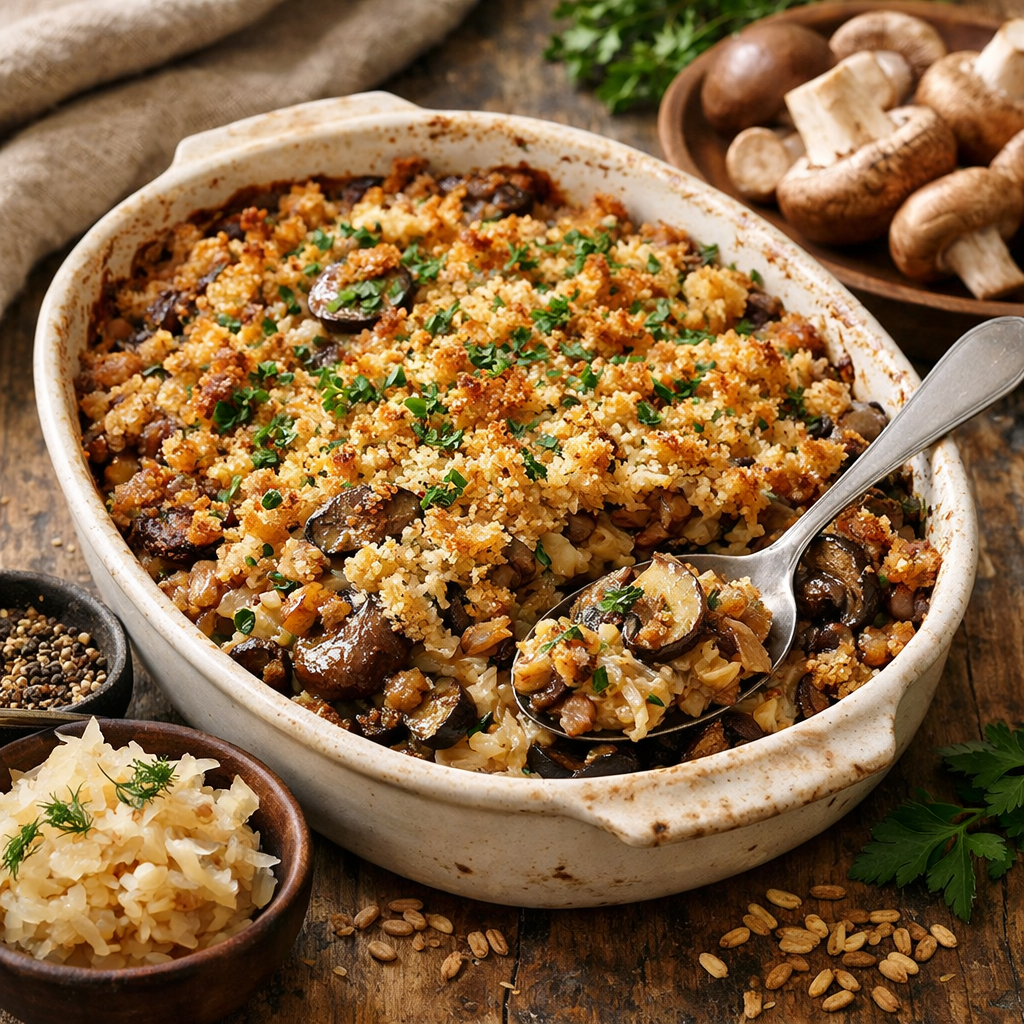
A warming, hearty casserole that is a modern, winter reinterpretation of Polish cuisine: it combines mushrooms, sour fermented cabbage, and whole grain barley, enveloped in a creamy sauce made of cottage cheese and sour cream, baked under a blanket of cheese. This dish is perfect for cold days — aromatic, with a contrast of creaminess and the tartness of the cabbage, it works well as a standalone lunch dish or as a warm side to a salad. Visually appealing with a golden, slightly crispy cheese crust, the cut pieces reveal layers: grainy barley, moist mushrooms, and cabbage. Serve with a simple salad of raw apples and carrots or pickled cucumber; for enthusiasts — with a touch of spicy mustard or horseradish.

Ingredients Used

Ingredients (18)

Servings:
4
  • Mushrooms 500 g
  • Onion 1 szt. (~150 g)
  • Garlic 3 ząbki (~15 g)
  • Sauerkraut 300 g
  • Barley groats 200 g
  • Vegetable broth 500 ml
  • 18% cream 200 ml
  • Semi-fat cottage cheese 200 g
  • Grated yellow cheese 150 g
  • Butter 30 g
  • Rapeseed oil 15 g
  • Dried thyme 2 g
  • Chicken egg 2 szt. (~120 g)
  • 🌿 Przyprawy
  • Salt 6 g
  • Black pepper 4 szczypty (~2 g)
  • Nutmeg (grated) 1 szczypta (~1 g)
  • ✨ Opcjonalne
  • Parsley 1 pęczek (~30 g)
  • Walnuts 50 g
💰 Szacowany koszt dania: ~54.11 PLN (13.53 PLN/porcję)

💡 Kliknij na składnik aby oznaczyć jako użyty

Preparation steps

Groats

1

Prepare the pearl barley: rinse 200 g of pearl barley in a sieve under cold water until the water runs clear. Transfer to a medium pot (2-3 l), and pour in 500 ml of warm vegetable broth. Bring to a boil over high heat, then reduce to low heat, cover with a lid, and cook for 25-30 minutes, stirring occasionally. After this time, taste the barley: the grain should be soft on the outside, slightly firm in the center (al dente). If the liquid has been absorbed and the barley is still hard, add 50-100 ml of hot broth and cook for another 5-10 minutes.

Use a medium pot with a thick bottom to prevent the groats from burning. If you don't have broth, you can use hot water and a vegetable cube. Start tasting the groats from the 20th minute — we don't want overcooked pearl barley.
Filling

2

Prepare the vegetables: peel the onion and chop it into small cubes (about 5 mm). Clean the mushrooms with a damp cloth or trim the ends of the stems with a knife, then slice them into pieces 3-4 mm thick. Peel the garlic and finely chop it or press it through a garlic press.

To clean mushrooms, avoid soaking them under running water — the mushrooms absorb water and will lose their flavor. Use a cutting board and a sharp knife.
3

In a large skillet, heat 15 g of rapeseed oil and 15 g of butter over medium heat. Add the chopped onion and sauté for 5-7 minutes, stirring frequently, until the onion softens and becomes translucent. Add the garlic and sauté for 30 seconds just to release the aroma (be careful not to burn it).

The best pan is 26-28 cm in diameter. Use a wooden spoon to avoid scratching the coating. Sauté the onion until it becomes soft and lightly golden — if it browns too quickly, lower the heat.
4

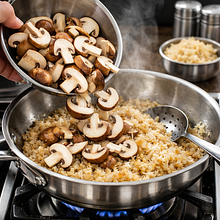
Add the chopped mushrooms to the pan and increase the heat to medium-high. Sauté uncovered for 8-10 minutes, stirring every 1-2 minutes, until most of the released water evaporates and the mushrooms begin to brown. At this stage, add 2 g of black pepper and 2 g of thyme (1 teaspoon). Taste — the mushrooms should have an intense aroma and slightly golden edges.

This is a key moment — the mushrooms need to evaporate and brown slightly. If the pan is too small, fry in two batches to avoid steaming the mushrooms in excess juice.
5

Drain the sauerkraut well with your hands (to avoid adding excess moisture), and if it's long, cut it into shorter strips with a knife. Add 300 g of drained sauerkraut to the pan with the mushrooms and sauté together for 5-7 minutes, until the flavors meld, the taste of the cabbage softens, and the mixture is moist but not watery. Season lightly with salt — remember that the cheeses and cabbage may already be salty; add about 2 g of salt and taste.

If the cabbage is very sour, you can rinse it first and then squeeze it again, but you will lose some of the aroma. Use a wooden spatula to stir so you don't crush the cabbage too much.

Sauce

6

In a large bowl, beat 120 g of eggs (2 pieces) with a fork. Add 200 g of 18% cream and 200 g of cottage cheese; mix thoroughly to create a smooth, creamy sauce. Add grated nutmeg (1 g) and another light pinch of salt to taste (about 2 g if needed). Fold in half of the grated cheese (75 g) — reserve the rest for sprinkling on top.

If the cottage cheese is grainy and hard to combine, first mash it with a fork or blend it in short pulses with a hand blender to make the sauce creamy. Use a bowl with a capacity of at least 1.5 l.

Assembly and baking

7

Preheat the oven to 190°C (top-bottom). Grease a baking dish measuring about 20x30 cm (depth 4-5 cm) with 10 g of butter. In a large bowl, combine the cooked spelt with the filling from the pan — gently mix with a wooden spoon to evenly distribute the ingredients. Transfer the mixture to the prepared dish and smooth the surface.

If you don't have a 20x30 cm dish, you can use a container of similar volume (about 2.5 l). Don't overbeat the mixture — we want to preserve the texture of the barley and mushrooms.
8

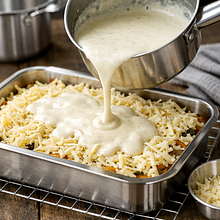
Pour the creamy sauce evenly over the top of the casserole. Sprinkle the remaining 75 g of grated cheese and, if using, chopped walnuts (50 g) for crunch. Place in the preheated oven and bake for 25-30 minutes, until the top is golden, the cheese melts, and starts to bubble slightly. After baking, remove and let it sit for 10 minutes to allow the dish to 'set' — the sauce will thicken a bit and it will be easier to portion.

Place the oven rack in the middle position. If the top browns too quickly, loosely cover it with aluminum foil and finish baking. Use oven mitts when removing the dish.

Serving

9

Serve the casserole on plates, portioning 1/4 of the contents per person. Garnish with freshly chopped parsley (30 g) just before serving to add freshness and color. Additionally, serve pickled cucumbers or a salad of apple and carrot as a sweet-and-sour contrast.

Use a large spoon for casseroles or a spatula — the portions will be compact thanks to the eggs and cottage cheese. If the casserole has been placed in the fridge, reheat in the oven for 15-20 minutes at 170°C.

Fun Fact

💡

Pearl barley was a traditional peasant product in Poland; it used to be served instead of more expensive rice. The combination of mushrooms and sauerkraut is a classic of rural cuisine — here it has gained a modern touch thanks to creamy cottage cheese and baked cheese.

Best for

Tips

🍽️ Serving

Serve hot, with a side of fresh salad (apple-carrot) or pickled cucumbers to balance the creaminess. For a bolder flavor, serve with a tablespoon of spicy mustard or a teaspoon of horseradish on the side. Leftover portions can be easily reheated in the oven without losing their texture.

🥡 Storage

Store in an airtight container in the refrigerator for up to 3 days. To reheat: place in an oven preheated to 170°C for 15-20 minutes, covered with aluminum foil at the beginning to prevent excessive browning on top. Long-term storage in the freezer is not recommended due to changes in the texture of the cream and cheese.

📸 Ugotowane przez społeczność

Zaloguj się, aby dodać zdjęcie
Dodaj zdjęcie gotowej potrawy

Po zatwierdzeniu przez moderatora otrzymasz 10 punktów doświadczenia.

🍲

Nikt jeszcze nie dodał zdjęcia. Bądź pierwszy!

Comments (0)

Be the first to comment on this recipe!

Add a comment

You might also like

Recipe Categories

Main dishes
Main dishes in: New Year's Eve

Main dishes for New Year's Eve should be hearty and impressive to satisfy the palates of all guests.

See all recipes in this category

Vegetarian cuisine is a wealth of flavors without meat - healthy, colorful, and filling. Plant-based proteins: lentils, chickpeas, beans, peas, and soy take center stage. Cheeses and dairy: feta, halloumi, ricotta, and mascarpone in main dishes. Eggs in various forms: omelets, frittata, shakshuka...

See all recipes in this category

Traditional recipes from various regions of Poland that showcase the richness of local flavors and ingredients.

See all recipes in this category
Reklama