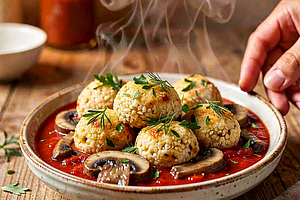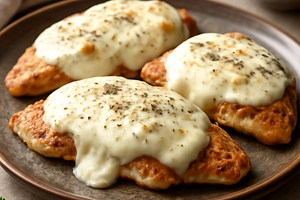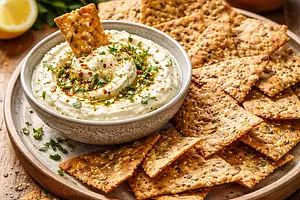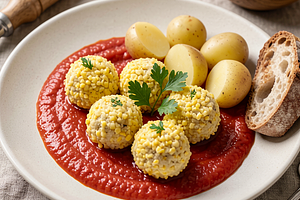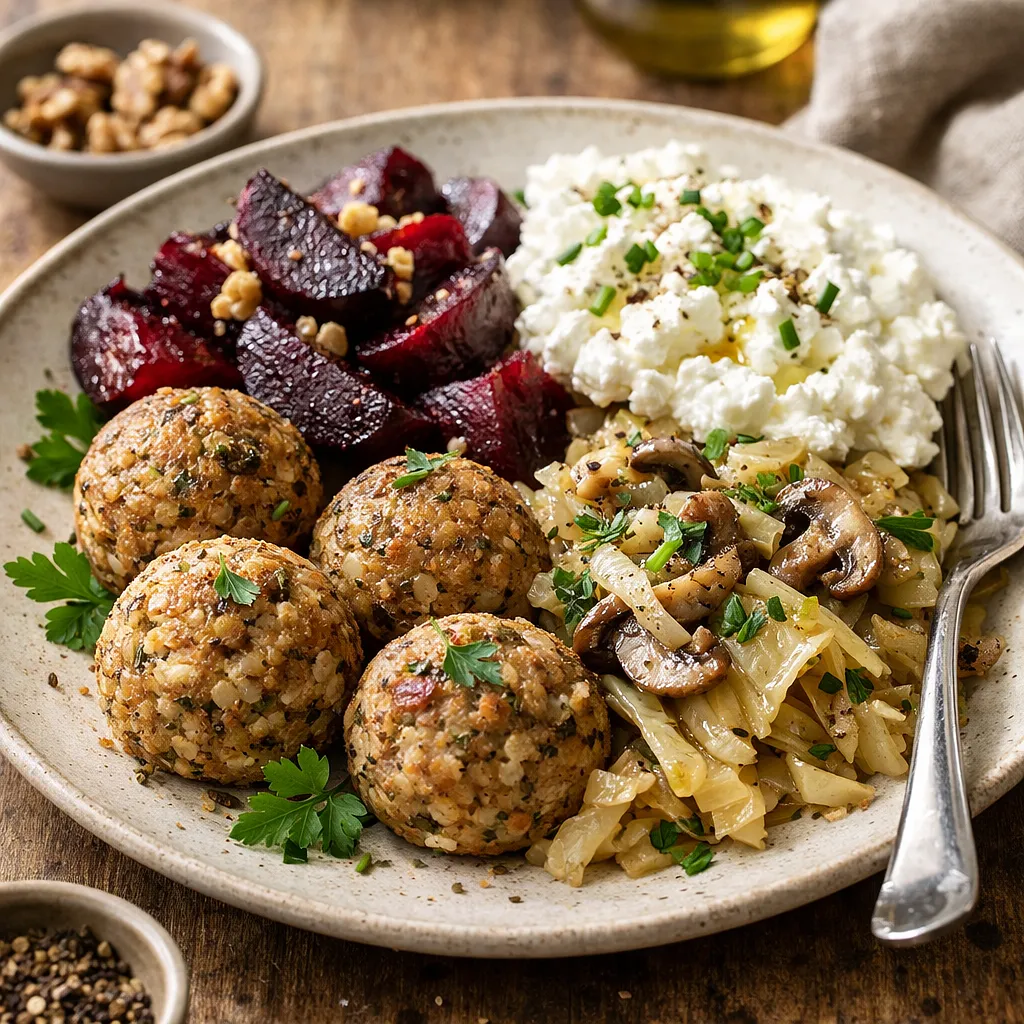
A warming winter snack that combines Polish flavors: firm buckwheat groats, sweet-earthy roasted beetroot, and creamy cheese in the form of golden balls coated in crunchy barley. Served on a bed of stewed sauerkraut with forest mushrooms and juicy apple, accompanied by a refreshing buttermilk-garlic sauce. The dish combines textures and flavor contrasts: sweet-salty, creamy-crunchy, tangy-earthy. Perfect as a warm snack for winter gatherings or an appetizer during a family dinner.
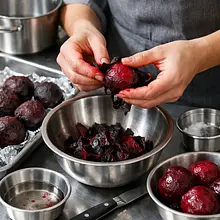
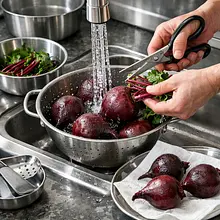
Preheat the oven to 200°C (top and bottom heat). Wash the beets under running water, trim the leaves, and dry with a paper towel. Wrap each beet individually in aluminum foil or place them in a covered baking dish. Put them in the preheated oven and bake for 50-60 minutes (depending on size) until the center is soft — you can check this by inserting a knife: it should go in easily.
Ingredients:
Fresh red beet
Use kitchen gloves to remove the hot beets. Smaller beets will be ready faster (about 40-45 min). If you want to speed things up, you can peel the beets and cut them into quarters, baking for 30-35 min.
Buckwheat
2
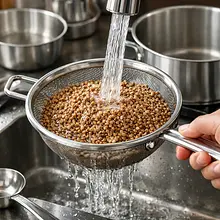
Rinse the buckwheat in a sieve under cold water (3-4 times) to remove dust. Pour 400 ml of water into a pot, add 2 g of salt (a small pinch), and bring to a boil. Add the buckwheat, stir, reduce the heat to low, and cook covered for 12-15 minutes until most of the water is absorbed. After cooking, remove the pot from the heat and let it sit covered for 5 minutes, then fluff with a fork.
Ingredients:
raw buckwheat groats, Salt
Use a pot with a lid that fits the diameter. The groats are ready when the grains are soft but hold their shape — they should not be mushy.
Preparation of the barley for coating
3
Pour the pearl barley into a dry pan and toast it over medium heat for 6-8 minutes until it starts to smell slightly nutty and browns a bit. Transfer to a plate to cool. Once cooled, grind or crush the pearl barley in a blender using a pulse setting to achieve a coarse crumb — not flour; pieces should be visible.
Ingredients:
Barley pearls for coating
Use a non-stick or cast iron skillet; stir every few seconds to avoid burning. A pulse blender provides the best control over texture.
Dough for the balls
4
When the beets have cooled slightly (about 10-15 minutes after taking them out of the oven), peel them (the skin comes off more easily when the beets are warm) and grate them on a coarse grater or finely chop with a knife. In a large bowl, combine the cooked, cooled groats, grated beet, cottage cheese, beaten egg, flour, and chopped soaked and drained plums. Season with 3 g of salt and 1 g of pepper. Mix with a wooden spoon or your hand (lightly greased with oil) until the mixture is uniform — it should be moist but not falling apart; if it's too wet, add another tablespoon of flour.
Ingredients:
raw buckwheat groats, Fresh red beet, Semi-fat cottage cheese, Chicken egg, Wheat flour, Dried plums, Salt, Black pepper
Use a large bowl. If the mixture sticks too much to your hands, dampen your hands with cold water or lightly grease them with oil. The mixture is ready when you can form a ball that holds its shape.
Shaping and coating
5
Form small balls from the mixture, about the size of a walnut (approximately 25-30 g each). Place them on a board. Roll each ball in the prepared crumble made from buckwheat, pressing lightly to ensure the crumble adheres evenly. Arrange the balls on a baking sheet lined with parchment paper, leaving a 2-3 cm gap between them.
Ingredients:
Barley pearls for coating, raw buckwheat groats, Wheat flour, Chicken egg
If the mixture sticks to the spoon, wet the spoon or your hands. If you want to achieve an even crispier crust, briefly dip the ball in a bit of beaten egg before coating (optional).
Baking the balls
6
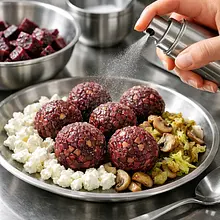
Drizzle the balls with a thin layer of rapeseed oil using a brush or spray from a bottle. Place the tray in the oven preheated to 200°C and bake for 18-22 minutes, until the barley turns brown and the balls are firm to the touch. After 10 minutes, gently turn the balls with a spatula to ensure they brown evenly.
Ingredients:
Rapeseed oil, Barley pearls for coating
The best option is a non-stick baking tray or one lined with parchment paper. Do not place the tray on the bottom shelf too close to the heating element - this can cause the bottom to burn.
Stewing cabbage with mushrooms
7
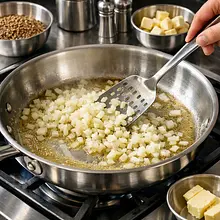
In a large skillet, melt the butter over medium heat. Add the finely chopped onion and sauté for 4-5 minutes until it becomes translucent. Add the chopped mushrooms and cook for another 6-8 minutes until most of the water evaporates and the mushrooms are lightly browned. Add the finely chopped apple and the chopped sauerkraut. Season with thyme and 1-2 g of salt (be mindful of the saltiness of the sauerkraut) and 1 g of pepper. Reduce the heat and simmer covered for 12-15 minutes, stirring every 3-4 minutes. The cabbage should soften and the flavors should meld together.
If the cabbage is very sour, rinse it briefly and squeeze it well before braising. Use a wide pan so that the ingredients have space and can quickly sauté before braising.
Buttermilk Garlic Sauce
8
In a bowl, combine buttermilk with finely chopped dill and crushed garlic clove. Season with 1 g of salt and 1 g of pepper. Whisk until the sauce is smooth. Taste and adjust the seasoning — the buttermilk should be fresh and slightly tangy, and the garlic should give a subtle kick.
Ingredients:
Buttermilk, Dill, Garlic, Salt, Black pepper
It's best to prepare the sauce shortly before serving to maintain its freshness. If the sauce is too thin, you can add 1-2 teaspoons of natural yogurt (optional).
Finishing and serving
9
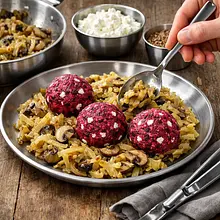
On a large platter, spread the warm stewed cabbage with mushrooms as a 'bed'. Place 3 balls for each serving (or more as finger food) on the cabbage. Drizzle each serving with 1-2 tablespoons of buttermilk sauce and sprinkle (optional) with chopped toasted walnuts for an additional contrast of textures. Serve immediately while the balls are warm and the cabbage is steaming.
Ingredients:
Sauerkraut, Buttermilk, Walnuts
Use a wide platter so everyone can reach. Additionally, you can serve extra buttermilk sauce in a small bowl for dipping.
Final tips
10
If you prepare in advance: the balls can be baked earlier and reheated for 6-8 minutes at 180°C before serving to regain their crispiness. Store the sauce separately in the fridge. Leftover cabbage tastes great the next day — gently press and heat in a pan.
Do not store the sauce at high temperatures — the buttermilk will curdle. Heat the balls briefly, preferably in the oven, not in the microwave if you want a crispy crust.
Fun Fact
💡
Buckwheat is a traditional Polish ingredient — once often used as 'bread for the poor'. Combined with beetroot and cottage cheese, it creates a modern yet tradition-rooted comfort food.
Serve the balls hot on warm cabbage, with the sauce served separately for those who prefer less acidity. For a snack version, reduce the size of the balls to about 15-20 g.
🥡Storage
Store the balls in the refrigerator for up to 2 days in an airtight container. Reheat in the oven for 6-8 minutes at 180°C. Keep the buttermilk sauce in the refrigerator for up to 48 hours. The cabbage with mushrooms can be stored for up to 3 days and tastes even better the next day.
Vegetarian cuisine is a wealth of flavors without meat - healthy, colorful, and filling. Plant-based proteins: lentils, chickpeas, beans, peas, and soy take center stage. Cheeses and dairy: feta, halloumi, ricotta, and mascarpone in main dishes. Eggs in various forms: omelets, frittata, shakshuka...
Comments (0)
Be the first to comment on this recipe!
Add a comment