Wash the asparagus under running water. Gently break each stalk by hand at the point where it naturally snaps — this will remove the woody end; peel the thicker stems with a peeler from the middle down. Cut the stalks into pieces about 4–5 cm long, keeping a few whole tips (about 8–10 pieces) for later decoration.
Description
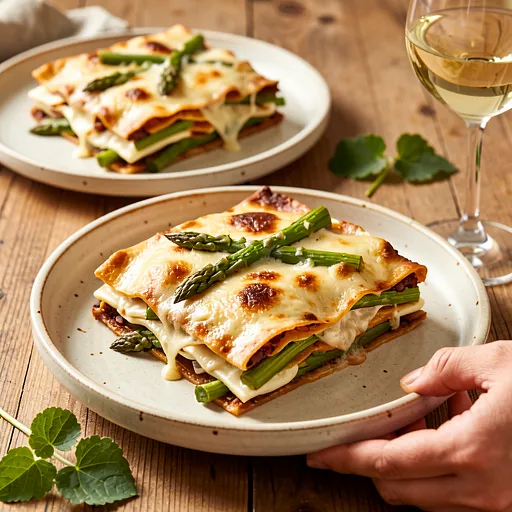
A warming lasagna that combines spring asparagus with salty, smoked oscypek and a velvety béchamel sauce. The dish has a layered structure: delicate sheets of pasta, lightly sautéed asparagus with fried onion and garlic, creamy béchamel with a hint of nutmeg, and topped with melted oscypek. This combination of Polish highlander tradition (oscypek) with classic Italian technique (béchamel, lasagna) is perfect as a winter, hearty dish served for a family lunch or dinner. Serve with a green salad or fresh sorrel for a contrast of acidity and refreshment.
Ingredients Used
Ingredients (14)
- Lasagna pasta 250 g
- Asparagus 400 g
- Oscypek 3 szt. (~300 g)
- Butter 50 g
- Wheat flour 40 g
- Milk 700 ml
- Onion 1 szt. (~150 g)
- Garlic 2 ząbki (~10 g)
- Rapeseed oil 30 g
- 🌿 Przyprawy
- Salt 0.1 szczypt (~3 g)
- Black pepper 4 szczypty (~2 g)
- Nutmeg 4 szczypty (~2 g)
- ✨ Opcjonalne
- Sorrel 40 g
- 18% cream 100 ml
💡 Kliknij na składnik aby oznaczyć jako użyty
Preparation steps
Preparing asparagus
In a large skillet, heat canola oil over medium heat (24–28 cm skillet). Add finely chopped onion and sauté for 4–5 minutes until the onion becomes translucent and slightly golden. Add minced garlic and sauté for 30 seconds to release its aroma. Add the chopped asparagus, season lightly with salt (about 1 g), increase the heat to medium-high, and sauté for 3 minutes, then pour in 50 ml of water, cover, and simmer for 4–6 minutes until the asparagus is tender but crisp (check by inserting a knife — it should have slight resistance). Uncover the skillet and evaporate any remaining liquid for 1–2 minutes.
Béchamel sauce
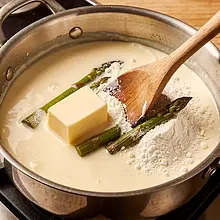
In a heavy-bottomed pot, melt the butter over low heat. When it starts to foam, add the flour and continuously stir with a wooden spoon or a whisk to create a light roux. Cook for 2–3 minutes over low heat, until the flour no longer smells raw, but does not brown.
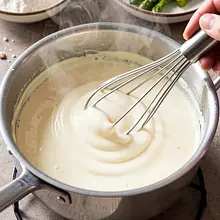
Slowly pour warm milk into the roux in three portions, stirring vigorously with a whisk each time to avoid lumps. After adding all the milk, increase the temperature to medium and bring the sauce to a gentle boil, stirring continuously until it thickens and is smooth — this will take about 5–7 minutes. The sauce is ready when it coats the back of a spoon and leaves a trail when you run your finger through it.
Add salt (1–2 g), black pepper, and grated nutmeg to the sauce; if you are using 18% cream (optional), lower the heat and mix it with 2–3 tablespoons of the sauce, then combine it with the rest of the béchamel. Taste the sauce — be careful with the salt, as oscypek is salty.
Optional green accent
If you want to add sorrel: blanch the sorrel leaves for 15–20 seconds in boiling water, immediately transfer to cold water, drain, and blend into a smooth puree. Set aside 50 g of béchamel and mix it with 40 g of sorrel puree — you will get a green stripe/sauce for layering or decorating the plate. Keep the rest of the béchamel in its natural color.
Cooking the pasta
In a large pot, bring plenty of salted water to a boil. Add the pasta sheets in batches and cook for 3–4 minutes, until they are flexible but still slightly firm (al dente). Remove each one individually onto a clean towel or baking sheet to prevent them from sticking together. If you are using 'no-boil' pasta, skip the cooking step and use more béchamel when assembling.
Assembly and baking
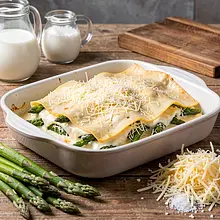
Preheat the oven to 180°C (top and bottom heat). Prepare a baking dish measuring about 20x30 cm and lightly grease the bottom with a thin layer of béchamel. Place the first layer of pasta, spread a thin layer of béchamel, evenly distribute some of the sautéed asparagus, and sprinkle with grated oscypek (about 50 g). Repeat the layering (pasta → béchamel → asparagus → oscypek) to create 3–4 layers; finish with a layer of béchamel and generously sprinkle with grated oscypek, and on top, place a few thin slices of oscypek to create a golden crust after baking.
Place the dish in the preheated oven and bake for 30–35 minutes. After 20 minutes, if the top is browning quickly, loosely cover it with aluminum foil or a sheet of baking paper to prevent it from burning. The lasagna is ready when the sauce is bubbling at the edges and the top is golden and slightly crispy.
Resting and Serving
Remove the lasagna from the oven and let it rest for 10–12 minutes so the layers can 'settle' and cutting will be cleaner. Before serving, you can sprinkle the dish with freshly chopped sorrel (optional) or parsley for color. When cutting, use a sharp knife or a serving spatula and take out pieces with a bit of juicy filling.
Fun Fact
Oscypek comes from the highlander tradition of Podhale — it is a smoked sheep cheese that, thanks to its aroma, pairs wonderfully with delicate, slightly sweet asparagus, creating a Polish-Italian fusion of flavors.
Best for
Tips
Serve a hot portion of lasagna with a light, tangy arugula salad or fresh sorrel. A white wine with higher acidity (e.g. sauvignon blanc) or a local wheat beer pairs well with the dish. Add freshly ground pepper just before serving.
Store leftovers in the refrigerator for up to 2 days in an airtight container. Reheat in the oven at 180°C for 12–15 minutes or in the microwave on medium power until the inside is hot. Freezing the dish with oscypek is not recommended — the texture of the cheese may change.
📸 Ugotowane przez społeczność
Zaloguj się, aby dodać zdjęcieDodaj zdjęcie gotowej potrawy
Po zatwierdzeniu przez moderatora otrzymasz 10 punktów doświadczenia.
Nikt jeszcze nie dodał zdjęcia. Bądź pierwszy!
Comments (0)
Be the first to comment on this recipe!
Add a comment