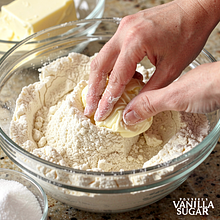
Prepare the ingredients; take the butter out 10–15 minutes in advance, it should be cool but not hard (it should be easy to cut). Sift the flour into a large bowl, add the powdered sugar, vanilla sugar, and salt. Cut the butter into cubes of about 2 cm and distribute evenly over the flour.
Description
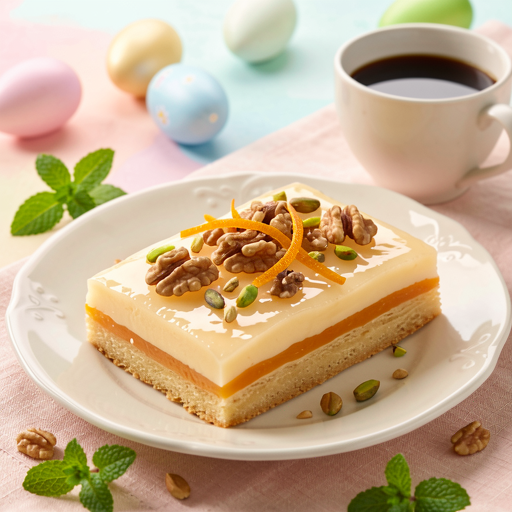
Traditional kajmak mazurek is a flat, crumbly cake with a thin layer of sweet kajmak (a mixture made from condensed milk), decorated with nuts and candied fruits. This variant combines classic kajmak with a thin layer of apricot jam, which balances the sweetness and adds a tangy aroma. The base is prepared as a shortcrust pastry (crumbly base) – simple, but requiring a short chill to prevent it from "working" during rolling. The kajmak filling can be made from scratch by gently boiling cans of condensed milk (the traditional method) or shortened by using ready-made kajmak. The result is a glossy, caramel coating with a smooth texture, contrasting with crunchy walnuts and optional pistachios and orange peel. The mazurek looks great as a centerpiece dessert on a holiday table or as an elegant dessert for a family gathering; it is best enjoyed chilled, cut into squares.
Ingredients Used
Ingredients (11)
- Wheat flour 300 g
- Butter 200 g
- Powdered sugar 80 g
- Chicken egg 1 szt. (~60 g)
- Sweetened condensed milk 800 ml
- Apricot jam 100 g
- Walnuts 80 g
- Vanilla sugar 8 g
- 🌿 Przyprawy
- Salt 1 g
- ✨ Opcjonalne
- Candied orange peel 30 g
- Pistachio 40 g
💡 Kliknij na składnik aby oznaczyć jako użyty
Preparation steps
Base
Rub the butter with the flour and sugar using your fingers or a pastry cutter until the mixture resembles coarse crumbs (the size of pea grains). This takes 1–3 minutes. Make a well in the center of the crumb mixture, crack in the egg, and quickly combine the ingredients with a wooden spoon or by hand until a cohesive dough forms. If the dough is too dry, add a teaspoon of cold water (5–10 g). Gather the dough into a ball, flatten it into a disk, wrap it in plastic wrap, and chill in the refrigerator for 30 minutes.
After cooling, preheat the oven to 180°C (top and bottom heat). Prepare a rectangular baking dish 24x30 cm or a baking tray lined with parchment paper. Remove the dough, lightly sprinkle the countertop with flour, and roll it out between two sheets of paper to a thickness of 3–4 mm. Transfer the rolled-out dough to the dish, press the edges, and trim the excess. Gently prick the bottom with a fork to allow air to escape.
Baking the crust
Line the bottom with parchment paper and fill it with dry peas or ceramic weights (if you don't have them — use dry beans). Place the dish in the preheated oven and bake for 12–15 minutes. After that time, remove the paper with the weights and bake for an additional 5–7 minutes, until the edges are golden and the center is matte and set. Remove and cool for 10–15 minutes in the dish.
Preparation of kajmak
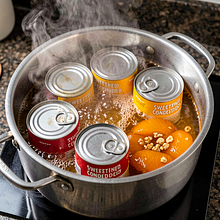
If you are making caramel from cans: place unopened cans of condensed milk in a large pot, cover with cold water so that the cans are submerged by at least 2–3 cm. Bring to a gentle boil, reduce the heat to very low, and cook covered for 2 hours. Every 20–30 minutes, add hot water to keep the cans fully submerged. After 2 hours, turn off the heat and leave the cans in the water to cool completely (at least 2 hours) — this is important for safety. Once cooled, open the cans and transfer the contents to a bowl.
Creamy cheese dough
To the cooled caramel in a bowl, add about 50 g of cold butter (set aside from the total amount of butter) and mix with a hand mixer on low speed for 1–2 minutes until the mixture is smooth and glossy. If the mixture is too thick, gently heat it in a water bath and stir. Taste and season if necessary - the caramel is already sweet, so balancing the flavor will be ensured by the later layer of jam.
Assembly
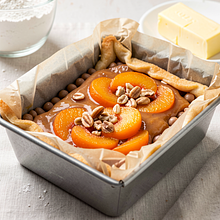
On the cooled base, evenly spread a thin layer of apricot jam (about 2–3 mm). Then, distribute the prepared dulce de leche over the entire surface, using a wide spatula and smoothing it to the edges. The mixture should have a smooth, shiny surface. Set aside in the refrigerator for 30–60 minutes to allow the dulce de leche to slightly thicken.
Decoration
Sprinkle the top with half of the chopped walnuts, arranging larger pieces decoratively. Add candied orange peel and chopped pistachios if using. Create patterns (e.g., a ring of nuts, center with pistachios). Additionally, you can create patterns with a fork in the caramel by gently dragging from the center outward, which will create a wavy effect.
Serving
Place the mazurek in the refrigerator for at least 1 hour before cutting (preferably 2 hours) so that the dulce de leche sets well. Cut with a sharp, heated knife (dip the knife in hot water, wipe it, and cut). Serve chilled, cut into squares or rectangles.
Fun Fact
Mazurek is one of the most decorative cakes in Polish Easter tradition; the name probably comes from the word 'mazur' (the Masurian duchy) or from the 'mazista' (fatty) mass, but the exact origin is uncertain. Mazurki were often richly decorated with dried fruits and candies, which was a sign of hospitality.
Best for
Tips
Serve well chilled, cut into small squares. For contrast, serve with a tangy rhubarb sauce or a small portion of sour cream (2 teaspoons) for adults, which will balance the sweetness of the caramel. For decoration, add fresh mint leaves just before serving.
Store in the refrigerator for up to 5 days in a closed container (to prevent the surface from drying out). Do not freeze with the caramel filling (it will change the texture). To refresh, take it out of the refrigerator 20–30 minutes before serving.
📸 Ugotowane przez społeczność
Zaloguj się, aby dodać zdjęcieDodaj zdjęcie gotowej potrawy
Po zatwierdzeniu przez moderatora otrzymasz 10 punktów doświadczenia.
Nikt jeszcze nie dodał zdjęcia. Bądź pierwszy!
Comments (0)
Be the first to comment on this recipe!
Add a comment