Recipe for: Grilled dumplings with pears and cheese

Desserts European cuisine 60 min Hard 26 wyświetleń ~34.86 PLN - (0)
Rate:
(0)
Start Cooking

Description

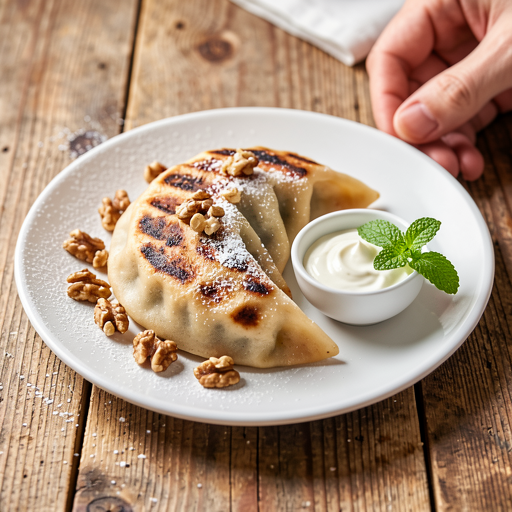
Delicate, hand-formed dumplings with a creamy filling of cheese and caramelized pears, finished with a brief grilling that gives them a slightly smoky aroma and a beautiful golden crust. This dessert combines the tradition of Polish cheese and seasonal spring pears with modern grilling or grill pan techniques. The dumplings are soft on the inside, with a light sweetness from the pears and a warm hint of cinnamon, and served with a nut sprinkle and sifted powdered sugar create a stunning, flavorful contrast. Perfect for a summer garden party or as an elegant dessert for dinner — they pair wonderfully with sour natural yogurt or caramel sauce.

Ingredients Used

Ingredients (13)

Servings:
4
  • Wheat flour 400 g
  • Chicken egg 2 szt. (~120 g)
  • Milk 100 ml
  • Butter 50 g
  • Cottage cheese 300 g
  • Pear 2.5 szt. (~450 g)
  • Sugar 60 g
  • Rapeseed oil 30 g
  • Lemon 0.4 szt. (~30 g)
  • 🌿 Przyprawy
  • Salt 0.2 szczypt (~5 g)
  • Cinnamon 4 g
  • ✨ Opcjonalne
  • Powdered sugar 30 g
  • Walnuts 50 g
💰 Szacowany koszt dania: ~34.86 PLN (8.71 PLN/porcję)

💡 Kliknij na składnik aby oznaczyć jako użyty

Preparation steps

Cake

1

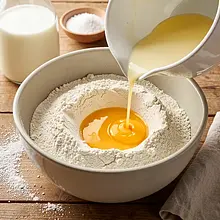
Sift 400 g of wheat flour into a large bowl to remove lumps and aerate the flour. Make a large indentation in the center of the flour (like a crater). In a separate container, crack 120 g of eggs (2 pieces) and lightly beat them with a fork. Heat 100 ml of milk to a temperature of about 30–35°C (it should be warm to the touch, not hot). Pour the beaten eggs and half of the milk into the indentation. Add 5 g of salt. Start mixing with a fork, first only the center part, gradually incorporating the flour from the edges until a thick mass forms.

Ingredients: Wheat flour, Milk, Salt
Use a large steel or ceramic bowl and a fork. If you don't have a kitchen thermometer, the milk should be pleasantly warm on the inside of your wrist. Don't add all the milk at once to control the consistency of the dough.
2

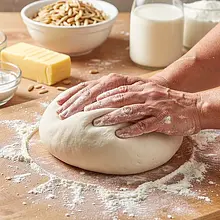
Add 50 g of soft butter cut into pieces to the mixture. Start kneading the dough by hand or with a mixer with a dough hook on low speed for 6–8 minutes, until the dough is smooth and elastic. If the dough is too dry, add the remaining milk by the spoonful; if it is too sticky, sprinkle in 1–2 tablespoons of flour. The dough is ready when it stops sticking heavily to your hands and does not tear easily when stretched.

Ingredients: Butter, Milk, Wheat flour
Use a mixer with a dough hook or knead by hand on a lightly floured surface for 8–10 minutes. Do not knead too long - 6–8 minutes is enough for the gluten to develop, but not to make the dough tough.
3

Shape the dough into a ball, lightly brush with rapeseed oil (a few drops) and place it in a bowl. Cover with a kitchen towel and let it rest for 20 minutes at room temperature so the dough can relax — it will become more elastic and easier to roll out.

Ingredients: Rapeseed oil, Wheat flour
Use a clean bowl and lightly grease the surface of the dough to prevent it from drying out. Letting the dough rest is an important step — it should not be skipped.

Filling

4

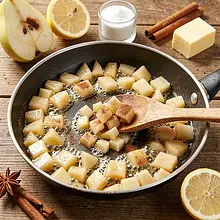
Prepare the pears: peel and remove the cores, then cut into small cubes about 5 mm in size. Transfer 450 g of the chopped pears to a pan, drizzle with the juice of 30 g of lemon (about 1/2 lemon), add 30 g of sugar and 4 g of cinnamon. Cook over medium heat for 6–8 minutes, until the pears soften and begin to caramelize slightly. At the end of cooking, add 20 g of butter and stir to achieve a glossy, slightly sticky filling.

Ingredients: Pear, Lemon, Sugar, Cinnamon, Butter
Use a pan with a diameter of 24–28 cm, preferably non-stick. The pieces of pear should be soft but not falling apart — check with a fork after 6–8 minutes.
5

Cool the pears to a temperature of about 30–35°C. In a large bowl, mash 300 g of cottage cheese with a fork until smooth. Add the cooled, caramelized pears and gently mix until the mixture is uniform but with visible pieces of fruit. Taste the mixture and sweeten with 10–20 g of sugar if needed.

Ingredients: Pear, Sugar
Use a wide bowl and a plastic or wooden spoon; do not blend on high speed with a blender to avoid making the filling too runny.

Shaping and cooking

6

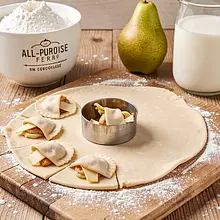
Roll out the dough on a floured surface to a thickness of about 2–3 mm. Use a glass with a diameter of 7–8 cm or a cookie cutter to cut out circles. Place about 25–30 g of filling on each circle (use a teaspoon), spreading the filling closer to the center, leaving the edges free. Moisten the edge of the dough with water using your finger, fold the circle in half, and seal the edges tightly by pressing them with your fingers. For a nice effect, bend the edges into half-moons or create a scalloped edge with a fork.

Ingredients: Wheat flour, Pear, Milk
Use a rolling pin and carefully dust with flour to prevent the dough from sticking. If the dough cracks while sealing, press the edge and smooth it with your finger — don't throw away the pierogi.
7

Prepare a pot with plenty of salted boiling water. Drop in the dumplings in batches (no more than 8–10 at a time), gently stirring to prevent them from sticking. Cook for 3–4 minutes from the moment they float to the surface — the dumplings are ready when they float and their edges are firm after this time.

Ingredients: Salt, Wheat flour
Use a strainer or slotted spoon to gently place and remove the dumplings. Cooking in batches prevents them from sticking together.

Grilling and Serving

8

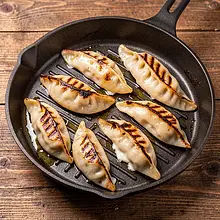
Preheat a grill pan or grill to medium-high heat (about 200°C). Lightly brush the surface with canola oil. Remove the dumplings from the water and carefully pat them dry with a paper towel. Place the dumplings on the heated grill and grill for 1–1.5 minutes on each side, until clear golden stripes appear and the skin is slightly crispy. Do not move the dumplings too early to achieve nice stripes.

Ingredients: Rapeseed oil, Wheat flour
The best is a grill pan with a ribbed surface; use a spatula with a thin edge to avoid tearing the dumplings. If you are grilling outside, keep the lid open to avoid excessive smoke.
9

Serve the pierogi hot, sprinkled with 30 g of sifted powdered sugar and 50 g of coarsely chopped roasted walnuts (optional). You can add a dollop of natural yogurt or slightly reduced caramel sauce next to the plate.

Ingredients: Powdered sugar
If you are adding nuts, toast them for 2–3 minutes in a dry pan before chopping for a more intense aroma. Additionally, you can add a teaspoon of honey or maple syrup on top for shine.

Fun Fact

💡

Pierogi are one of the most recognizable dishes of Polish cuisine, but the grilled version is a modern approach — combining traditional dumpling-making with grilling techniques creates an interesting texture and aroma, popular in fusion cuisines.

Best for

Tips

🍽️ Serving

Serve immediately after grilling so that the dumplings are crispy on the outside and soft on the inside. Serve with a spoonful of thick natural yogurt or with caramel sauce on the side of the plate. For a contrast of temperatures and textures, add cold vanilla ice cream as a dessert element.

🥡 Storage

Cooked and cooled pierogi can be stored in the refrigerator for up to 24 hours in an airtight container. To reheat, briefly grill in a pan or sauté in butter over medium heat for 2–3 minutes on each side. Longer storage of pear filling is not recommended as it loses its fresh taste.

📸 Ugotowane przez społeczność

Zaloguj się, aby dodać zdjęcie
Dodaj zdjęcie gotowej potrawy

Po zatwierdzeniu przez moderatora otrzymasz 10 punktów doświadczenia.

🍲

Nikt jeszcze nie dodał zdjęcia. Bądź pierwszy!

Comments (0)

Be the first to comment on this recipe!

Add a comment

You might also like

Recipe Categories

Desserts are a sweet ending to every meal - from simple puddings to exquisite creamy cakes. Our collection includes recipes for homemade ice cream, chocolate mousses, panna cotta, tiramisu, crème brûlée, and lemon tart. Summer fruit desserts: jellies, sorbets, parfaits, and fruit salads with whip...

See all recipes in this category

European cuisine is a mosaic of culinary traditions from the Old Continent - from Spain to Scandinavia. Valencian paella and tapas from Spain - sunshine on a plate. Boeuf bourguignon and ratatouille from France - elegance and finesse. Wiener schnitzel and strudel from Austria - Central European c...

See all recipes in this category
Reklama