Bear Potato Pancakes

Main dishes Regional Cuisine of Poland 30 min Easy 26 wyświetleń ~8.82 PLN - (0)
Rate:
(0)
Start Cooking

Description

Misiowe potato pancakes are homemade, golden pancakes made from grated potatoes with the addition of onion and egg, traditionally served with sour cream and fresh dill. This dish is inspired by Polish rural cuisine — simple, hearty, and warming, perfect for a winter lunch. The pancakes have crispy edges and a soft interior; they can be served solo, with meat stew, sour cream, mustard, or sautéed mushrooms. The recipe includes detailed instructions for beginners: how to grate potatoes, how to drain excess liquid, how to recognize the right consistency of the mixture, and how to fry the pancakes to make them even and crispy. It also includes variations and storage tips.

Ingredients Used

Ingredients (9)

Servings:
4
  • Chicken egg 2 szt. (~120 g)
  • Potatoes 6.7 szt. (~1000 g)
  • Onion 1 szt. (~150 g)
  • Wheat flour 80 g
  • Rapeseed oil 80 g
  • 🌿 Przyprawy
  • Salt 8 g
  • Black pepper 4 szczypty (~2 g)
  • ✨ Opcjonalne
  • Sour cream 200 g
  • Dill 1.5 pęczki (~30 g)
💰 Szacowany koszt dania: ~8.82 PLN (2.21 PLN/porcję)

💡 Kliknij na składnik aby oznaczyć jako użyty

Preparation steps

Preparation

1

Prepare your workspace: a large cutting board, a sharp vegetable peeler, a coarse grater (or a food processor with a grating disc), a large bowl for the grated mixture, and a small bowl for the liquid. Peel the potatoes thinly using the peeler (remove any green spots and sprouts). Peel the onion and cut it in half to make grating easier.

Use a potato peeler and a sharp grater or a food processor with a coarse grating disc. The bowl should be large (at least 3 l) — the grated mixture reduces in volume when drained. A common mistake: not peeling the potatoes thoroughly (the skin will be tough in the pancakes).
2

Grate the potatoes on a coarse grater directly into a large bowl. Then grate the onion on the same grater and add it to the potatoes. Grating the potatoes takes about 4–6 minutes for 1 kg — do it in batches if you are doing it by hand to avoid straining your wrists.

If you are using a food processor, work in short bursts to prevent the mixture from becoming watery. Note: grating too finely will result in a sticky mixture; coarser grating provides better structure and crunch.
3

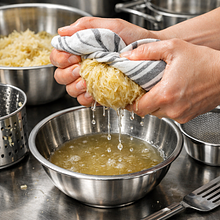
Drain excess water: transfer the grated potato-onion mixture to a clean kitchen towel or cheesecloth. Fold the towel over the mixture and squeeze out the liquid over a bowl — press with both hands until there is much less moisture left. Alternatively: let the grated mixture sit in a bowl for 5–10 minutes — the liquid will settle at the bottom; pour off the water and keep the starchy sediment (if you want, add it later to the mixture as a natural thickener).

Use a thick material (cheesecloth/kitchen towel). Squeeze firmly: if after squeezing the mixture is loosely packed and does not drip, it is a sign that it is ready. A common mistake: only lightly pressing — then the pancakes will fall apart while frying.

Dough

4

Transfer the drained mixture back to a clean bowl. Add the beaten eggs (120 g), wheat flour (80 g), salt (8 g), and black pepper (2 g). Stir with a wooden spoon or spatula until the ingredients are combined — mix briefly, just until a homogeneous mixture is achieved. The mixture should be firm enough to be shaped with a spoon, but not dry; if it is too runny, add a tablespoon of flour, if too thick, add a tablespoon of water.

Use a large wooden spoon or spatula. Check the consistency: the mixture should be scoopable with a spoon and form flattened patties — if the mixture spreads, add flour in 10 g increments until the desired thickness is reached. Do not overmix — this will cause excessive starch release and make the patties dense.
5

Heat a pan (preferably cast iron or 24–26 cm in diameter) over medium heat. Pour in the rapeseed oil (about 80 ml) and spread it across the bottom. Test the hot pan: drop a small amount of the mixture — it should sizzle and ignite quickly (not burn).

The best is a thick-bottomed pan that retains even heat. Use a spatula with a wide edge to flip the pancakes. A common mistake: frying on too cold a pan — the pancakes then absorb too much fat and become soft.

Frying

6

In a heated fat, spoon portions of the mixture (about 2–3 tablespoons per pancake) and flatten them with a spatula to a thickness of about 5–7 mm. Keep space between the pancakes, fry in batches to avoid overcrowding the pan. Fry for about 3–4 minutes on each side until golden brown — leave the first side longer until the edges are well browned and easily come off the pan.

Use a wide metal or silicone spatula. Gently flip the pancakes in one motion — if there is a lot of resistance, give it another 30–60 seconds until the bottom is browned. A typical sign of readiness: the center is set, the edges are crispy and golden.
7

After frying, place the pancakes on a plate lined with paper towels to drain excess fat. Fry the next batches, adding a tablespoon of oil between batches if necessary. The total frying time for 1 kg of potatoes should take about 15–18 minutes.

Use a paper towel to drain and a large plate. Do not keep the pancakes stacked for longer than a minute — the steam will make them lose their crispy edges. A common mistake: keeping the pancakes on the pan for too long — they will start to burn.

Serving

8

Serve the pancakes hot: on each stack, add a tablespoon of sour cream (optional) and sprinkle with chopped dill. Additionally, you can serve lemon or grated apple for a sweet-sour contrast. Arrange the pancakes on the plate slightly overlapping for an aesthetic presentation.

Use finely chopped fresh dill just before serving (do not sauté). Additionally, you can add mushroom sauce or meat stew to turn the pancakes into a full-fledged main dish.

Storage

9

If there are any pancakes left, set them aside to cool, then transfer them to a container in a single layer with paper between the pancakes and store in the fridge for up to 48 hours. To reheat and regain crispiness — bake in an oven preheated to 200°C for 6–8 minutes with convection or briefly fry in a pan with a small amount of fat.

Do not store the pancakes in a closed container while hot (the condensed steam will make them soggy). For longer storage, frozen flattened portions are suitable — freeze them spread out on a baking sheet, then transfer to bags.

Fun Fact

💡

Potato pancakes appeared in Europe after the spread of potatoes in the 17th-18th century. In Poland, they became a popular, inexpensive, and filling rural dish; in many regions, onions or cracklings were added, and in the festive version — they were served with goulash.

Best for

Tips

🍽️ Serving

Serve immediately after frying to maintain the crispy edges. For variety, stack the pancakes and drizzle with slightly sour cream mixed with dill and a bit of lemon juice. You can also serve with braised meat, mushroom stew, or apple jam for a contrast of flavors.

🥡 Storage

Store for up to 48 hours in the refrigerator in single layers with paper. For reheating, use the oven (200°C, 6–8 minutes) to regain crispiness; avoid the microwave, which will make the pancakes rubbery.

📸 Ugotowane przez społeczność

Zaloguj się, aby dodać zdjęcie
Dodaj zdjęcie gotowej potrawy

Po zatwierdzeniu przez moderatora otrzymasz 10 punktów doświadczenia.

🍲

Nikt jeszcze nie dodał zdjęcia. Bądź pierwszy!

Comments (0)

Be the first to comment on this recipe!

Add a comment

You might also like

Recipe Categories

Main dishes
Main dishes in: New Year's Eve

Main dishes for New Year's Eve should be hearty and impressive to satisfy the palates of all guests.

See all recipes in this category

Traditional recipes from various regions of Poland that showcase the richness of local flavors and ingredients.

See all recipes in this category
Reklama