Meatloaf with Egg

Pikantne Main dishes Regional Cuisine of Poland Lunches 90 min Medium 4 wyświetleń ~30.20 PLN - (0)
Rate:
(0)
Start Cooking

Description

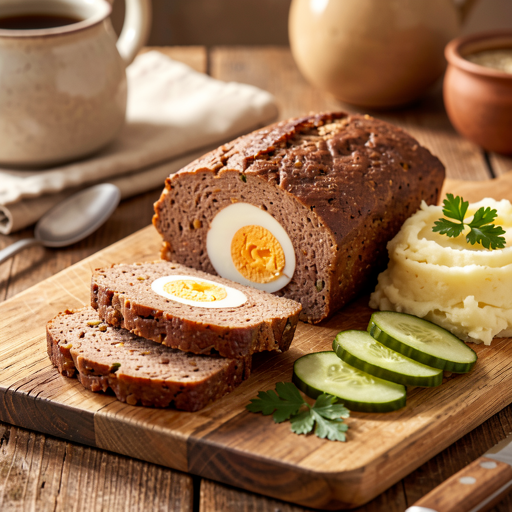
Classic Polish meatloaf with egg is a juicy roll made from minced meat, filled with whole hard-boiled eggs. This dish originates from a country home and is served both for family dinners and festive occasions. It has a distinct meaty flavor complemented by fresh parsley and marjoram; when sliced, it presents beautifully — a white ribbon of egg surrounded by the pink interior of the meat. It pairs wonderfully with mashed potatoes, pickled cucumbers, young cabbage, or a salad of fresh spring vegetables. I recommend serving it slightly warm, as this enhances the flavors and keeps the meat moist.

Ingredients Used

Ingredients (13)

Servings:
4
  • Ground pork 600 g
  • Ground beef 200 g
  • Chicken egg 4 szt. (~240 g)
  • Wheat bread 80 g
  • Milk 100 ml
  • Onion 1 szt. (~150 g)
  • Garlic 3 ząbki (~15 g)
  • Rapeseed oil 15 g
  • 🌿 Przyprawy
  • Marjoram 4 g
  • Salt 0.2 szczypt (~5 g)
  • Black pepper 4 szczypty (~2 g)
  • ✨ Opcjonalne
  • Smoked bacon 100 g
  • Mustard 30 g
💰 Szacowany koszt dania: ~30.20 PLN (7.55 PLN/porcję)

💡 Kliknij na składnik aby oznaczyć jako użyty

Preparation steps

Preparation of eggs

1

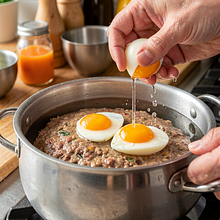
Prepare hard-boiled eggs for the filling: place 2 eggs in a medium pot and cover them with cold water so that the water covers the eggs by about 2 cm. Put the pot on high heat and bring to a boil. Once the water starts boiling, reduce the heat to medium and cook for 8-9 minutes from the moment it starts boiling (no more — this will prevent the yolk from turning green). After cooking, pour cold water over the eggs and set them aside to cool, then peel them.

Use a pot with a diameter of 18–20 cm. If you have a kitchen thermometer, the inside of the cooked yolk should be around 70–75°C. If the eggs are very fresh, peeling may be more difficult — cool them in very cold water, then the shell comes off more easily.
Soaking the bread

2

Tear the wheat bread into pieces and transfer to a medium bowl. Pour room temperature milk (100 ml) over the bread and let it sit for 5 minutes until the bread absorbs the milk. Then, poke the bread with a fork or squeeze out the excess milk by hand, so that a moist mixture remains, but without excess liquid.

Ingredients: Wheat bread, Milk
Use a bowl with a capacity of at least 2 liters to mix the ingredients freely later. If the bread is very fresh, dry the pieces in the oven for 5–7 minutes before soaking.

Sautéing the vegetables

3

Peel the onion and chop it into small cubes. Peel the garlic and finely chop it or press it through a garlic press. Heat a pan (preferably 24–28 cm) with 1 tablespoon of rapeseed oil over medium heat. Add the onion and sauté for 4–5 minutes, stirring, until the onion becomes translucent and soft. Add the garlic and sauté for another 30–40 seconds — just until the aroma is released, but do not let the garlic brown. Transfer the cooled onion with garlic to a plate and set aside to cool.

Ingredients: Onion, Garlic, Rapeseed oil
Use a non-stick pan or a thick-bottomed steel one. The onion should be soft and translucent; if it browns too quickly, the heat is too high — reduce it and continue frying.

Preparation of the meat mixture

4

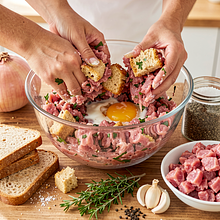
In a large bowl, place the ground pork and ground beef. Add the drained bread soaked in milk, the cooled onion with garlic, 2 raw eggs (about 120 g), marjoram, salt, and pepper. Start mixing with a spoon, then knead with your hands for 2–3 minutes until the ingredients are well combined and the mixture is uniform. Do not over-knead — 2–3 minutes is enough; longer kneading will make the meatloaf dense.

Ingredients: Ground pork, Ground beef, Wheat bread, Onion, Garlic, Marjoram, Salt, Black pepper
Use a large bowl (at least 3 liters) and if you have kitchen gloves, use them or wash your hands well before and after. Mixing by hand allows you to feel the consistency — the mixture should be sticky but moldable.

Shaping the roast

5

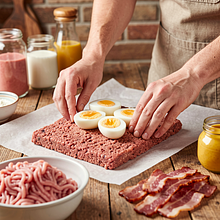
Lay out parchment paper on the countertop. Transfer half of the meat mixture and shape it into a rectangle about 1.5–2 cm thick. Along the length of the rectangle, create a groove in the center using your finger or a spoon. Place the peeled hard-boiled eggs (2 pieces — lay them side by side) in the groove, then cover with the second half of the mixture, sealing the edges well so that the eggs are completely enclosed inside. If you are using bacon, wrap the meatloaf with thin slices of bacon now. If you are using mustard, spread it on top of the meatloaf (you can also add mustard for extra flavor). Shape it into an even roll that matches the length of the baking tray.

Ingredients: Ground pork, Ground beef, Smoked bacon, Mustard
Use parchment paper and hands lightly moistened with water to prevent sticking. It is important to seal the meat thoroughly at the bottom and sides so that the eggs do not leak during baking. Additionally, you can add bacon for flavor and texture.

Cooling before baking

6

Transfer the shaped meatloaf to a baking sheet lined with parchment paper. Place in the refrigerator for 15–20 minutes — chilling will help maintain its shape during baking and prevent juices from spilling.

If you have a meat thermometer, you can check the internal temperature after baking; chilling before baking slightly shortens the baking time and improves the texture.

Baking

7

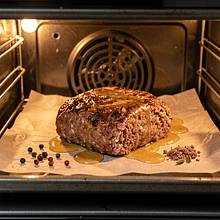
Preheat the oven to 180°C (top-bottom). Place the roast in the preheated oven and bake for 50–60 minutes. After 30–40 minutes, check the top — if it is browning too quickly, lightly cover it with aluminum foil. The roast is ready when the juices run clear after piercing, and the internal temperature of the meat reaches about 72°C. After baking, remove the roast and let it rest on a cutting board for 10–15 minutes — resting allows the juices to distribute evenly.

Use a kitchen thermometer inserted into the center of the roast (do not pierce one of the eggs). If you don't have a thermometer, pierce the thickest part with a sharp knife — the juices should be clear, not pink.

Slicing and serving

8

After 10–15 minutes of resting, transfer the roast to a cutting board and slice it with a sharp knife into 2–3 cm thick slices. Arrange the slices so that the white-yellow interior of the egg is visible with each slice. Serve with mashed potatoes or roasted young vegetables, along with pickled cucumber or a salad of young spring vegetables.

Use a long, sharp knife to cut into even slices; if the roast is sticking a lot, cut the paper underneath to transfer it to the board more easily.

Fun Fact

💡

Meatloaf with egg is a variation of the meat filling found in many regions of Europe; in Poland, it has gained popularity as a home-cooked dish that is easy to prepare for a larger family — the halved egg in the middle adds an elegant touch.

Best for

Tips

🍽️ Serving

Serve slightly warm — too hot makes it harder to slice and loses juices. It pairs well with mashed potatoes, horseradish, pickled cucumber, or a fresh salad with radishes and sorrel (seasonally). Sprinkle finely chopped parsley just before serving for freshness.

🥡 Storage

Store in the refrigerator in a closed container for up to 3 days. To preserve the flavor, wait until the roast has completely cooled before storing. Reheat in the oven at 160°C for 10–15 minutes or in the microwave on medium power for 2–3 minutes (per serving).

📸 Ugotowane przez społeczność

Zaloguj się, aby dodać zdjęcie
Dodaj zdjęcie gotowej potrawy

Po zatwierdzeniu przez moderatora otrzymasz 10 punktów doświadczenia.

🍲

Nikt jeszcze nie dodał zdjęcia. Bądź pierwszy!

Comments (0)

Be the first to comment on this recipe!

Add a comment

You might also like

Recipe Categories

Main courses are the heart of every meal - hearty, nutritious, and full of flavor. In this category, we present a rich selection of recipes for lunches and dinners that will satisfy even the most discerning palates. From classic Polish pork chops to aromatic chicken dishes, to exquisite steaks an...

See all recipes in this category

Traditional recipes from various regions of Poland that showcase the richness of local flavors and ingredients.

See all recipes in this category

Lunches are the main meal of the day - filling, balanced, and full of flavor. Traditional two-course lunches: soup and a main dish in Polish tradition. Pork chop with potatoes and cabbage - a classic of Polish lunches. Dumplings with meat, cheese, and fruit - hand-formed delicacies. Beef goulash,...

See all recipes in this category
Reklama