Recipe for: Rhubarb and Cottage Cheese Pierogi

Main Dishes Regional Cuisine of Poland 60 min Medium 2 wyświetleń ~28.99 PLN - (0)
Rate:
(0)
Start Cooking

Description

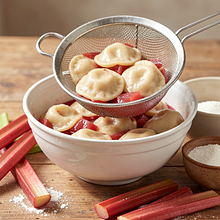
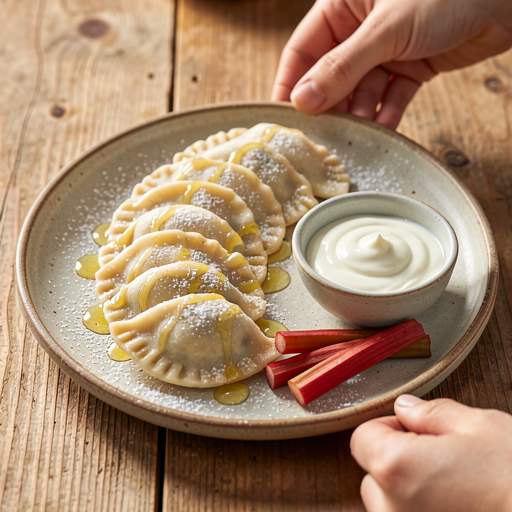
Traditional Polish pierogi combine tart spring rhubarb with creamy cottage cheese, creating a contrast of freshness and delicate sweetness. This main dish has a dessert-like character — perfect for a light lunch, family dinner, or a May picnic. Rhubarb provides a vibrant color and pleasant acidity, while the cottage cheese softens the filling's texture, and the slightly crispy edge of the dough adds texture. Serve drizzled with melted butter and sprinkled with powdered sugar or with mild sour cream for a more classic taste. The recipe includes detailed instructions on how to knead the dough, how to prepare a moist but not soggy filling, and how to properly seal the pierogi so they don't fall apart during cooking.

Ingredients Used

Ingredients (11)

Servings:
4
  • Wheat flour 400 g
  • Chicken egg 2 szt. (~120 g)
  • Water 120 ml
  • Cottage cheese 300 g
  • Rhubarb 350 g
  • Sugar 100 g
  • Cornstarch 10 g
  • 🌿 Przyprawy
  • Salt 0.2 szczypt (~5 g)
  • ✨ Opcjonalne
  • Butter 50 g
  • Powdered sugar 20 g
  • Sour cream 200 g
💰 Szacowany koszt dania: ~28.99 PLN (7.25 PLN/porcję)

💡 Kliknij na składnik aby oznaczyć jako użyty

Preparation steps

Cake

1

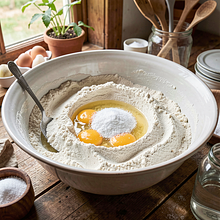
Sift the flour into a large bowl (preferably 4 l capacity), making a wide well in the center. Add salt (5 g) to the edge of the flour, and crack the eggs (120 g) into the well. In a separate glass, mix the water (120 ml) — it should be lukewarm (about 20–25°C). Pour half of the water into the eggs and mix with a fork only the central part, pulling the flour from the edges until a thick, lumpy mass forms.

Ingredients: Wheat flour, Water, Salt
Use a large bowl and a fork for the initial mixing. If you don't have a bowl of that size, use the countertop. Don't pour all the water at once — add it gradually to avoid making the dough too wet.
2

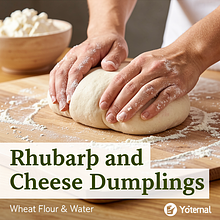
When the dough in the center is compact, start mixing the flour from the center outwards with a wooden spoon, gradually adding the rest of the water until the ingredients are combined. Transfer the dough to a floured surface and knead by hand for 8–10 minutes until it is smooth, elastic, and no longer sticks excessively to your hands. If the dough is too sticky, sprinkle a little flour (max. 1–2 tablespoons).

Ingredients: Wheat flour, Water
Use a wooden spoon for mixing and a floured countertop. Alternative: knead with a mixer using a dough hook for 6–7 minutes. The dough is ready when it springs back after being pressed with a finger.
3

Form a ball from the dough, lightly brush it with oil or dust it with flour, cover it with a bowl or a damp cloth, and let it rest for 20 minutes. The resting allows the gluten to relax, making the dough easier to roll out.

Ingredients: Wheat flour
Cover the bowl with a cloth or plastic wrap. Don't skip this step — it shortens the later rolling out.

Filling

4

Wash the rhubarb, trim the ends, and remove the leaves. Cut the stalks into pieces about 1 cm long. Place the rhubarb in a medium saucepan, add 80 g of sugar (from 100 g), and heat over medium heat for 5–8 minutes, stirring every 1–2 minutes — the rhubarb should release juice and soften, but pieces should remain discernible.

Ingredients: Rhubarb, Sugar
Use a sharp knife and cutting board. Rhubarb cooks quickly — monitor the texture so it doesn't fall apart completely.
5

Dissolve the cornstarch (10 g) in 2 tablespoons of cold water (about 30 ml). Reduce the heat, pour the dissolved cornstarch into the rhubarb, and stir vigorously — cook for another minute until the juice thickens slightly. Pour the rhubarb into a strainer to drain the excess juice into a separate bowl (you can keep the juice for drizzling or for compote). Set the rhubarb aside to cool to room temperature.

Ingredients: Cornstarch, Rhubarb, Sugar
Use a strainer to drain. If the filling is still very watery after cooling, add a teaspoon of starch mixed in cold water and heat briefly.
6

In a large bowl, crumble the cottage cheese with a fork or pass it through a sieve until creamy and smooth. Add the cooled rhubarb (all the drained pieces) and the remaining 20 g of sugar. Gently mix to create a uniform mixture — do not blend with a mixer to avoid making the filling too runny.

Ingredients: Cottage cheese, Rhubarb, Sugar
Use a fork or spatula. The consistency should be slightly moist but not liquid; the filling should hold its shape when applied.

Shaping and cooking

7

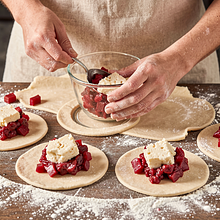
Divide the rested dough into 2 parts. Work with one part at a time — roll it out thinly on a floured surface to a thickness of about 2–3 mm. Cut out circles with a diameter of 7–8 cm (use a glass or a round cutter). Place about 20–25 g of filling (a large teaspoon) in the center of each circle.

Ingredients: Wheat flour, Cottage cheese, Rhubarb
Use a rolling pin and a glass 7–8 cm. Do not overload the filling too much — then the dumplings will not seal properly.
8

Fold the circle in half over the filling and seal the edges tightly by pressing with your fingers. For a secure closure, pinch every 1 cm with your fingers or use a fork to press the edges. Place the formed dumplings on a floured tray to prevent them from sticking together.

Ingredients: Wheat flour, Cottage cheese, Rhubarb
Press the edges firmly to prevent the filling from leaking out during cooking. If the edges don't want to stick, moisten them with a little water.
9

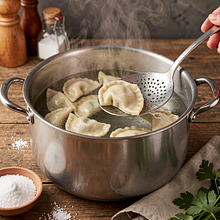
In a large pot, bring salted water (about 1.5–2 l) to a boil. Cook the dumplings in batches, gently dropping them into the boiling water. Once they float to the surface, cook for an additional 2–3 minutes. Remove with a slotted spoon and set aside on a plate or serve immediately.

Ingredients: Salt
Use a wide pot and a slotted spoon. Don't drop too many dumplings at once — it's best to do 8–10 pieces so that the water temperature doesn't drop.

Serving

10

Serve the pierogi hot: drizzle with melted butter (optionally clarified butter) and sprinkle with powdered sugar or serve with a spoonful of sour cream on the side. For a flavor contrast, you can add a bit of fresh lemon zest or mint leaves.

Ingredients: Butter, Powdered sugar, Sour cream
Use a small saucepan to melt the butter. You can also add powdered sugar to enhance the sweetness or cream for a milder flavor.

Final tips

11

If you prepare the dumplings in advance, arrange them on a tray individually (without touching) and freeze. After freezing, transfer them to a bag. Cook the frozen dumplings without thawing, adding 1–2 minutes to the cooking time after they float.

Ingredients: Wheat flour
Use a flat freezing tray and baking paper. When defrosting, the dumplings may be wet — cook them straight from the freezer.

Fun Fact

💡

Pierogi are one of the most characteristic dishes of Polish cuisine — the words 'pieróg' and 'pierogi' have appeared in records for centuries as a dish flexible in filling: from meat, through vegetable, to sweet with fruits.

Best for

Tips

🍽️ Serving

Serve immediately after cooking: arrange the dumplings on warm plates, drizzle with melted butter, and sprinkle with powdered sugar. Alternatively, serve with cool 18% sour cream and a mint leaf. For a richer set, add stewed apples or rhubarb compote on the side.

🥡 Storage

Store raw, unformed dumplings in the refrigerator for a maximum of 8 hours. Shaped dumplings can be frozen on a tray and then transferred to a bag — they will stay fresh for up to 2 months. Store cooked dumplings in the refrigerator for up to 48 hours; reheat in a pot of boiling water (2–3 minutes) or in a pan with a bit of butter.

📸 Ugotowane przez społeczność

Zaloguj się, aby dodać zdjęcie
Dodaj zdjęcie gotowej potrawy

Po zatwierdzeniu przez moderatora otrzymasz 10 punktów doświadczenia.

🍲

Nikt jeszcze nie dodał zdjęcia. Bądź pierwszy!

Comments (0)

Be the first to comment on this recipe!

Add a comment

You might also like

Recipe Categories

Main Dishes
Main Dishes in: Valentine's Day

Exquisite main dishes that will delight with their flavor and aroma, perfect for a romantic dinner.

See all recipes in this category

Traditional recipes from various regions of Poland that showcase the richness of local flavors and ingredients.

See all recipes in this category
Reklama