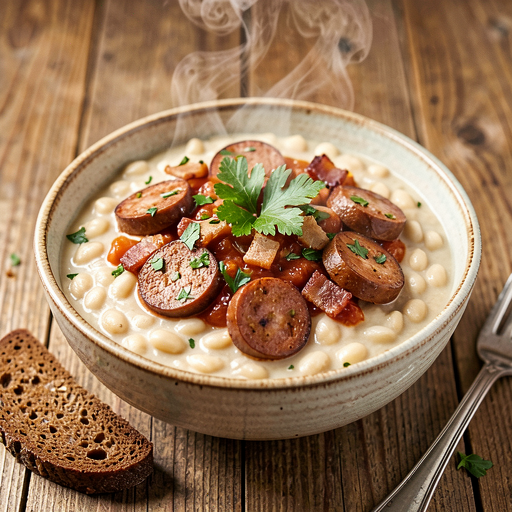
Classic Polish baked beans in a Breton style with sausage — a hearty, aromatic one-pot dish known from the homey, rural table. The base consists of soaked and slowly stewed white beans with the addition of smoked sausage and tomato paste, seasoned with bay leaves, allspice, and marjoram. The dish has a creamy consistency, a distinct, slightly smoky flavor thanks to the sausage (and optionally bacon), and a pleasant sweet-sour note from the tomatoes. Serve hot with whole grain or fresh bread, and it can also be served with buckwheat or potatoes. Perfect for cooler days, it tastes great reheated the next day — the flavors meld together.
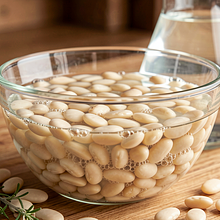
The day before: Sort 250 g of white beans, removing damaged beans and pebbles. Transfer to a large bowl and cover with cold water so that the water covers the beans by at least 5 cm. Let it sit for 8–12 hours (preferably overnight). After soaking, the beans will significantly increase in volume — this is normal.
Ingredients:
White bean, Water
Use a large glass or plastic bowl. Changing the water after 4–6 hours will speed up the softening. Do not use metal containers for long soaking.
Cooking beans
2
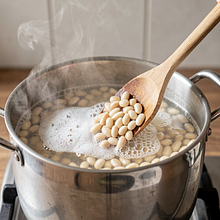
Pour the soaked beans into a large pot (min. 3 l). Cover with fresh cold water to a level 2–3 cm above the beans (about 1.2–1.5 l). Bring to a boil over high heat, then reduce the heat and simmer, covered loosely, for 40–50 minutes, until the beans are tender when pressed with a fork, but not falling apart. During cooking, skim off any foam with a spoon.
Ingredients:
White bean, Water
Use a large stainless steel pot. Check for tenderness every 10 minutes after the first 30 minutes. If the beans are still hard after 50 minutes, continue cooking until tender.
Preparation of ingredients for frying
3
Peel and chop the onion (300 g) into small cubes. Peel and crush or finely chop 15 g of garlic. Cut 400 g of sausage into slices about 5–7 mm thick. If using bacon (100 g), cut it into small cubes.
Ingredients:
Onion, Garlic, Sausage, Bacon
Use a sharp knife and a cutting board. If you don't feel confident cutting the sausage, first cut it lengthwise and lay it flat before slicing.
Frying
4
Heat a large skillet or wide saucepan (diameter 26–28 cm) and pour in 30 g of rapeseed oil. First, sauté the bacon (if using) over medium heat for 4–5 minutes until the fat renders and it becomes slightly crispy. Add the sausage and fry for another 4–5 minutes until the slices are browned. Transfer the meat to a plate and leave the fat in the skillet.
Ingredients:
Rapeseed oil, Bacon, Sausage
The best is a cast iron skillet or a wide saucepan. Use a wooden spoon for stirring. Be careful not to burn the fat — the heat should be medium.
Frying (continued)
5
In the same pan, sauté the onion: add the chopped onion to the fat and cook for 6–8 minutes over medium heat until it is translucent and slightly golden. Add the garlic (15 g) and sauté for an additional 30 seconds until you can smell the aroma — do not let the garlic darken.
Ingredients:
Onion, Garlic, Rapeseed oil
Use a lid if the onion retains too much moisture, but remove it at the end so the onion can brown slightly. Add the garlic last, as it burns easily.
Combining the ingredients
6
To the sautéed onion, add the browned sausage and bacon, pour in 70 g of tomato paste and mix thoroughly, frying everything for 2–3 minutes until the paste starts to smell intense. This is the base of the sauce that gives the dish a deep flavor. If the sauce is too thick, add 50–100 ml of the water from cooking the beans.
Ingredients:
Tomato paste, Sausage, Bacon, Water
Use a wooden spatula to scrape up the browned bits from the bottom of the pan — this is important for the flavor. Don't add too much water right away; it's better to add it later.
Combining with beans and seasoning
7
Transfer the cooked beans (along with the liquid, if you want more sauce) to a large pot or the same wide pan with the meat and tomato sauce. Add 2 g of black pepper, 6 g of salt, 2 g of bay leaf, and 4 g of allspice. If necessary, add up to 300–500 ml of water to make the mixture slightly liquid. Bring to a gentle boil.
Ingredients:
White bean, Sausage, Tomato paste, Salt, Black pepper, Bay leaf, Water
If the beans were cooked separately, drain some of the water and add as needed — it's easier to give up the liquid than to evaporate it later.
Stewing
8
Reduce the heat to low and simmer the dish covered for 20–25 minutes, stirring every 5–7 minutes to prevent it from burning. Check the consistency: the sauce should thicken slightly, and the beans should be soft and creamy. If the dish is too watery, increase the heat and cook for a few minutes uncovered until the excess liquid evaporates.
Ingredients:
White bean, Tomato paste, Sausage
Use a wide pot with a heavy lid. Stir with a wooden spoon from the bottom to prevent sticking. Do not cook on too high heat — the beans may break apart.
Final seasoning
9
Taste the dish, season if necessary: add more salt or pepper. Sprinkle in 4 g of marjoram and mix. Cook for another 2–3 minutes to allow the marjoram to release its aroma. Remove the bay leaf and allspice before serving.
Ingredients:
Marjoram, Salt, Black pepper, Bay leaf
Add salt gradually — remember that the sausage and bacon may already be salty. Add marjoram at the end, as prolonged contact with heat will diminish its aroma.
Serving
10
Transfer the beans to deep plates or a cast iron pot. Sprinkle with finely chopped parsley (30 g) for freshness. Serve hot with dark bread, pickles, or buckwheat as an alternative. The dish also tastes great after sitting for a few hours — the flavors meld together.
Ingredients:
Parsley, Sausage, White bean
Use a ladle for serving. If you want an attractive presentation, serve in a cast iron dish on a wooden board and sprinkle with fresh parsley.
Tips after preparation
11
If you plan to reheat the dish the next day, store it in the refrigerator in an airtight container for 2–3 days. When reheating, add a little water or broth and heat over low heat, stirring until the dish is warmed through and thickens again.
Ingredients:
Water
The version without parsley is suitable for freezing; after thawing, season with fresh herbs.
Fun Fact
💡
Despite the name 'Breton-style', this dish is considered typically Polish and has no direct connection to Brittany in France; the name may have originated as a culinary label distinguishing the intense, stewed nature of the dish.
Serve in deep plates or a cast iron pot, sprinkled with fresh parsley. Accompany with good sourdough bread or buckwheat groats. You can add slices of fresh hot pepper to cut through the richness.
🥡Storage
Store in the refrigerator for 2–3 days in an airtight container. To reheat, use low heat and add 1–2 tablespoons of water or broth to restore the creamy consistency. Can be frozen for up to 3 months — thaw slowly in the refrigerator before reheating.
Comments (0)
Be the first to comment on this recipe!
Add a comment