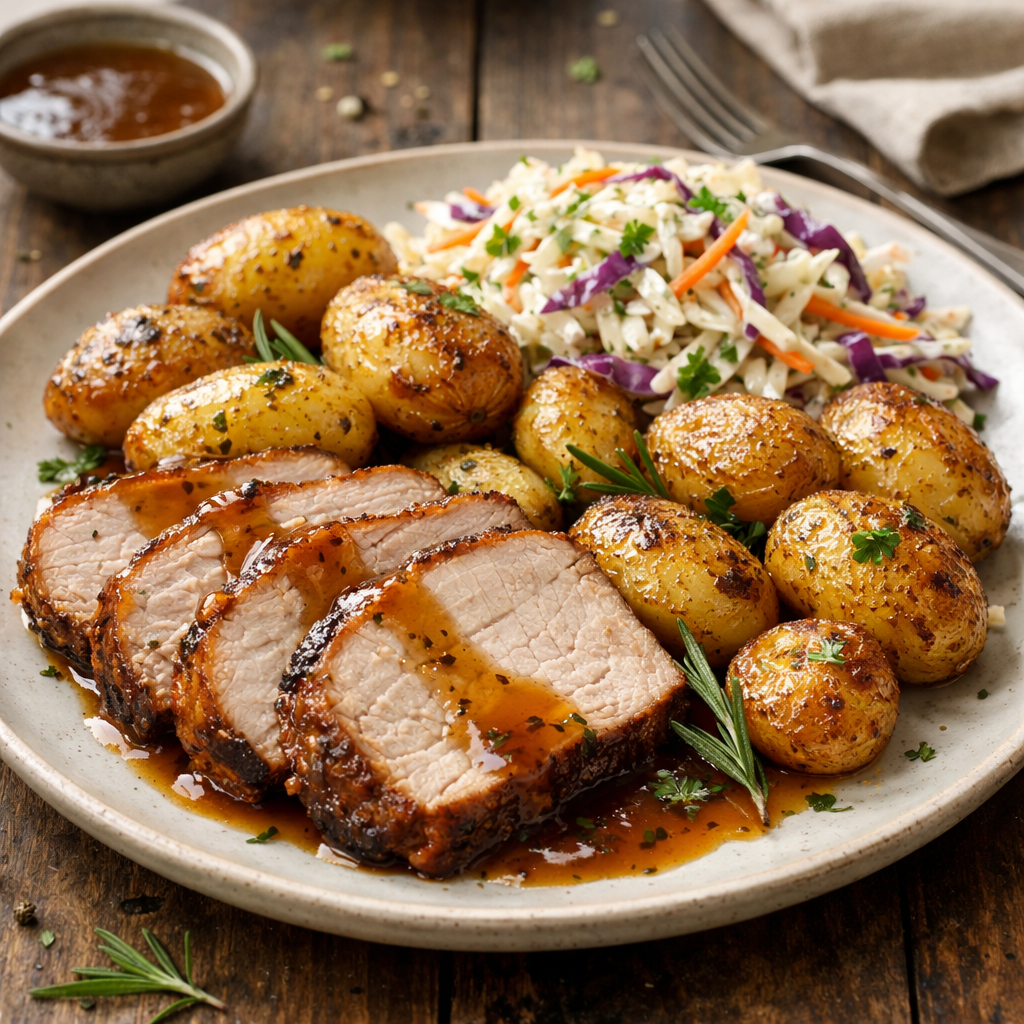
Pork loin roast with roasted potatoes and white cabbage salad

Pikantne Main Dishes Regional Cuisine of Poland 150 min Medium 144 wyświetleń ~11.20 PLN * - (0)
Rate:
(0)
Start Cooking

Description

Traditional pork loin roast in a modern version: juicy pork loin with a delicate crust, aromatic garlic-marjoram rub, crispy roasted potatoes, and a fresh coleslaw of white cabbage with carrot and creamy dressing. The dish combines the classic Polish flavor of roasted meat with a light, slightly tangy coleslaw that balances the richness of the meat. It is perfect for a family dinner on a winter day and pairs well with pickled cucumber or beets on the side. Visually: the golden crust of the pork, browned potatoes, and colorful coleslaw create a contrast on the plate.

Ingredients Used

Ingredients (15)

Servings:
4
  • Boneless pork loin 800 g
  • Potatoes 5.3 szt. (~800 g)
  • White cabbage 300 g
  • Carrot 1.3 szt. (~100 g)
  • Onion 1 szt. (~150 g)
  • Garlic 3 ząbki (~15 g)
  • Rapeseed oil 45 g
  • Butter 30 g
  • Sour cream 100 g
  • Apple cider vinegar 15 ml
  • Sugar 10 g
  • 🌿 Przyprawy
  • Salt 8 g
  • Black pepper 4 szczypty (~2 g)
  • ✨ Opcjonalne
  • Marjoram 2 g
  • Apple 0.8 szt. (~150 g)
💰 Szacowany koszt dania: ~11.20 PLN (2.80 PLN/porcję)
* Brak cen dla niektórych składników

💡 Kliknij na składnik aby oznaczyć jako użyty

Preparation steps

Roast

1

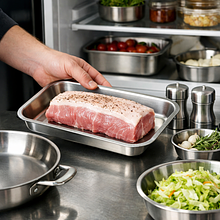
Prepare the pork loin: take the meat out of the fridge 30 minutes before cooking to reach room temperature. Wash the piece of pork loin by hand and dry it with a paper towel. If there are thin membranes, gently trim them off with a sharp knife. If the shape is uneven, tie the pork loin with kitchen twine every 3–4 cm to ensure the roast has an even shape and cooks evenly.

Use a sharp knife for trimming and kitchen twine (about 2–3 m). Tying improves appearance and makes slicing easier.
2

Prepare the dry marinade: press or finely chop 3 cloves of garlic (15 g) and mix in a bowl with 8 g of salt, 2 g of pepper, and (optional) 2 g of marjoram. Spread the mixture evenly over the entire surface of the pork loin: first, rub the meat with your hands, massaging the spices into the meat for 1–2 minutes.

Use a small bowl and a teaspoon to mix. If you don't like marjoram, skip it — marked as an optional ingredient.
3

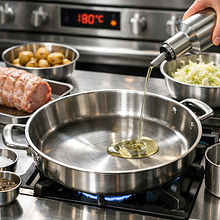
Preheat the oven to 180°C (top-bottom). Heat a large skillet (preferably cast iron or with a thick bottom) over medium-high heat, add 15 g of oil (1 tablespoon). When the oil starts to shimmer slightly, place the pork loin in and sear for 3–4 minutes on each side until the surface is golden-brown — the goal is to seal the meat's pores, not to cook the inside.

Use kitchen tongs to turn. The surface of the pork loin should be clearly browned. Frying takes about 10–12 minutes in total.
4

Transfer the browned pork loin to a baking dish (approximately 30×20 cm) or a heatproof dish. Add the quartered onion (150 g) to the dish and place 30 g of butter on top of the meat. Place in the preheated oven on the middle rack and bake for 50–60 minutes at 180°C. After 15, 30, and 45 minutes, baste the roast with the resulting sauce and butter to ensure a shiny crust and juicy meat.

Use a meat thermometer — after 50 minutes, the internal temperature should be 68–70°C; then the meat is juicy. If you don't have a thermometer, press it with your finger: the meat should be firm but not hard.
5

After baking, remove the pork loin from the oven and place it on a cutting board. Loosely cover it with aluminum foil and let it rest for 15 minutes to allow the juices to redistribute evenly. After resting, remove the string and slice the pork loin into pieces 1–1.5 cm thick using a sharp knife.

Resting the meat is key — if you skip this step, the juices will run out and the meat will be dry. Use a long, sharp carving knife.

Potatoes

6

Prepare the potatoes: peel the potatoes (800 g) and cut them into equal pieces about 2–3 cm on each side (chunks, quarters, depending on size). The more uniform the pieces, the more even the baking. Place the cut potatoes in a pot, cover with cold water so that they are submerged, add 1 g of salt, and bring to a boil.

Use a large pot so that the potatoes have enough space and do not stick together while cooking.
7

Cook the potatoes for 8–10 minutes from the moment they start boiling — they should be almost soft, you can check this with a fork: the fork should go in with slight resistance, but the pieces should not fall apart. Drain the potatoes and let them steam off for a moment (1–2 minutes).

Do not overcook the potatoes — if they are too soft, they will fall apart during baking and won't be crispy.
8

Transfer the drained potatoes to a large bowl, add 30 g of rapeseed oil (2 tablespoons), 5 g of salt, and 10 g of melted butter (optional). Mix thoroughly with your hands or a spoon to ensure each piece is coated in fat. Spread the potatoes on a baking sheet in a single layer.

The best is a baking tray lined with parchment paper. Hands help to evenly spread the fat and slightly turn the pieces, which increases crispiness.
9

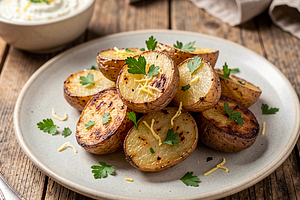
Baking potatoes: place the tray with potatoes in the oven preheated to 200°C and bake for 35–40 minutes, turning the potatoes once halfway through (after 18–20 minutes) to ensure all sides are golden brown. If you are baking the potatoes at the same time as the pork loin, add the potatoes to the oven for the last 35–40 minutes of the pork's baking time; if the pork is still in the oven at a lower temperature, increase the temperature to 200°C only for the duration of baking the potatoes or bake the potatoes after removing the pork.

Use kitchen gloves to carefully turn the potatoes. The potatoes are ready when they have a golden, crispy skin and a soft center.

Salad

10

Prepare the vegetables: finely shred the white cabbage (300 g) with a knife or a shredder into very thin strips. Grate the carrot (100 g) on a coarse grater. If you are using an apple (optional 150 g), peel and grate it on the grater along with the carrot. Finely chop 1/2 of a small onion (about 50 g) if you like a spicier note.

For shredding cabbage, use a sharp knife and a large cutting board or mandoline. Try to cut thinly so that the salad is delicate.
11

In a large bowl, mix the shredded cabbage with 1 g of salt and massage it with your hands for 2–3 minutes until the leaves soften, become more flexible, and release some moisture. Add the grated carrot and apple (if using).

Massaging the cabbage softens it and improves the texture of the salad — use clean hands or disposable gloves.
12

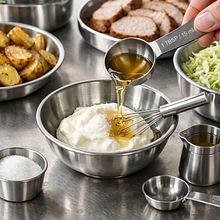
Prepare the dressing: in a small bowl, combine 100 g of 18% sour cream, 15 ml of apple cider vinegar, and 10 g of sugar. Mix thoroughly with a fork until the sugar dissolves, then season with 1 g of salt and 1 g of pepper to taste. Drizzle the dressing over the salad and mix well — taste and if necessary, add a bit more salt or vinegar to achieve a pleasant flavor balance (sweet and sour).

Use a spoon or whisk to emulsify the cream with the vinegar. The dressing should be smooth, not lumpy.
13

Combining and chilling: mix the salad with the dressing, taste and adjust the seasoning. Set aside in the refrigerator for at least 15–30 minutes before serving to let the flavors meld. Before serving, mix again and season with salt and pepper if needed.

The salad tastes better after a short chill, but no longer than 24 hours to maintain freshness. For longer storage, keep in an airtight container.

Assembly

14

Serving: on each plate, place a portion of roasted potatoes (about 200 g), a few slices of pork loin (about 180–200 g of meat per serving), and a portion of coleslaw (about 150 g). Drizzle the pork loin with a little sauce from the roasting pan (a tablespoon per serving) and garnish with a slice of apple or parsley, if you have it.

Use a slotted spoon to scoop out the nice sauce from the roasting pan without the burnt parts. Serve hot potatoes and meat with a cool salad.

Fun Fact

💡

In traditional Polish cuisine, mayonnaise or sour cream often accompanies cabbage salads, and marjoram is a classic addition to pork — in old homes, it was almost mandatory for roasts.

Best for

Tips

🍽️ Serving

Serve the roast sliced thinly so that each piece is tender. A glass of light red wine or dried fruit compote pairs well with the pork loin. Serve the salad chilled, while the potatoes and meat should be hot — the contrast in temperatures enhances the flavor.

🥡 Storage

Store the roast in the refrigerator in a covered container for up to 3 days. The potatoes lose their crispness — to reheat, spread them on a baking sheet and bake in the oven for 10–12 minutes at 200°C until they regain their crispness. Store the salad separately in an airtight container for up to 24 hours. It is not recommended to refreeze meat after it has been thawed.

📸 Ugotowane przez społeczność

Zaloguj się, aby dodać zdjęcie
Dodaj zdjęcie gotowej potrawy

Po zatwierdzeniu przez moderatora otrzymasz 10 punktów doświadczenia.

🍲

Nikt jeszcze nie dodał zdjęcia. Bądź pierwszy!

Comments (0)

Be the first to comment on this recipe!

Add a comment

You might also like

Recipe Categories

Main Dishes
Main Dishes in: Christmas Eve Dinner

Main courses are the heart of every meal - hearty, delicious, and full of nutrients. Meats: beef, pork, poultry, and lamb in various versions. Fish and seafood: baked, fried, grilled, and stewed. Vegetarian dishes: tofu, tempeh, legumes as the main protein. Casseroles: pasta, potato, vegetable wi...

See all recipes in this category

Traditional recipes from various regions of Poland that showcase the richness of local flavors and ingredients.

See all recipes in this category
Reklama