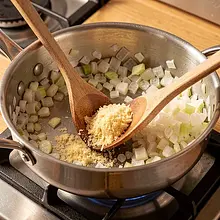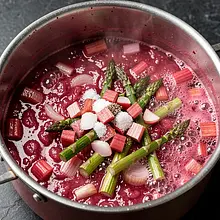
Prepare the ingredients for the chutney. Wash the rhubarb, trim the ends, and cut the stalks into 1–2 cm pieces. Peel and finely chop the onion. Peel the ginger thinly and grate it on a fine grater. Measure out the sugar, apple cider vinegar, and honey.
Description
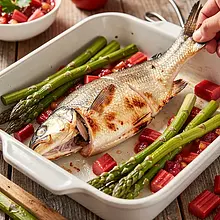
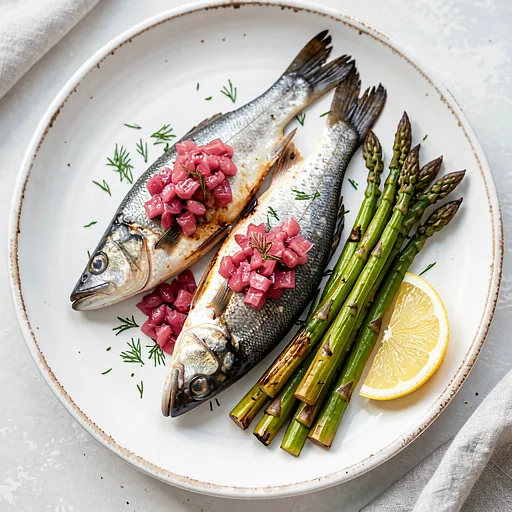
An exquisite spring dish in the Masurian style: delicate pike-perch baked under a sweet and sour rhubarb chutney and served with crunchy young asparagus and aromatic sorrel. The chutney adds freshness and a slight tartness that balances the richness of the butter used for baking, while the green asparagus and sorrel provide color and a spring character. This dish is perfect as a main course for a family lunch or a festive spring gathering; it pairs well with roasted young potatoes or light millet. Visually striking: the pink rhubarb chutney, the golden crust of the pike-perch, and the green asparagus shoots create a harmonious composition on the plate.
Ingredients Used
Ingredients (16)
- Zander 600 g
- Rhubarb 400 g
- Sugar 100 g
- Apple cider vinegar 60 ml
- Onion 1 szt. (~150 g)
- Honey 30 ml
- Butter 50 g
- Rapeseed oil 30 g
- Young asparagus 400 g
- Sorrel 40 g
- Lemon 0.8 szt. (~60 g)
- 🌿 Przyprawy
- Ginger 20 g
- Salt 0.1 szczypt (~3 g)
- Black pepper 4 szczypty (~2 g)
- ✨ Opcjonalne
- Almond flakes 30 g
- Dill 30 g
💡 Kliknij na składnik aby oznaczyć jako użyty
Preparation steps
Rhubarb chutney
In a medium saucepan, heat 10 g of butter (set aside from the total butter) and add the chopped onion. Sauté over medium heat for 4–5 minutes, until the onion becomes soft and translucent, stirring with a wooden spoon every 30 seconds to prevent burning. Add the grated ginger and sauté for another 30 seconds.
Add the chopped rhubarb, sugar, apple cider vinegar, and honey. Mix and bring to a gentle boil over medium heat. Reduce the heat and cook uncovered for 12–15 minutes, stirring every 2–3 minutes, until the rhubarb breaks down and the consistency is thick, resembling jam. When the chutney thickens, taste and season with 1 g of salt and 1 g of black pepper (or more to taste).
Asparagus
Prepare the asparagus: snap off the woody ends (hold the stalk near the base and bend it, it will naturally break at the tender point). Lay the stalks on a board and, if necessary, peel the lower part with a vegetable peeler if the stalks are thicker.
Heat a large grill pan or regular pan with 10 g of butter and 10 g of canola oil over medium-high heat. Arrange the asparagus in a single layer and sauté for 2–3 minutes on each side until lightly browned, tender but crisp. Season the asparagus with 1 g of salt just before the end of cooking.
Pikeperch
Preheat the oven to 180°C (top-bottom). Pat the pikeperch fillets dry with a paper towel. Gently salt (1 g salt) and pepper (1 g black pepper) both sides of the fillet. In a large skillet, heat 10 g of butter and 10 g of canola oil over medium-high heat. When the fat is hot (but not smoking), place the fillets skin-side down. Fry for 2–3 minutes until the skin becomes golden and crispy — do not move the fillet during this time. Flip the fillets to the flesh side and fry for 20–30 seconds to seal the meat's pores.
After 2–3 minutes of frying and lightly browning skin-side down, transfer the pan (if oven-safe) to the preheated oven or place the fillets in a baking dish skin-side up and put it in the oven. Bake for 6–10 minutes depending on the thickness of the fillet (for a fillet about 2–3 cm thick, about 8 minutes). You will know the fish is ready when the flesh becomes opaque, slightly flakes, and easily separates with a fork.
Assembly and serving
Gently heat the chutney for 1–2 minutes over low heat if it has cooled down. On each plate, arrange 3–4 asparagus spears, and place the roasted pike perch fillet (skin side up) next to them. Spoon 1–2 tablespoons of rhubarb chutney over the fish. Drizzle a few drops of lemon juice over the fish (about 5–10 g per serving). Sprinkle with a pinch of freshly chopped dill (optional) and, if using, toasted almond flakes on the asparagus for crunch.
Additional seasoning: check the taste of each portion and, if necessary, add a pinch of salt or lemon juice. Serve immediately to keep the asparagus crunchy and the pike-perch juicy.
Fun Fact
Zander (from the perch family) is valued in Polish cuisine, especially in lake regions like Masuria; it combines delicate meat with bold, local additions such as rhubarb, which was historically used in Poland not only for desserts but also for sauces and preserves.
Best for
Tips
Serve with young roasted potatoes or millet for a light, traditional accompaniment. For a creamier addition, you can serve a spoonful of sour cream alongside the chutney. For guests, prepare extra lemon slices.
Store chutney in a tightly sealed jar in the refrigerator for up to 5 days. Baked pike perch is best eaten immediately; it can be stored in the refrigerator for up to 24 hours in an airtight container, but reheat briefly in the oven at 150°C for 6–8 minutes to avoid drying out. Asparagus is best eaten fresh; if there are leftovers, store them wrapped in a damp paper towel in the refrigerator for 1 day.
📸 Ugotowane przez społeczność
Zaloguj się, aby dodać zdjęcieDodaj zdjęcie gotowej potrawy
Po zatwierdzeniu przez moderatora otrzymasz 10 punktów doświadczenia.
Nikt jeszcze nie dodał zdjęcia. Bądź pierwszy!
Comments (0)
Be the first to comment on this recipe!
Add a comment