Take the duck breasts out of the fridge 20-30 minutes before frying to bring them to room temperature. Pat dry with a paper towel. Place the breast skin-side up on a cutting board. With a sharp knife, score the skin in a crisscross pattern: diagonal cuts about 5 mm apart, being careful not to cut deeply into the meat — the goal is to cut only through the skin and a thin layer of fat. Season evenly with salt and freshly ground pepper on the skin side and a little on the meat side.
Description
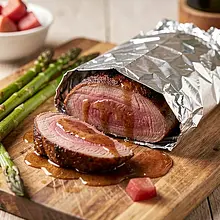
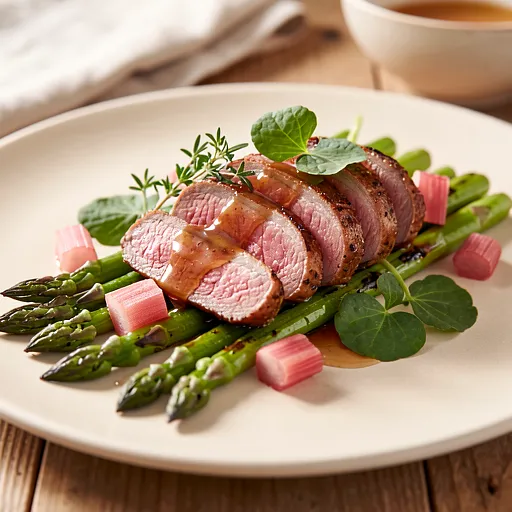
Mazurian variation on duck: juicy duck breast with crispy, caramelized skin, drizzled with a sweet and sour rhubarb-honey glaze, served with grilled green asparagus and fresh sorrel. The dish combines seasonal spring ingredients (rhubarb, asparagus, sorrel) with a traditional Mazurian touch — simplicity and a distinct taste of nature. Perfect for a family spring lunch or a candlelit dinner; pairs well with young potatoes with dill, celery puree, or a light red wine. Aesthetically: thinly sliced breast, glossy glaze, and green asparagus create an elegant, colorful plate.
Ingredients Used
Ingredients (15)
- Duck breast 4 szt. (~800 g)
- Rhubarb 400 g
- Honey 60 ml
- Butter 30 g
- Shallot 80 g
- Garlic 2 ząbki (~10 g)
- Red wine vinegar 30 ml
- Chicken broth 100 ml
- Rapeseed oil 30 g
- Asparagus 600 g
- Lemon 1.3 szt. (~100 g)
- 🌿 Przyprawy
- Salt 0.1 szczypt (~3 g)
- Black pepper 4 szczypty (~2 g)
- Thyme 6 g
- ✨ Opcjonalne
- Sorrel 60 g
💡 Kliknij na składnik aby oznaczyć jako użyty
Preparation steps
Preparing the duck
Place the raw breasts skin-side down in a cold cast iron skillet or heavy skillet with a diameter of 26-28 cm. Turn the burner to medium heat (not high temperature to start). Allow the fat from the duck to slowly render out — do not move the meat for the first 4-6 minutes, then gently press with tongs and continue cooking for 8-12 minutes, until the skin is deeply golden and very crispy. During this time, tilt the skillet and use a spoon to collect the rendered fat and drizzle it over the skin.
After achieving a crispy skin, turn the breasts to the meat side and fry for 1-2 minutes to seal the pores. Then transfer the pan (if oven-safe) to an oven preheated to 180°C and bake for 6-8 minutes for medium-rare doneness (internal temperature about 58-60°C). If you don't have an oven, continue frying on low heat for 6-8 minutes, covering the pan with a lid. Remove the breasts and place them on a cutting board, loosely cover with aluminum foil, and let rest for 8-10 minutes to allow the juices to redistribute.
Rhubarb-Honey Glaze
Prepare the ingredients for the glaze: wash the rhubarb, trim the ends, and cut the stalks into pieces about 1 cm. Peel and finely chop the shallot (use a knife or a chopper). Crush and finely chop the garlic. Remove the leaves from the thyme sprig.
In a medium saucepan, melt the butter over medium heat. Add the chopped shallot and sauté for 3-4 minutes until it becomes translucent and soft. Add the garlic and sauté for 30 seconds until fragrant. Add the chopped rhubarb, 2/3 of the honey, and red wine vinegar. Slightly increase the heat and cook, stirring occasionally, for 8-10 minutes until the rhubarb breaks down and the mixture thickens. If it is too thick, add 2 tablespoons of chicken broth at a time to achieve a glossy consistency. Finally, season with salt and pepper, add the juice of half a lemon, and a bit of fresh thyme. If you want a smooth glaze, briefly blend with an immersion blender to the desired smoothness.
Asparagus
Prepare the asparagus: snap or cut off the tough ends (they will break naturally at the bending point). If the stalks are thick, gently peel the lower part with a peeler. In a bowl, mix the asparagus with canola oil and a little salt and pepper.
Preheat a grill pan or grill to medium-high heat. Arrange the asparagus in a single layer and grill for 3-4 minutes on one side until clear grill marks and a slight char appear, then flip and grill for another 2-3 minutes — they should be tender-crisp, not overcooked. After removing from the grill, drizzle with a little lemon juice.
Finishing the duck
Heat the glaze over low heat, adding the remaining honey if you want a sweeter shine. Place the rested breasts skin-side up in a clean pan (without additional fat) and over medium-high heat, brush the skin with the glaze and sauté very briefly — 20-40 seconds, until the glaze starts to lightly caramelize and shine. Be careful not to burn the honey — remove immediately if the glaze begins to darken too quickly.
Assembly and serving
On warm plates, arrange the grilled asparagus in a fan shape. Slice the duck breast diagonally into thin slices, 3-5 mm thick, cutting against the grain to ensure the slices are tender. Place the slices on the asparagus, drizzle with an additional tablespoon of glaze, and garnish with a few leaves of sorrel (optional) and a sprig of thyme. Serve with a wedge of lemon on the side and optionally with young potatoes or a light puree.
Fun Fact
In Masurian cuisine, duck often appeared as game meat, combining with forest and garden flavors — here we paired it with rhubarb, which is a classic spring ingredient in Poland.
Best for
Tips
Serve the dish immediately after slicing to keep the breast juicy. Pair it with young potatoes with dill or a delicate celery puree. For drinks, choose a light red wine (e.g., Pinot Noir) or a structured white (Chardonnay), or possibly a light craft beer.
Store cooked ingredients separately: duck slices and glaze in the refrigerator for up to 24 hours in a closed container. Asparagus is best consumed fresh; when stored, it becomes soft. To reheat the duck, preheat the oven to 120°C and heat for 6-8 minutes, then briefly sear the skin in a pan to regain crispiness. Do not freeze the already cooked honey glaze (the consistency may change).
📸 Ugotowane przez społeczność
Zaloguj się, aby dodać zdjęcieDodaj zdjęcie gotowej potrawy
Po zatwierdzeniu przez moderatora otrzymasz 10 punktów doświadczenia.
Nikt jeszcze nie dodał zdjęcia. Bądź pierwszy!
Comments (0)
Be the first to comment on this recipe!
Add a comment