St. Martin's Croissants with Rose Filling

Desserts Regional Cuisine of Poland 120 min Hard 24 wyświetleń ~49.70 PLN * - (0)
Rate:
(0)
Start Cooking

Description

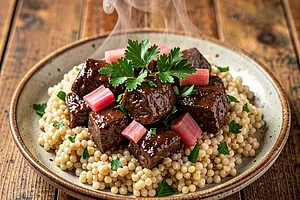
Rogale marcińskie are traditional pastries from Greater Poland, characteristic of St. Martin's Day (November 11), usually filled with a mixture of white poppy seeds, almonds, and dried fruits. In this version, we maintain the classic structure of the croissant (yeast dough with a layer of fat/a lava filling) and add a twist: a delicate hint of rose jam and rose water in the filling and glaze, which gives the pastries a subtle, floral aroma. The croissants are fluffy, with distinct layers of dough and a golden, shiny glaze; the filling is creamy, sweet with noticeable pieces of almond and the aroma of poppy seeds. Serve slightly warm or at room temperature, perfect as a dessert during holidays, family gatherings, or for special occasions. It's worth planning time for rising and cooling — the final effect rewards the effort.

Ingredients Used

Ingredients (17)

Servings:
12
  • Wheat flour 600 g
  • Fresh yeast 30 g
  • Milk 450 ml
  • Butter 250 g
  • Sugar 120 g
  • Chicken egg 5 szt. (~300 g)
  • Vanilla sugar 8 g
  • White flour 220 g
  • Almond 150 g
  • Honey 60 ml
  • Powdered sugar 160 g
  • Rose jam 150 g
  • Rose water 10 g
  • Egg white 60 g
  • 🌿 Przyprawy
  • Salt 0.2 szczypt (~5 g)
  • ✨ Opcjonalne
  • Raisin 80 g
  • Almond flakes 30 g
💰 Szacowany koszt dania: ~49.70 PLN (4.14 PLN/porcję)
* Brak cen dla niektórych składników

💡 Kliknij na składnik aby oznaczyć jako użyty

Preparation steps

Dough - starter

1

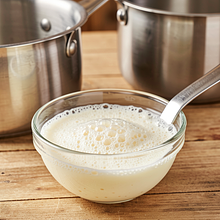
Prepare the starter: in a small saucepan or in the microwave, heat 150 ml of milk to a temperature of 35–37°C (it should be pleasantly warm, not hot — check with your wrist). To the warm milk, add 1 teaspoon of sugar from the total amount and crumble the fresh yeast (30 g) directly into the milk. Gently mix with a fork until the yeast dissolves. Set aside in a warm place for 8–10 minutes; a foamy "cap" should appear on the surface, indicating that the yeast is active.

Ingredients: Milk, Sugar, Fresh yeast
Use a small bowl and a fork. If no foam appears after 10 minutes, the yeast may be inactive — prepare a new batch. The milk cannot be hot (>45°C), as it will kill the yeast.
Dough - mixing and kneading

2

In a large bowl, sift the flour (600 g). Add salt (5 g), vanilla sugar (8 g), and 100 g of sugar from the pool. Make a well in the center. In a separate bowl, lightly beat the eggs (use about 240 g from a total of 300 g — the remainder will be used for glazing and icing) and pour into the well along with the yeast mixture. Add 100 g of soft butter (taken out of the fridge beforehand, it should be pliable but not melted). Stir with a wooden spoon, and when the ingredients are combined, start kneading the dough for about 8–10 minutes until it is smooth and elastic. The dough should be slightly sticky but not permanently stick to your hands — if it is very sticky, add a maximum of 1–2 tablespoons of flour.

Ingredients: Wheat flour, Salt, Vanilla sugar, Sugar, Butter, Fresh yeast, Milk
Use a mixer with a dough hook (medium speed) — knead for 6–8 minutes. If kneading by hand, use a wooden spoon to combine, then knead on a countertop for 10–12 minutes. Do not add too much flour, as the dough will become tough.

Dough - first rising

3

Place the kneaded dough in a large, lightly greased bowl (grease the bottom with a little butter), cover with a clean cloth or plastic wrap, and set aside in a warm place (about 24–26°C) for 50–60 minutes, until it doubles in size. Check by gently pressing with your finger: the dough should slowly spring back and the indentation should hold slightly.

Ingredients: Wheat flour, Butter
The best vessel is a glass or metal bowl with a capacity of at least 4 L. Do not place it in a draft. If the kitchen is cold, you can put the bowl in a slightly warm (turned off) oven with the light turned on for a moment.

Lamination

4

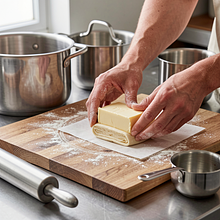
Prepare the butter block for lamination: place the remaining 150 g of butter between two sheets of parchment paper and roll it out with a rolling pin into a rectangle of about 20x15 cm with a thickness of ~5–7 mm. Put the butter in the fridge for 10 minutes to make it cold but pliable. Place the risen dough on a lightly floured surface, roll it out into a rectangle of 30x20 cm. Place the chilled butter block in the center of the dough, fold the edges of the dough like an envelope so that the butter is completely enclosed. Gently roll it out into a rectangle of 40x20 cm, make a double fold: fold it into thirds (like a letter), turn it 90°, wrap it in plastic wrap, and place it in the fridge for 20 minutes. Repeat the rolling and folding once more, then chill again for 20–30 minutes. The goal is to create layers of fat and dough (similar to puff pastry).

Ingredients: Butter, Wheat flour, Milk
Use a rolling pin, parchment paper, and a knife or dough scraper. Roll out vigorously, but not so much that the butter melts; if the butter starts to melt, chill the dough in the refrigerator. Rolling too long will cause the layers to combine instead of separating.

Filling - cooking poppy seeds

5

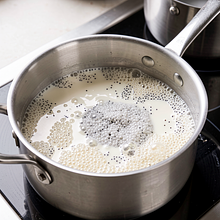
Prepare the poppy seed filling: in a medium pot, heat 200 ml of milk to boiling, add white poppy seeds (220 g) and reduce the heat to low. Cook on very low heat for 15–20 minutes, stirring occasionally, until the poppy seeds swell and absorb most of the milk. After cooking, transfer the mixture to a blender or use a poppy seed mill (sieve 2–3 mm) and grind twice until the mixture is creamy. If using a blender, blend until smooth; you can add 1–2 tablespoons of milk if the mixture is too thick.

Ingredients: white flour, Milk
Use a non-stick pot and a wooden spoon. If you have a poppy seed grinder, pass the poppy seeds through it twice for a delicate texture. The mixture should be creamy, without hard grains.

Filling - seasoning

6

Add ground almonds (150 g) to the ground poppy seeds — you can grind the almonds in a food processor or chop them very finely. Add honey (60 g), 60 g of sugar (from the sugar pool), and 100 g of powdered sugar, as well as 150 g of rose jam. Finally, add 10 ml of rose water and, if using, drained raisins (80 g). Mix until you achieve a thick, sticky-cream consistency. Taste and add a bit more powdered sugar or honey if needed. Set the filling aside to cool to room temperature (about 20–30 minutes).

Ingredients: almond, Honey, Sugar, Powdered sugar, Rose jam, Rose water, Raisin
Use a bowl and a spatula or a mixer with a paddle attachment. The filling should be thick and sticky — if it is too runny, add a bit more ground almonds or powdered sugar. If it is too dry, add 1–2 teaspoons of milk.

Shaping

7

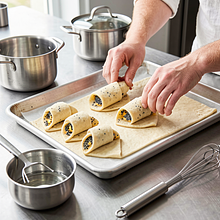
Take the chilled dough out of the refrigerator and roll it out into a rectangle about 3–4 mm thick (approx. 40x30 cm). Using a knife or pastry wheel, cut the dough into 12 equal triangles (base of the triangle approx. 12–13 cm). On the wide end of each triangle, place 1 tablespoon of poppy seed filling and 1/2 teaspoon of rose jam (additionally), leaving a 1 cm margin at the edge. Starting from the wide end, roll each triangle towards the tip, forming a crescent. Slightly bend the ends to give it the characteristic crescent shape. Arrange the crescents on a baking sheet lined with parchment paper, leaving 3–4 cm between them.

Ingredients: Wheat flour, Rose jam, white flour
Use a rolling pin, pastry wheel, and spoon. Do not add too much filling (it may leak during baking). Pinch the edges together, gently pressing with your fingers to prevent the pastry from unfolding while baking.

Proofing/final rising

8

Cover the shaped croissants loosely with a cloth (not tightly, so they don't stick) and set aside for 30–40 minutes in a warm place until they puff up slightly (they should increase in volume by 30–40%). Touch test: the surface should be springy, and pressing with a finger should slowly bounce back.

Ingredients: Wheat flour
Do not let the croissants rise too much (risk of the filling spilling out). If the kitchen is cold, turn the oven on for a moment to 30°C, turn it off, and place the tray in the warmed oven.

Baking

9

Preheat the oven to 190°C (top-bottom, without convection). Before placing the croissants in, beat the remaining egg (the rest from the batch — use the yolk for brushing; if you separated the egg white for icing, use only the yolk + 1 teaspoon of milk) and gently brush the surface of the croissants with a pastry brush. Place the tray in the preheated oven on the middle rack and bake for 15–18 minutes, until the croissants are golden and have distinct layers. After 12 minutes, watch the color; if they brown quickly, reduce the temperature to 180°C.

The best is a baking tray measuring about 30x40 cm lined with baking paper. Use a silicone brush for greasing. Do not open the oven for the first 10 minutes to prevent the croissants from deflating.

Glaze and decoration

10

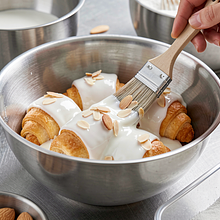
Prepare the protein icing: in a bowl, beat the egg white (60 g) with 100 g of powdered sugar until smooth. Add a few drops of rose water (2–3 ml) and optionally 1 teaspoon of lemon juice to achieve the right acidity and consistency. The consistency should be thick but pourable — if it's too thick, add a drop of water; if it's too thin, add more powdered sugar. After removing the croissants from the oven and letting them cool slightly (about 5 minutes), use a brush to apply the icing on top of each croissant. Sprinkle with almond flakes (30 g) if using. The icing sets quickly on warm pastries, giving a glossy effect.

Ingredients: egg white, Powdered sugar, Rose water, Almond flakes
Use a bowl and a whisk or a mixer on low speed. Apply the icing while the pastries are still warm — this way the icing will adhere nicely. Additionally, you can add almond flakes for crunch.

Cooling and serving

11

Allow the croissants to cool completely on a wire rack (about 30–45 minutes) — during this time, the icing will set. Serve at room temperature; they taste best on the same day, as the pastry retains its ideal layered texture.

Ingredients: Almond flakes
Use a cooling rack to prevent the bottom from getting soft. The croissants can be served with a cup of strong coffee or Earl Grey tea.

Final tips

12

If you want to prepare the croissants in advance: bake, cool, and freeze individually wrapped in paper and foil (for up to 1 month). After thawing (preferably overnight in the fridge + 15 minutes at room temperature), refresh briefly in the oven for 5–7 minutes at 160°C. Remember that freshness and the structure of the layers are best preserved within the first 24 hours.

Ingredients: Wheat flour
To refresh, use a hot oven without steam; heating for too long will dry out the dough.

Fun Fact

💡

Rogale marcińskie come from Poznań and are associated with the feast of St. Martin (November 11). They are traditionally made with white poppy seeds and almonds; legend has it that the first croissant was created out of gratitude from a knight for helping the poor.

Best for

Tips

🍽️ Serving

Serve slightly warm or at room temperature. They pair well with strong coffee, coffee with milk, or tea with lemon. You can cut them in half and serve with a drizzle of vanilla cream for contrast.

🥡 Storage

Store in a cool place in an airtight container for up to 48 hours. For longer storage, freeze individually wrapped in paper and foil (for up to 1 month). To refresh: oven at 160°C for 5–7 minutes.

📸 Ugotowane przez społeczność

Zaloguj się, aby dodać zdjęcie
Dodaj zdjęcie gotowej potrawy

Po zatwierdzeniu przez moderatora otrzymasz 10 punktów doświadczenia.

🍲

Nikt jeszcze nie dodał zdjęcia. Bądź pierwszy!

Comments (0)

Be the first to comment on this recipe!

Add a comment

You might also like

Recipe Categories

Desserts
Desserts in: New Year's Eve

A sweet ending to the New Year's Eve dinner is a must-have that will put everyone in a joyful mood for the new year.

See all recipes in this category

Traditional recipes from various regions of Poland that showcase the richness of local flavors and ingredients.

See all recipes in this category
Reklama