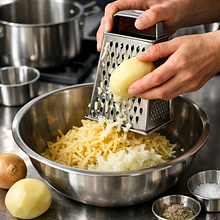
Wash the potatoes under running water, peel them with a vegetable peeler. Peel the onion and garlic. Prepare a cutting board, a large bowl, and a grater with large holes (if you have one, use a food processor with a grating disc). Place a clean linen towel or cheesecloth to drain the potato juice.
Description
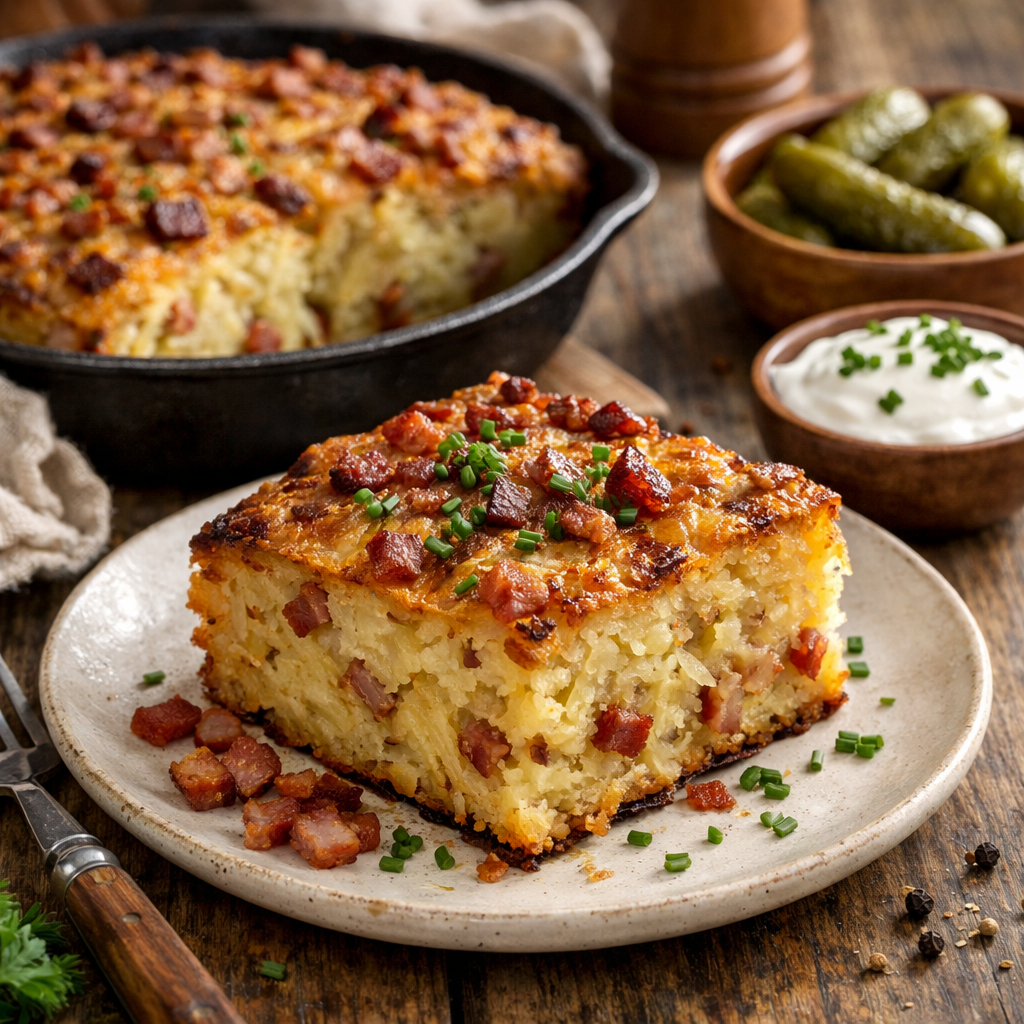
Potato babka is a hearty, rustic dish from Polish cuisine made with raw potatoes, eggs, and additions, here enriched with crispy bacon and sautéed onions. In this version, we use winter ingredients and the technique of recovering starch from potato juice, which allows us to reduce the amount of flour and achieve a compact, moist structure with a golden, crispy crust. It can be served hot as a main dish with sour cream or cooked sauerkraut; it works great for a family dinner or a Sunday table. Flavor: distinct salty bacon, aromatic onion, and marjoram, contrasting with the creamy sour cream or tangy sauerkraut.
Ingredients Used
Ingredients (14)
- Potatoes 8 szt. (~1200 g)
- Smoked bacon 200 g
- Chicken egg 3 szt. (~180 g)
- Onion 1 szt. (~150 g)
- Wheat flour 80 g
- Garlic 2 ząbki (~10 g)
- Rapeseed oil 30 g
- Butter 30 g
- 🌿 Przyprawy
- Salt 10 g
- Black pepper 4 szczypty (~2 g)
- Marjoram 4 g
- ✨ Opcjonalne
- 18% cream 200 ml
- Sauerkraut 200 g
- Parsley 0.5 pęczek (~15 g)
💡 Kliknij na składnik aby oznaczyć jako użyty
Preparation steps
Preparation of ingredients
Grate the potatoes on a grater directly into a large bowl (coarse grater). Grate the onion into the same bowl - the onion will release juice that will help with draining. If you are using a food processor, pulse briefly to avoid turning the potatoes into a mush.
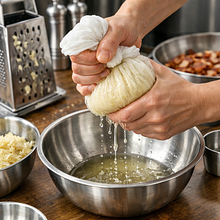
Transfer the grated potato-onion mixture to a linen towel or cheesecloth. Tie the corners and squeeze firmly over the sink until the light-colored juice stops flowing. Leave the drained liquid in a bowl and let it sit for 3-4 minutes until the starch settles at the bottom; then gently pour off the clear water and keep the whitish layer of starch at the bottom - this is valuable potato starch that will enhance the consistency of the cake.
Sautéing bacon and onion
Cut the bacon into cubes about 1 cm. In a large skillet, heat the rapeseed oil over medium heat, add the bacon and fry for 5-7 minutes until the fat renders and the bacon becomes golden and crispy. Add the drained grated onion (if some onion remains in the mixture, don't worry) and fry for another 4-5 minutes until the onion softens and slightly caramelizes. Finally, add the finely chopped garlic and fry for 30 seconds just to release the aroma. Transfer everything to a plate to cool and keep the fat from the skillet.
Mixing the batter
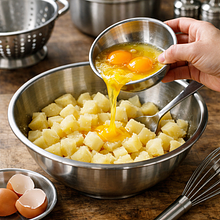
In a large bowl with drained potatoes, add the eggs (crack them directly into a small bowl to check freshness), add the wheat flour and a tablespoon of the starch collected at the bottom of the bowl. Add salt, black pepper, and marjoram. Then add the cooled bacon with onion and the pressed garlic. Stir vigorously with a wooden spoon for about 1-2 minutes until the ingredients are evenly combined and the mixture is smooth. The mixture should be moist but not runny — if it is too thin, add 1-2 tablespoons more flour; if it is too thick, you can add 1 tablespoon of oil or 1 egg (an additional egg would increase the number of servings).
Preparing the baking pan
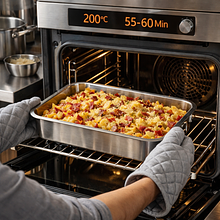
Preheat the oven to 200°C (without fan) or 180°C (with fan). Grease the bundt pan (loaf pan 22-24 cm or springform/bundt with a capacity of 1.5–2 l) with butter. If you are using a pan with a chimney, lightly dust it with flour and shake off the excess. Transfer the mixture to the pan, smooth the surface with a spatula, and press down slightly to eliminate any air pockets.
Baking
Place the mold on the middle rack of the oven. Bake for 55–60 minutes at 200°C (180°C with fan). After 30 minutes, take a look through the glass — if the top is browning too much, loosely cover it with aluminum foil. The cake is ready when the top is deeply golden, the edges slightly pull away from the mold, and a toothpick/knife inserted comes out dry or with a few moist crumbs, but no raw batter.
Cooling and removing
After baking, remove the pan from the oven and let it cool on a rack for 10 minutes. Gently run a knife around the edges to loosen it from the pan. Invert the pan onto the rack (if using a loaf pan, gently shake it) to release the cake. Allow it to cool for another 10 minutes before slicing, which will help the structure set and prevent the slices from falling apart.
Serving
Slice the cake into thick pieces and serve hot. On the plate, add a tablespoon of sour cream and sprinkle with chopped parsley. Alternatively, serve with drained and lightly sautéed sauerkraut. If you like, drizzle the portion with a few drops of the fat from the pan in which the bacon was fried to enhance the aroma.
Final tips
If the cake is too moist in the middle after cooling, you can slice it and sauté it until golden on a dry pan just before serving — this will give you a crispy crust. Store leftovers in the fridge for up to 3 days or freeze in portions for up to 1 month.
Fun Fact
Potato babka has many local variations in Poland: from simple pancakes to tall, baked forms. In some regions, apple or caraway is added, and in the past, starch recovered from potato juice was often used as a natural binder.
Best for
Tips
Serve with sour cream or thick natural yogurt and sautéed sauerkraut. For a more refined version, add a salad of pickled cucumbers and thinly sliced red onion. The slices can also be pan-fried and served as a snack.
Store in an airtight container in the refrigerator for up to 3 days. For freezing, portion slices on parchment paper and place in the freezer; thaw in the refrigerator, and before serving, sauté in a pan or heat in the oven for 10–15 minutes at 180°C.
📸 Ugotowane przez społeczność
Zaloguj się, aby dodać zdjęcieDodaj zdjęcie gotowej potrawy
Po zatwierdzeniu przez moderatora otrzymasz 10 punktów doświadczenia.
Nikt jeszcze nie dodał zdjęcia. Bądź pierwszy!
Comments (0)
Be the first to comment on this recipe!
Add a comment