Beef steaks with mushroom sauce

Pikantne Main dishes Regional Cuisine of Poland 70 min Medium 21 wyświetleń ~25.05 PLN * - (0)
Rate:
(0)
Start Cooking

Description

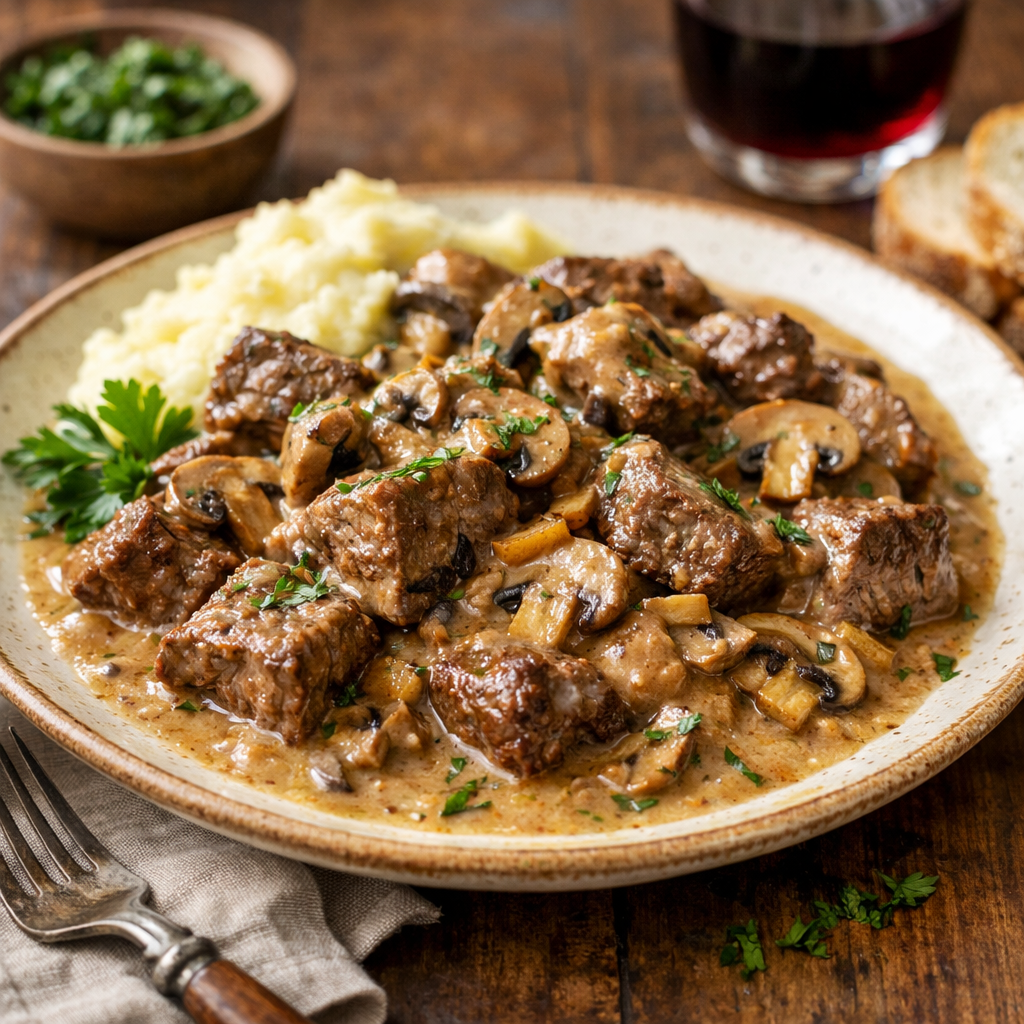
Traditional Polish beef bites in a version with aromatic mushroom sauce — meat cut from a larger piece of beef, gently tenderized, seared, and simmered in a broth made from dried mushrooms and fresh champignons. The dish has a spicy-mushroom character: the depth of flavor comes from dried porcini and beef broth, rounded off with cream. It looks rustic — pieces of meat in a brown, thick sauce with visible slices of mushrooms and chopped parsley. It pairs wonderfully with mashed potatoes, Silesian dumplings, pearl barley, or buckwheat. This dish is hearty, warming, and perfect for a family dinner on winter days.

Ingredients Used

Ingredients (18)

Servings:
4
  • Beef 1000 g
  • Onion 2 szt. (~300 g)
  • Garlic 3 ząbki (~15 g)
  • Wheat flour 60 g
  • Butter 30 g
  • Rapeseed oil 30 g
  • Beef broth 800 ml
  • 18% cream 100 ml
  • Dried mushrooms 20 g
  • Mushrooms 200 g
  • 🌿 Przyprawy
  • Bay leaf 6.7 szt. (~2 g)
  • Allspice (berries) 3 szt. (~3 g)
  • Salt 0.1 szczypt (~4 g)
  • Black pepper 4 szczypty (~2 g)
  • Parsley 30 g
  • ✨ Opcjonalne
  • Red wine 100 ml
  • Mustard 20 g
  • Potato flour 10 g
💰 Szacowany koszt dania: ~25.05 PLN (6.26 PLN/porcję)
* Brak cen dla niektórych składników

💡 Kliknij na składnik aby oznaczyć jako użyty

Preparation steps

Meat preparation

1

Lay the piece of beef on a cutting board. Use a sharp knife to trim the membranes and excess fat, creating an even rectangular piece. Cut the meat across the grain into 8 cutlets about 1.5 cm thick (each ~125 g). Cutting across the grain will make the meat more tender.

Use a wide cutting board and a sharp knife. Cutting against the grain shortens the muscle fibers — this will make it easier to chew after cooking.
2

Place one piece of meat on the board, loosely cover it with plastic wrap. Use a meat mallet and gently pound evenly until the cutlet reaches a thickness of about 8–10 mm — do not turn it into mush. Repeat for all pieces. Then sprinkle both sides of the meat with salt and pepper (evenly), and dust lightly with wheat flour on both sides, shaking off the excess.

If you don't have a meat mallet, use the heavy bottom of a pot. The foil will prevent the juices from splattering and dirtying the cutting board. Over-pounding will make the meat tough.

Frying

3

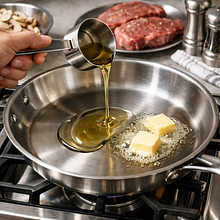
Heat a large skillet (26–28 cm in diameter) over medium-high heat. Pour in the rapeseed oil and add the butter — the butter should melt and bubble slightly, but not burn. When the fat is hot (the surface glistens slightly and steam begins to rise), add the pieces of meat and fry for 2–3 minutes without moving them, until a golden crust forms. Turn and fry for another 2–3 minutes.

It's best to fry in batches so that the temperature of the pan doesn't drop. Use tongs or a spatula. The meat is properly browned when it has a dark brown, crispy edge — not burnt.
4

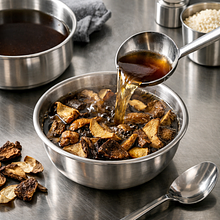
Remove the browned pieces of meat to a plate and loosely cover with foil to keep them warm. If there is flour left in the pan, gently scrape it with a wooden spoon — it's a good source of flavor for the sauce.

Do not stack the meat on top of each other — cover it lightly to keep the steam in. The pan will be the base for the sauce's flavor, so scraping off the browned bits is important.

Mushroom sauce

5

Soak the dried mushrooms in about 200 ml of hot, but not boiling beef broth in a small bowl and set aside for 20 minutes to rehydrate. After 20 minutes, strain the liquid through a sieve lined with cheesecloth or a fine mesh strainer, separating the grit — reserve the liquid for the sauce.

Use a bowl and a strainer; collect the sand particles from the bottom of the bowl after soaking, do not pour them into the sauce. You can slightly filter the mushroom marinade through a paper towel if it is cloudy.
6

In the meantime, peel and finely chop the onion, mince the garlic very finely or press it through a garlic press. Wash the mushrooms, dry them, and slice them into pieces about 3–4 mm thick.

A cutting board and a sharp knife will make your work easier. Try to cut the onion into even pieces so that it caramelizes evenly.
7

In the same pan (if needed, add 1 tablespoon of oil), reduce the heat to medium. Add the chopped onion and sauté for 4–5 minutes, until the onion becomes translucent and soft. Add the garlic and sauté for 30–45 seconds, until the garlic starts to smell fragrant. Add the mushrooms and sauté for 6–8 minutes, until the water from the mushrooms evaporates and the edges of the slices begin to brown.

Use a wooden spoon for stirring, the pan should be hot but not too hot to burn the garlic. Properly sautéed mushrooms will have shriveled, golden edges.
8

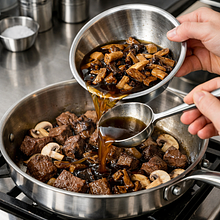
Add the soaked dried mushrooms to the pan along with the drained liquid (be careful not to pour in the sediment). If you are using red wine, pour it in now and cook for 2–3 minutes to evaporate the alcohol and enhance the flavor. Scrape all the browned bits from the pan (deglazing) — this is the base of the sauce's flavor.

You can use a wooden or silicone spatula for deglazing. If you don't want to use wine, add a bit more broth.

Stewing

9

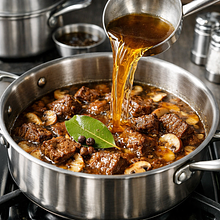
Pour in the remaining beef broth (enough to almost cover the meat). Add the bay leaf and allspice. Place the seared beef slices back in the pan, arranging them individually. Bring to a gentle boil, reduce the heat to very low, and cover the pan with a lid. Simmer for 35–40 minutes: the meat should become tender and easily pierced with a fork.

Use a large pot or wide pan with a lid — it's important that the pieces of meat are not packed tightly. Check every 15 minutes to avoid burning and to monitor the liquid level.

Finishing the sauce

10

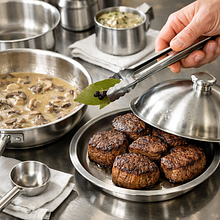
Remove the bay leaves and allspice berries. Take the meat out onto a plate and keep it warm. Increase the heat and cook the sauce for a few minutes to reduce and thicken it. If you want to add mustard, mix it in now. To add the cream, first temper it: pour 2–3 tablespoons of hot sauce into a bowl and mix it with the cream, then pour this mixture back into the pot, stirring quickly to prevent the cream from curdling. If the sauce is too thin, dissolve cornstarch in 2 tablespoons of cold water and pour it in a thin stream into the boiling sauce, stirring until it thickens (1–2 minutes).

Use a whisk to prevent lumps. Tempering the cream is key — pouring the cream directly into the hot sauce can cause it to curdle. If you don't have potato starch, you can cook the sauce a bit longer, but the flavor will become more concentrated.

Finalization

11

Put the steaks back into the sauce for 1–2 minutes to heat through and coat with the sauce. Taste the sauce and season with salt and pepper to your liking. Generously sprinkle with chopped parsley just before serving.

The meat should rest for 3–5 minutes before serving; this allows the juices to distribute evenly. When seasoning, remember that the broth may be salty — add salt gradually.

Serving

12

On a plate, arrange a serving of mashed potatoes, pearl barley, or Silesian dumplings. Place the meat slices on top and generously drizzle with the mushroom sauce. Garnish with additional parsley. Serve hot, with pickled cucumbers or beetroot to balance the creaminess of the sauce.

For serving, use a wide deep plate to prevent the sauce from spilling over the portion. Serve immediately, as the sauce combines best with the potatoes when it is hot.

Fun Fact

💡

Beef bits are a transformation of a larger piece of meat — a classic way to utilize cheaper cuts of beef. The sauce made from dried mushrooms is a traditional way to bring a "winter" aroma to Polish cuisine.

Best for

Tips

🍽️ Serving

Serve with mashed potatoes, Silesian dumplings, or pearl barley. Sour additions pair well: pickled cucumber, sauerkraut, or beetroot salad. You can add a pinch of freshly ground pepper to the sauce just before serving.

🥡 Storage

Store in the refrigerator in an airtight container for 2–3 days. Reheat on low heat with a little water or broth to prevent the sauce from thickening too much. Do not freeze the cream sauce for too long — after thawing, the texture of the cream may change.

📸 Ugotowane przez społeczność

Zaloguj się, aby dodać zdjęcie
Dodaj zdjęcie gotowej potrawy

Po zatwierdzeniu przez moderatora otrzymasz 10 punktów doświadczenia.

🍲

Nikt jeszcze nie dodał zdjęcia. Bądź pierwszy!

Comments (0)

Be the first to comment on this recipe!

Add a comment

You might also like

Recipe Categories

Main dishes
Main dishes in: New Year's Eve

Main dishes for New Year's Eve should be hearty and impressive to satisfy the palates of all guests.

See all recipes in this category

Traditional recipes from various regions of Poland that showcase the richness of local flavors and ingredients.

See all recipes in this category
Reklama